Meta Andromeda has become an all-purpose explanation for changes in Facebook ad performance. One week it means "go broad." The next it means "launch 50 creatives." Neither instruction comes from Meta's technical description of the system.
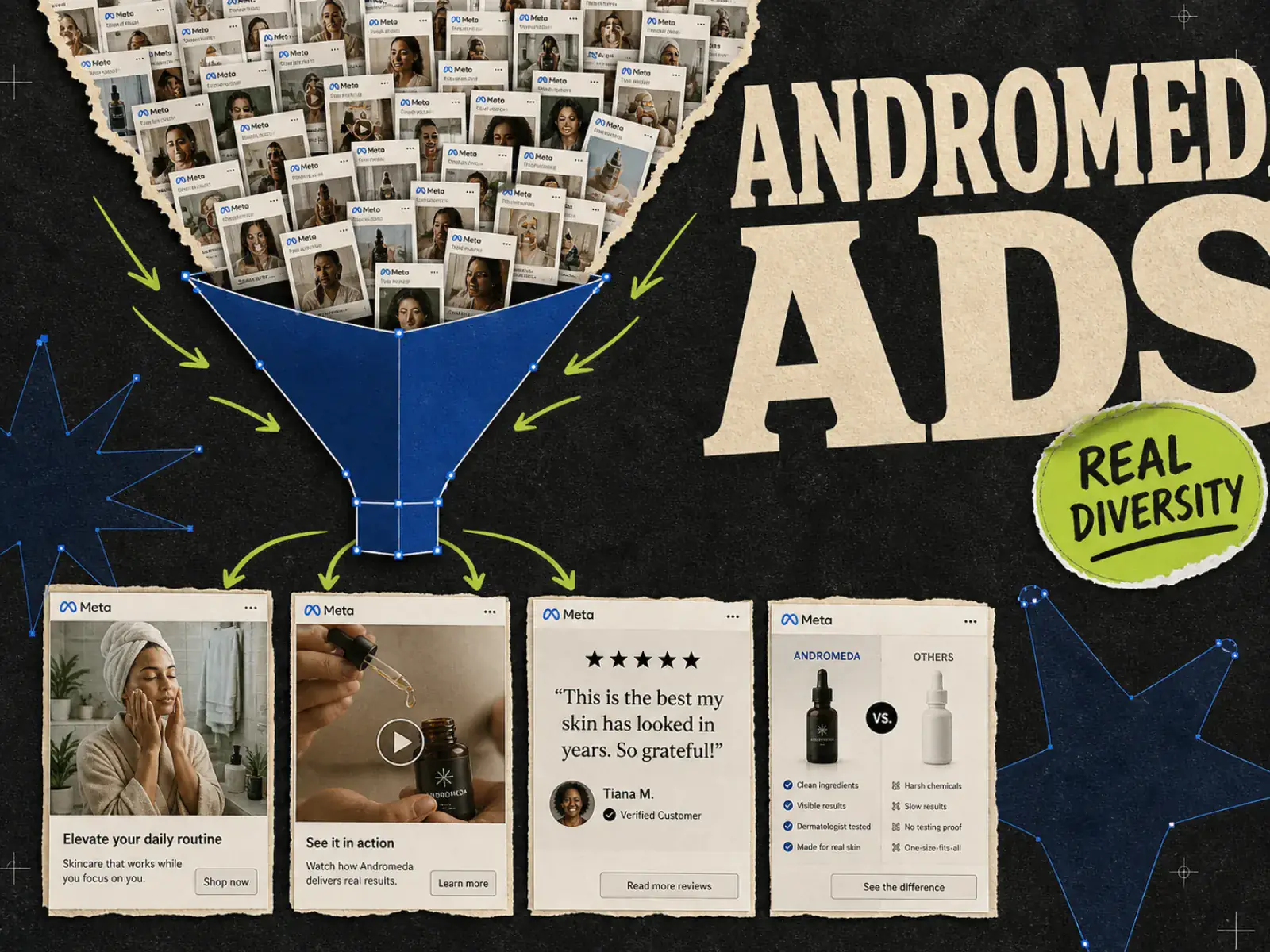
Andromeda is an ads retrieval engine. It helps Meta choose a manageable set of relevant ads before later ranking systems decide what a person may see. A larger candidate pool makes creative variety worth thinking about, but volume alone solves nothing. Fifty near-identical ads are still one idea repeated 50 times.
So what should change in the next brief? Less than the LinkedIn folklore suggests.
Meta Andromeda in plain English
Meta's ad recommendation process has several stages. Retrieval happens first. It reduces tens of millions of eligible ads to a few thousand candidates. Larger ranking models then estimate which candidates may create value for the person and the advertiser.
Meta describes Andromeda as the machine-learning system built for that retrieval stage. Its job is to consider a much larger, more complex pool of ads while staying fast enough to serve them in real time.
You cannot turn Andromeda on in Ads Manager. There is no Andromeda campaign type, score, or reporting column. It sits inside Meta's delivery system.
Andromeda is not a new button for advertisers. It is infrastructure that gives Meta more capacity to find relevant candidates from a growing supply of ads, including ads made with generative AI.
What Andromeda does not tell you
Meta's engineering post explains retrieval architecture. It does not prescribe:
- A minimum number of ads per ad set
- A weekly creative quota
- A required campaign structure
- A list of visual styles that receive preferential delivery
- A rule that every background or headline change counts as a new concept
Be wary of an "Andromeda strategy" built around a universal number. A brand spending $100 per day cannot support the same active creative pool as an account spending $10,000 per day. Budget, conversion volume, offer complexity, and production capacity still set practical limits.
Meta does separately recommend creative diversification and a mixed-format strategy. The cautious takeaway is that a stronger retrieval system can choose from more candidates, so the candidate pool should contain different messages and visual information. That is an inference from Meta's system description and creative guidance, not a published ranking rule.
Creative diversity is not file count
Cosmetic variation has a place in testing. It just should not be confused with diversification.
Suppose a skincare brand has one product shot, one "dry skin" headline, and one testimonial. It makes 12 ads by changing the background colour and moving the button. The production folder contains 12 files. The customer sees the same argument 12 times.
Now compare four ads that use the same product:
- 1.A bathroom photo that explains a two-minute evening routine
- 2.A close-up product demo focused on texture and absorption
- 3.A customer review that answers the objection "will this feel greasy?"
- 4.A comparison graphic for people choosing between a cream and a gel
Those ads express different reasons to care. The promise changes. So do the proof, setting, and format.
The line between iteration and diversification is simple:
| If you change... | You are probably... | Best use |
|---|---|---|
| Background colour, crop, or CTA wording | Iterating | Improve or extend a known concept |
| Headline while keeping the same argument | Iterating | Test hooks inside one concept |
| Customer problem or desired outcome | Diversifying | Reach a different buying motivation |
| Proof type, such as demo versus review | Diversifying | Answer a different objection |
| Static comparison versus creator video | Diversifying | Change how the idea is understood |
For a deeper audit of the difference, read iteration vs diversification.
A practical Meta Andromeda creative strategy
The practical response to Andromeda is a better-labelled creative pool, not an upload sprint. Build it in this order.
1. Start with buying reasons
List the main reasons someone buys, delays, or rejects the product. Keep each one tied to something a customer has actually said or done: support tickets, reviews, sales calls, search terms, post-purchase surveys, or landing-page behaviour.
A meal-delivery service might find four useful reasons:
- I do not have time to cook after work
- I want predictable portions without tracking every ingredient
- I am bored with my usual meals
- I do not trust ready meals to taste fresh
These are creative territories. "Busy parents aged 25-44" is an audience description, not a creative idea.
2. Turn each reason into a testable concept
Give each concept one job. A concept should be clear enough that a designer or creator can make several executions without changing the argument.
| Buying reason | Concept | Proof to show | Possible format |
|---|---|---|---|
| No time after work | Dinner in the time it takes to choose takeout | Timer and preparation steps | Short demo video |
| Wants predictable portions | The plate is already planned | Label and plated meal | Static explainer |
| Bored with routine | A different menu without more decisions | Weekly menu range | Carousel |
| Doubts freshness | Show the meal before and after heating | Ingredient close-ups | Creator review |
The concepts belong to one campaign, but they carry different signals. If one wins, you know more than "the blue ad worked." You know which buying reason and proof earned attention.
3. Make variants inside the concept
Once a concept is distinct, make controlled variants. Change the opening line, first frame, proof detail, or composition while keeping the central argument stable.
This is where iteration earns its keep. It helps you learn how to express a good concept. It should sit inside diversification, not replace it.
The number of variants should fit the budget. If most ads receive little or no delivery, the batch is too large to read. Our guide to how many Meta ad creatives to test gives spend-based starting points, but treat them as planning ranges rather than platform rules.
4. Cover the placements the concept needs
A resized file is not a new concept, but placement coverage still matters. A Feed ad and a Reels ad may need different compositions even when they carry the same argument.
Design for the placement instead of dropping a square ad into every slot. A 4:5 static can give a comparison room to breathe in Feed. A 9:16 version may need fewer words, larger proof, and the main subject inside the safe area. The Meta ad sizes guide covers the three practical source files.
Meta also offers Advantage+ creative features such as image expansion, text variations, background generation, and animation. These can adapt or iterate a source asset. Review every output. An automatic variation can preserve the pixels while weakening the claim or hierarchy.
5. Avoid rebuilding audience silos around every idea
Creating a new ad set for every concept may make the spreadsheet look tidy, but it can split budget and learning. Meta's own performance guidance pairs creative diversification with simpler account structures and enough room for delivery to learn.
That does not mean every ad belongs in one permanent campaign. It means campaign structure should follow the business objective and measurement plan, not the desire to force equal spend to every file.
If a concept receives little delivery, decide whether you need a controlled experiment to answer a specific question. Do not duplicate it into five ad sets and call the extra impressions a fair test.
6. Read results at concept level first
An asset-level winner tells you what to keep running. A concept-level pattern tells you what to make next.
Tag each ad with:
- The buying reason
- The concept
- The proof type
- The format
- The variant
Then review spend, outcomes, and leading indicators by concept. A single variant may look weak because delivery found a better version of the same idea. If every variant under one concept struggles, the argument may be the problem.
Use that read to choose the next move:
- Strong concept, one clear winner: iterate the winner
- Strong concept, weak execution: rebuild the hook or proof
- Weak concept across several fair executions: replace the concept
- Strong early engagement, weak conversion: inspect the offer and landing-page match
This keeps creative production attached to a hypothesis. The creative testing framework shows how to write one before launch.
What to change in your next creative cycle
You do not need to rebuild the account because you learned the name Andromeda. Start with one cycle.
- 1.Export the active ads and group the ones making the same argument.
- 2.Count concepts, not files.
- 3.Keep one or two proven concepts as controls.
- 4.Add two concepts built around different buying reasons or objections.
- 5.Make only as many variants as the budget can support.
- 6.Label every ad before launch.
- 7.Review concept performance before requesting more versions.
The uncomfortable part is step two. A folder with 40 ads can collapse into three concepts once the colour and crop changes are stripped away. That is useful news. It tells the team exactly where the next brief should go.
Common Andromeda mistakes
Chasing an unpublished quota
No public Meta document says an account needs a specific number of new creatives each week for Andromeda. Use budget and delivery to size the pool.
Calling every edit diversification
A fresh background can help a winner last longer. It rarely creates a new reason to buy.
Making random concepts for the sake of difference
Variety without customer evidence produces noise. New concepts should come from a real problem, desired outcome, objection, or use case.
Letting generative AI flood the account
Andromeda was designed partly for a world with far more AI-generated ad candidates. That is a capacity story, not permission to skip editing. More weak candidates still cost production time and make analysis harder.
Treating retrieval as the whole auction
Andromeda helps choose candidates for later stages. It does not replace ranking, auction dynamics, measurement, the offer, or the landing page. A relevant ad can still be unpersuasive.
Where Adrio fits
The hard part of diversification is usually production after the strategy is clear. Adrio helps teams research competitor patterns, turn a reference into their own on-brand static concept, make controlled variants, and export the main Meta aspect ratios. It does not decide which customer problem deserves the next test. That decision still belongs in the brief.
Use the Meta ad creative workflow to connect research, angles, production, launch, and the next read.
FAQ
What is Meta Andromeda?
Meta Andromeda is a machine-learning system for the retrieval stage of Meta's ads recommendation process. It narrows a very large pool of eligible ads to a smaller candidate set before later ranking stages.
Does Andromeda require more ad creatives?
Meta has not published a universal creative requirement for Andromeda. A varied pool gives retrieval more distinct candidates to consider, but the useful number depends on budget, conversion volume, and how much delivery each ad can receive.
Does changing a headline count as creative diversification?
Usually not by itself. A headline change is an iteration when the audience problem, argument, proof, and visual structure stay the same. It is still a valid test, just a different kind of test.
Should I use broad targeting with Andromeda?
Andromeda is part of Meta's delivery infrastructure, not a targeting setting. Choose audience controls based on the offer, legal or geographic limits, available signal, and the campaign objective. Do not change targeting only because a creative post mentioned Andromeda.
Can Advantage+ creative create enough diversity for Andromeda?
Advantage+ creative can generate useful text, background, sizing, and animation variations. Those outputs often iterate a source concept. Teams still need distinct customer arguments, proof types, and formats if they want a genuinely diversified creative pool.