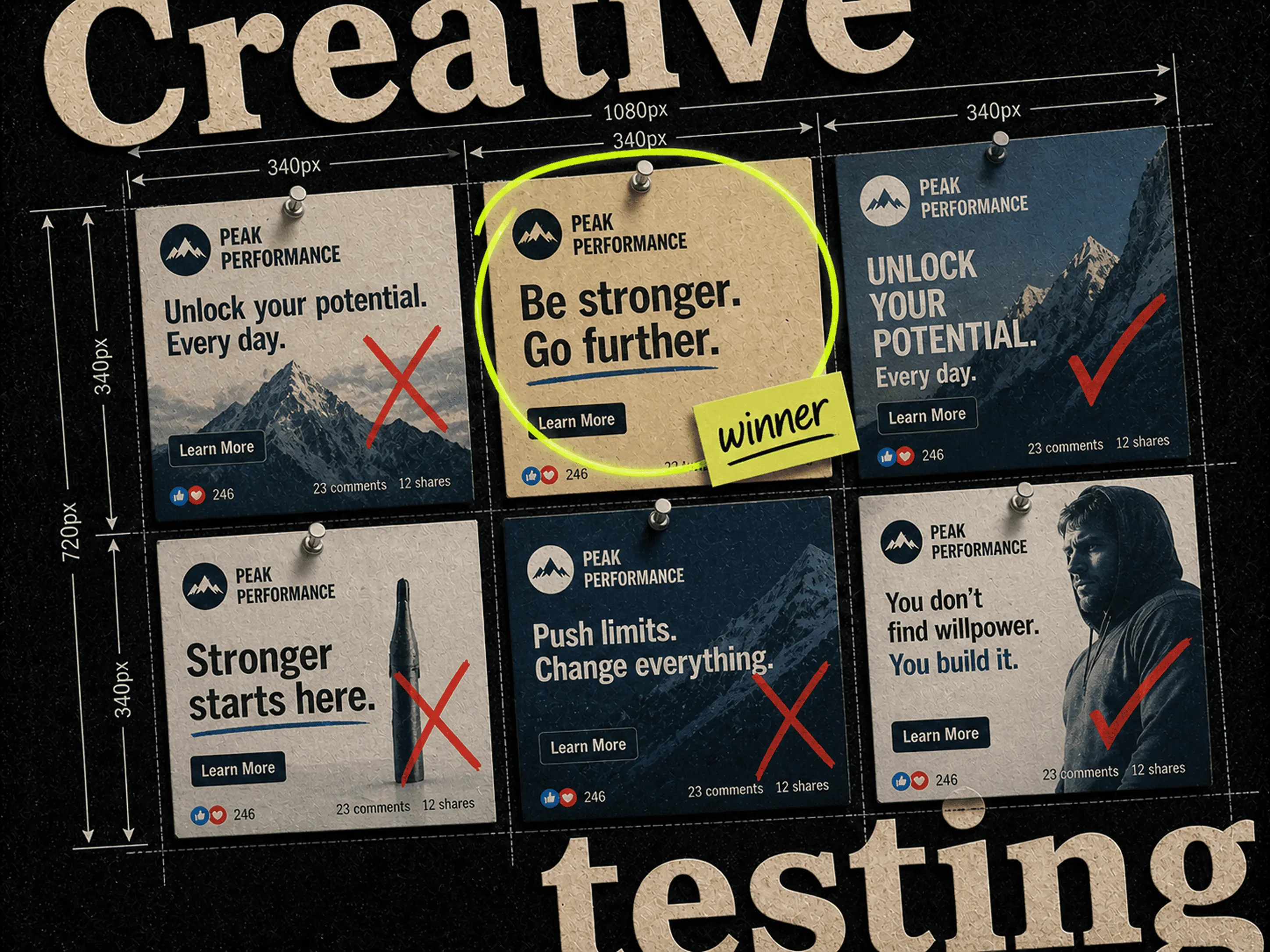
Creative testing is how you find out which ad works before you scale spend on it. Done right, it tells you what your audience responds to in 7 to 10 days for under $1,000. Done wrong, it eats budget and gives you the wrong answer because the test was never set up to be conclusive.
This guide covers what creative testing is, the framework we use for static ads on Meta in 2026, sample sizes and when to kill an ad.
TL;DR
Creative testing means running multiple ad variants against the same audience and offer to find the strongest one. The 2026 framework is hypothesis-led, runs 4 to 6 variants per concept, holds everything constant except the test variable and kills bottom variants at day 5 to 7 based on CTR and CPA.
What is creative testing?
Creative testing is running 2 or more ad variants in the same ad set, with the same audience, offer, budget and CTA, where only the creative changes. The goal is to find which creative element drives the best CTR, CPA and ROAS, so you can scale that variant and replace the others.
It is the cheapest form of risk reduction in paid media. Every dollar spent learning saves five later when you scale.
Why most creative tests fail
Five problems we see again and again:
- 1.Too many variables changed at once (hook plus image plus CTA)
- 2.Sample size too small (under 30 conversions per variant)
- 3.Test killed too early, before day 5
- 4.No clear hypothesis written down before launch
- 5.No clear kill rule, so the test runs until budget runs out
Fix any two of these and your test results get reliable.
The 4-step framework
Step 1: Write a hypothesis
"Hook A (problem callout) will outperform hook B (specific number) on cold audience because the audience is unaware of the problem."
If you cannot write that sentence in under a minute, the test is not ready. Vague hypotheses produce vague results.
Step 2: Pick one test variable
One variable per test. Pick from:
- Hook (first 3 to 5 words of the headline)
- Image or first frame
- Body copy
- CTA
Hook tests are the highest-signal test for static ads in 2026, since hooks decide whether the rest of the ad gets read at all. If you only have time for one type of test, run hook tests.
For the 8 hook types that work, see our hook guide.
Step 3: Set the test
- 4 to 6 variants per ad set
- Same audience, same budget, same offer
- $50 to $100 per day per ad set
- Run for 7 to 10 days minimum
Two variants gives noise. Three is the floor. Four to six is the range that produces a clear winner most of the time.
Step 4: Read the result
- Day 3 to 5: kill the bottom 2 variants if they are clearly behind
- Day 7 to 10: pick the winner using CTR and CPA together
- After: iterate the winner with 3 more variants in a new test
How much should a test cost?
For a single hook test on cold audience:
- $50 to $100 per day per ad set
- 7 to 10 days
- Total: $350 to $1,000 per test
If you cannot afford a full test, run 3 variants instead of 6. Do not run 2. Two variants gives a coin flip, not a result.
When to kill a variant early
Kill at day 3 to 5 if any of these hit:
- CTR is more than 50% below the leading variant
- CPA is more than 2x the leading variant
- Spent over $30 with zero conversions
Otherwise, let it run to day 7 to 10. Killing too early is the most common reason media buyers think their tests are inconclusive.
Reading results without fooling yourself
Four rules that prevent bad reads:
- 1.A 5% CTR difference on 100 clicks is noise. The same difference on 1,000 clicks is signal.
- 2.ROAS at day 5 lies. Day 7 to 10 ROAS is the one to act on.
- 3.A variant that wins on CPA but loses on CTR usually means the audience is wrong, not the creative.
- 4.If two variants are within 10% of each other on every metric, either could win at scale. Pick the one with the cleanest creative and move on.
How often should you run tests?
A simple cadence that works for most accounts:
- Run 1 to 2 hook tests per week per active campaign
- Refresh winning ads every 2 to 3 weeks before fatigue hits
- Keep a 2-week creative backlog so you never run dry
For more on catching fatigue early, see our ad fatigue guide.
Where Adrio fits
The hardest part of creative testing is having enough variants to test. Most media buyers test 2 ads because that is all they had time to make. We built Adrio so you can ship 4 to 6 static ad variants per concept in a couple of hours. That is the difference between a noisy test and a conclusive one.
FAQ
How many ads should I test at once? 4 to 6 per concept. Less than 3 gives noise. More than 6 splits budget too thin per variant.
How long until I have a winner? 7 to 10 days at $50 to $100 per day per ad set, on cold audience.
What CTR should I aim for? Depends on offer and audience. On Meta cold audience, aim for 1.5% or higher. Below 1% is usually a hook problem.
Can I test on warm audience? Yes, but the signal is noisier because warm audiences already know the brand. Cold audience gives cleaner reads on hooks and images.
Should I always kill the loser? Not always. If a losing variant has a unique angle that might work on a different audience, save it for retargeting or a different placement before binning it.