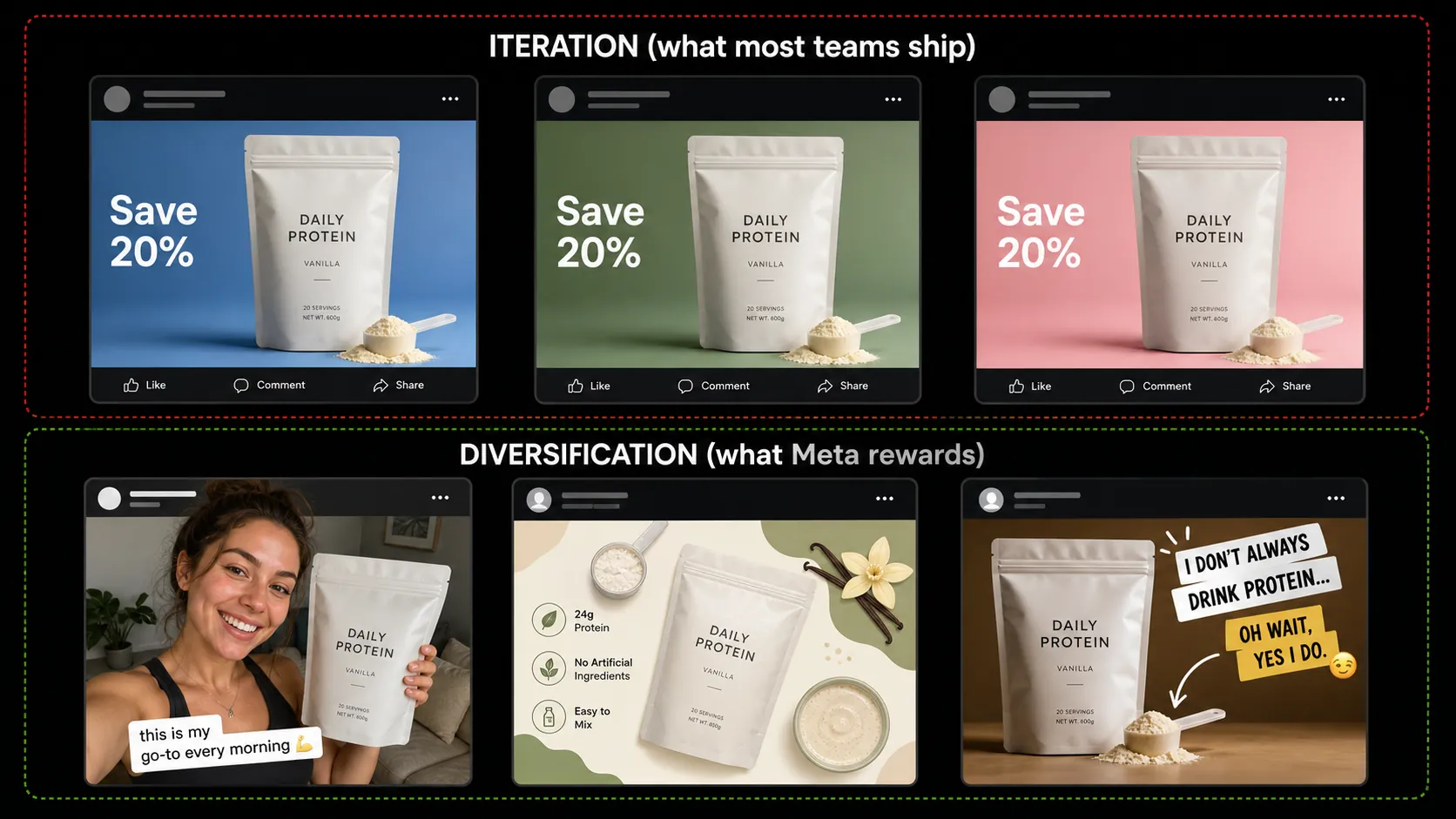
Most media buyers think they are launching new creatives every week. Meta's delivery system disagrees. Three ads with the same layout, same product shot, and the same "Save 20%" headline on different background colours read as the same ad to the algorithm, and to the user scrolling past them.
This guide covers the difference between iteration and diversification, why it matters more in 2026, and how to build a creative pool that Meta actually classifies as diverse.
TL;DR
Iteration is small changes to a creative that already works, used to extend its life with the same audience. Diversification is creatives that look and feel different enough to reach a new audience. Top advertisers spend over 90% of their Q5 budget on creatives less than 7 days old, run 700 to 2,000 new creatives per day, and replace creatives within 2 to 5 days of launch. If your "new" ad uses the same product shot and the same headline as last week's, the auction does not see a new ad.
What is iteration?
Iteration is changing one or two elements of a creative that has already proven it works. The hook, the headline, the colour treatment, the background, the CTA copy. The point of iteration is to squeeze more performance out of an audience you have already unlocked, by giving slightly different versions of the same idea to different people inside that audience.
Iteration is the right move when you have a winning concept. It is the wrong move when you are trying to reach new buyers.
What is diversification?
Diversification is making creatives that are visually and conceptually different from each other. Different format, different setting, different angle on the product, different emotional hook. The point of diversification is to give Meta's delivery system a wider pool of signals so it can match the right ad to the right person.
A diversified creative pool does not mean random. It means each creative carries a meaningfully different signal: format, characters, setting, message, mood. If you can summarise three ads with the same one sentence, they are iterations of each other, not diversified creatives.
Why this matters more in 2026
Three things changed in the last 18 months.
- 1.Meta's AI reads creatives at the component level. The delivery system now classifies creatives by text overlay, characters, setting, format, social proof, motivators, emotions, branding, and aspect ratio. When two ads share most of these components, Meta treats them as the same ad, even if the colours and copy differ.
- 2.Spend is concentrated on a narrow top. Internal Meta figures indicate that the top 3% of best-performing creatives capture 2 to 5% of total ad spend across the network. The rest get a long tail of impressions and minimal budget. Iterations of a tired ad rarely break into that top 3%.
- 3.Audience targeting has flattened. Advantage+ and broad targeting do most of the heavy lifting now. Creative is the main lever you have left to differentiate which audience your ad ends up in front of. If your creatives are not diverse, your audience pool will not be either.
The combined effect: you cannot iterate your way out of a narrow creative pool any more.
The cadence top advertisers actually run
Most accounts we audit refresh creatives every 30 to 60 days. The advertisers Meta classifies as top performers run a much faster cycle.
| Metric | Top performers | Typical advertiser |
|---|---|---|
| Creatives under 7 days old | Over 90% of Q5 spend | Under 30% of spend |
| New creatives per day | 700 to 2,000 | 1 to 5 |
| Time to peak spend on a winner | 1 to 2 days | 7 to 14 days |
| Time to replace a winner | 2 to 5 days | 30 to 60 days |
| Maximum creative lifespan | 60 to 90 days | Indefinite |
The point is not that every account needs to ship 700 ads a day. Most do not have the production capacity for that. The point is the gap between what the algorithm rewards and what most accounts actually deliver is wider than most media buyers think.
Iteration vs diversification: a side-by-side example
A skincare brand wants to launch a winter campaign. The product is a moisturiser. The offer is 20% off.
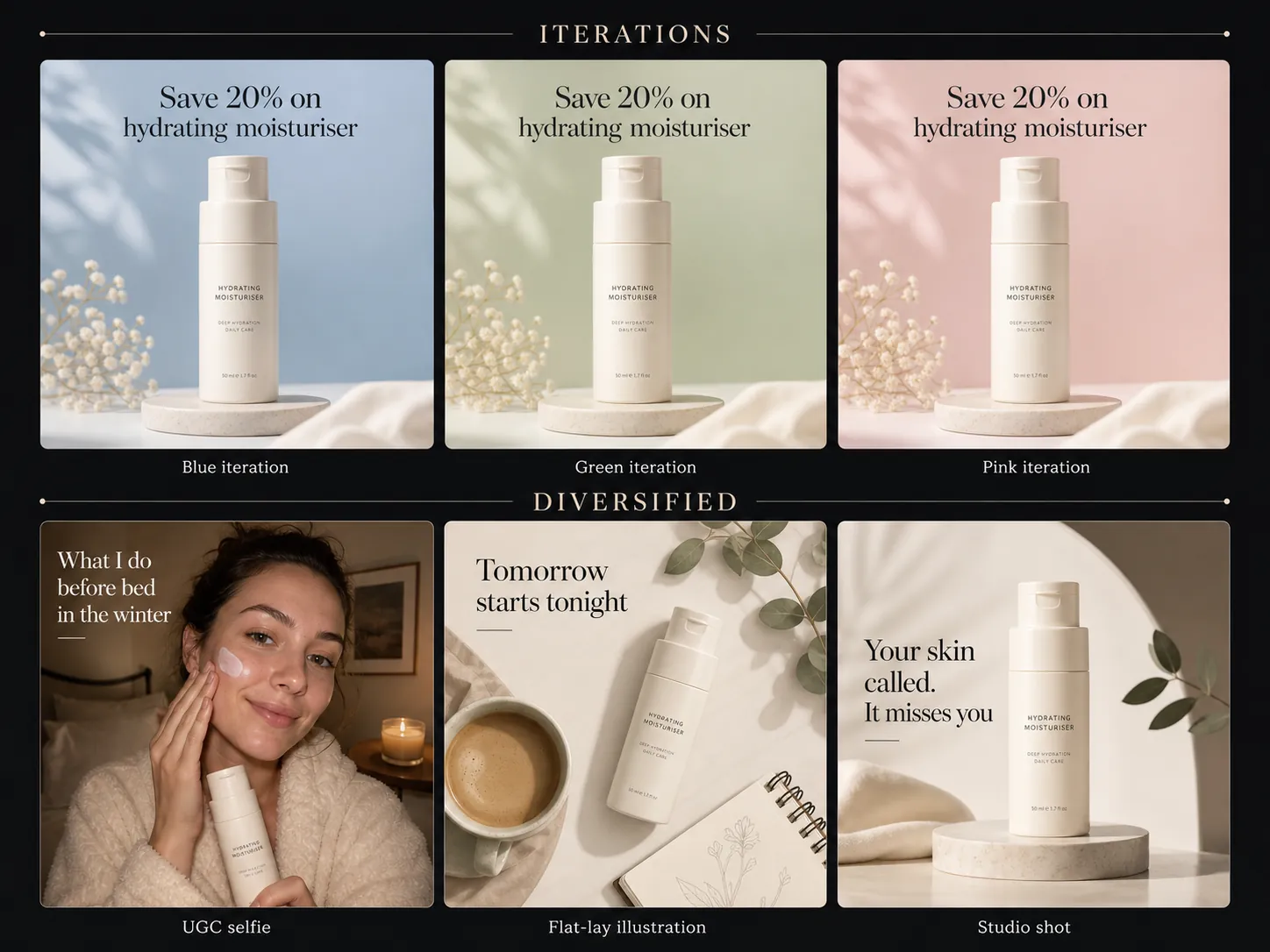
Three iterations:
- 1.Product on a blue background with the headline "Save 20% on hydrating moisturiser"
- 2.Product on a green background with the headline "Save 20% on hydrating moisturiser"
- 3.Product on a pink background with the headline "Save 20% on hydrating moisturiser"
The user sees the same ad three times. The auction sees the same ad three times. Spend gets split across three slots that compete with each other for the same audience, and frequency climbs faster.
Three diversified creatives:
- 1.UGC photo of a person applying the moisturiser, with the caption "What I do before bed in the winter"
- 2.Flat-lay illustration of the product next to a coffee cup, with the headline "Tomorrow starts tonight"
- 3.Studio photo with a humour overlay reading "Your skin called. It misses you"
Same product, same offer, three different signals. Format changes (UGC vs illustration vs studio). Setting changes (bathroom vs kitchen vs studio). Tone changes (utility vs aspiration vs humour). The auction now has three signals to match against three different slices of the audience.
When to iterate and when to diversify
A simple rule that fits most accounts.
Iterate when:
- A creative is generating profitable conversions and the only question is how to extend its life
- You have a clear winner inside an audience you have already unlocked
- You need 4 to 6 hook variants for a structured creative test on the same concept
- Frequency is climbing but CTR has not dropped yet
Diversify when:
- You are launching into a new audience or a new market
- CTR is dropping across all current creatives, not just one
- Your last 10 ads share more than half their visual components
- You are entering a new season, holiday, or campaign phase
A practical split: 70 / 20 / 10
The split that most performance teams settle on is 70 / 20 / 10.
- 70% optimize. Iterate winners. New hooks, new headlines, small visual tweaks on creatives that have already proven they work in your audience.
- 20% explore. Test new visual directions taken from competitor research, ad libraries, and what is working for adjacent brands. These are not your existing winners with new copy. They are new concepts.
- 10% go wild. Ideas that might not work. Different format, different mood, different visual register from anything you have run before.
If your ratio looks like 95% optimize and 5% explore, your account will plateau the moment your current winners fatigue. The 20 / 10 portion is what keeps the pipeline producing the next winner.
Common mistakes that look like diversification
These show up in almost every account audit we run.
- 1.Same layout, different colours. A new background colour does not change the visual signal Meta classifies. The product shot, layout, and text positioning are the dominant signals.
- 2.Same image, different headline. Headline tests are useful inside an iteration cycle. They do not produce diversification on their own.
- 3.Same concept, different aspect ratio. Cropping a 1:1 to 9:16 produces a placement variant, not a new creative.
- 4.Same hook, different stock photo. If both photos communicate the same message and use the same composition, you have iterated the visual without diversifying the signal.
- 5.New concept, same visual execution. This is the most common failure. The brief changed but the designer kept the same template. Meta sees the same template, not the new concept.
How to audit your own creative pool
Run this in 20 minutes for any active account.
- 1.Pull the last 30 active ads in the account.
- 2.For each ad, write down the format, the setting, the main character or product framing, the hook, and the dominant emotion.
- 3.Group ads where 3 or more of those columns match.
- 4.Count the groups.
Most accounts end up with 2 to 4 groups across 30 ads. The target is at least 8 to 10 groups. If you have fewer, you are running iterations and calling them diversified creatives.
For more on how to test diversified creatives without burning budget, see our creative testing framework. For catching when iterations stop working, see the ad fatigue guide.
Where Adrio fits
The reason most accounts iterate instead of diversify is supply, not strategy. A media buyer who can only ship 4 ads per week will iterate on their best one because that is the safest bet. A media buyer who can ship 20 to 30 static ad variants per week, across different formats and visual directions, has the budget to actually run a 70 / 20 / 10 split. We built Adrio for that second case. Static ad production at the volume Meta now expects, without booking a designer for every brief.
FAQ
How many creatives should I have running at once? For most ecom accounts, 8 to 15 active ads per ad set, refreshed every 7 to 14 days. Top performers run more, but the marginal gain above 15 is small without a much larger budget.
Is changing the headline enough to count as a new creative? Not for diversification. A new headline counts as iteration of the same creative. Meta's classifier reads visual components alongside text, and the visual is the heavier signal.
What is Q5? The two weeks after Christmas through mid-January. CPMs drop, competition softens, and creative diversity matters more than usual because audiences are broader. The figures we cite in this guide are drawn from Q5 performance.
How fast should I be replacing winners? Top advertisers replace creatives within 2 to 5 days of launch. Most accounts can target 7 to 14 days realistically. Either way, no creative should run untouched for more than 60 to 90 days.
Can Advantage+ Creative replace diversification? No. Advantage+ Creative is a way to vary the components of a single creative inside placements. It is iteration, not diversification. You still need to feed it visually distinct source creatives.