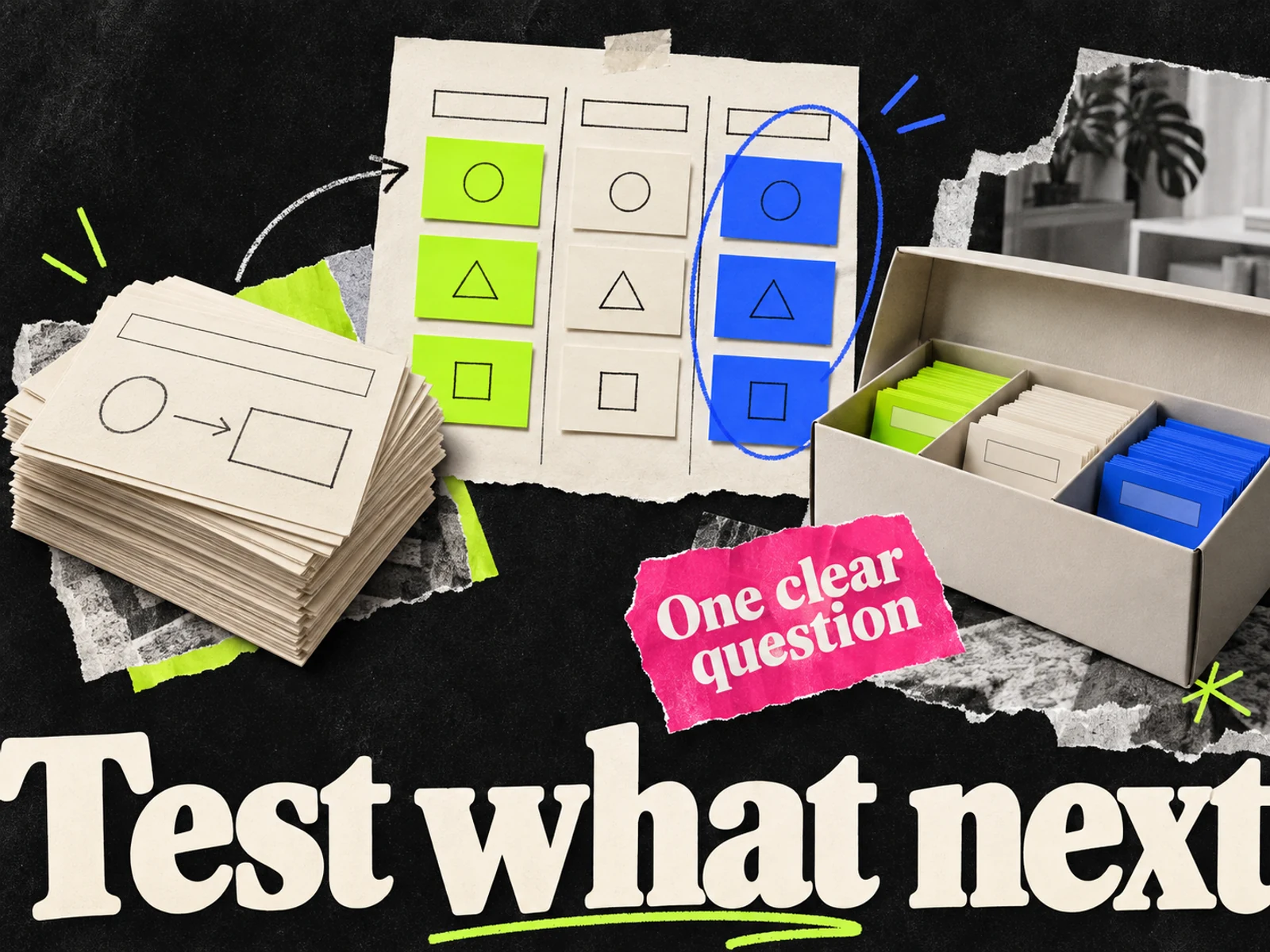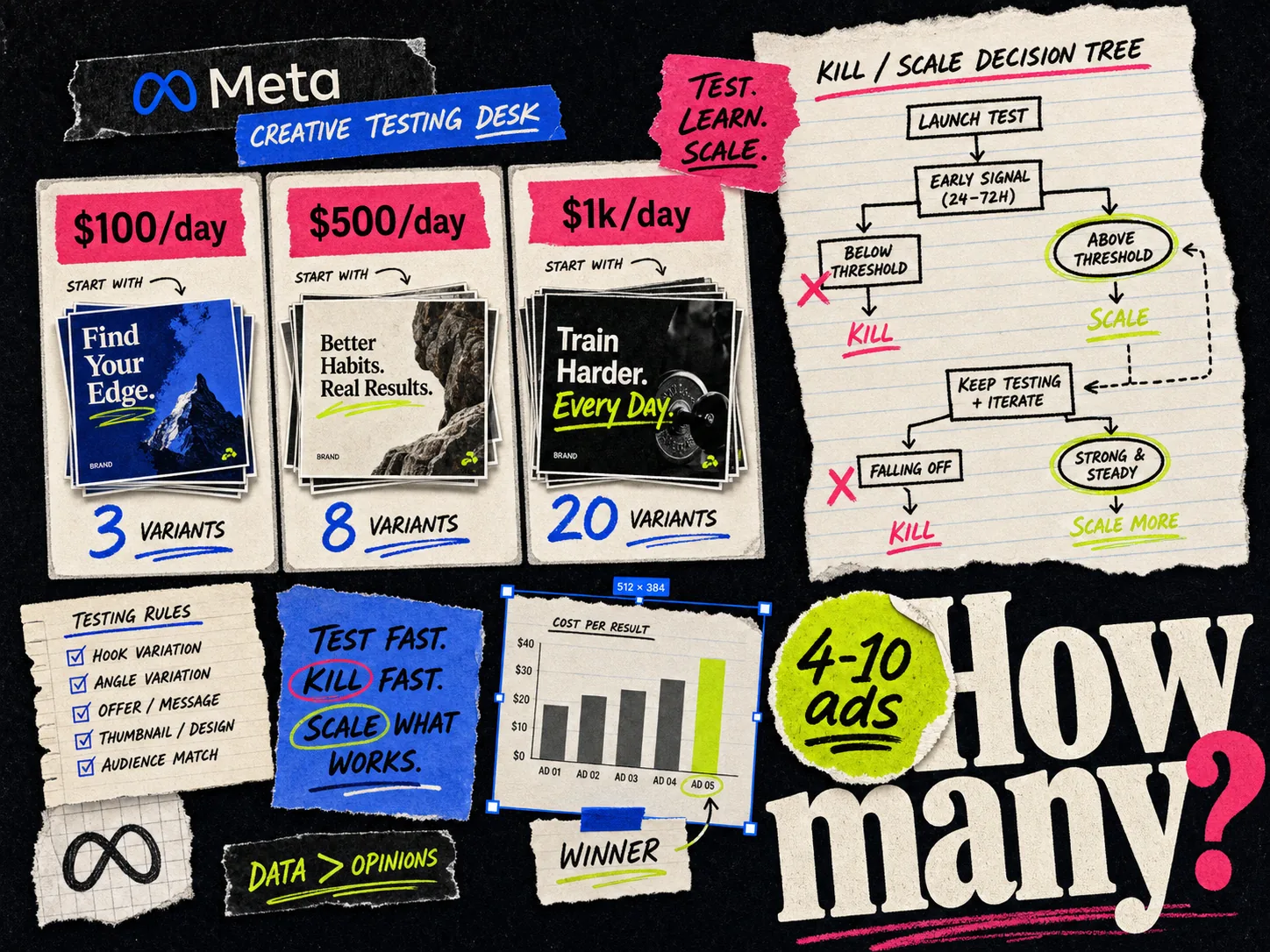
Most Meta accounts should test 4 to 10 ad creatives per concept. Low-budget accounts should use fewer variants so each ad gets enough delivery. Higher-spend accounts can test more, as long as each creative has a clear reason to exist.
The right number is not the highest number your team can make. It is the number your budget can support while still giving each creative a fair read.
TL;DR
If you spend less than $200 per day, test 3-5 creatives at a time. If you spend $200-$1,000 per day, test 5-12 creatives per batch. If you spend more than $1,000 per day, you can test 10-20 creatives across multiple angles.
| Daily Meta spend | Creatives to test | Timing | Best use |
|---|---|---|---|
| Under $100/day | 2-3 | 7-14 days | Test one concept slowly |
| $100-$200/day | 3-5 | 5-10 days | Test hooks or layouts |
| $200-$500/day | 5-8 | 4-7 days | Compare 1-2 angles |
| $500-$1,000/day | 8-12 | 3-7 days | Run weekly batches |
| $1,000+/day | 10-20+ | 2-5 days | Test multiple angles |
Why budget decides the ad count
Each creative needs enough delivery to produce useful data. If you launch too many ads on a small budget, Meta will only give real spend to a few of them. The rest may not get enough impressions or clicks to judge.
The goal is to avoid two problems:
- Too few creatives, so the test does not explore enough
- Too many creatives, so the budget is spread too thin
Start with concepts
Count concepts before counting ads. A concept is the main idea behind a group of creatives.
Examples:
- Save time making Meta statics
- Turn competitor research into new ads
- Avoid ad fatigue with weekly refreshes
- Test static ads before making videos
Then create variants inside the concept.
| Test type | Recommended variant count |
|---|---|
| Hook test | 4-6 hooks |
| Layout test | 3-5 layouts |
| Offer test | 3-4 offers |
| Proof test | 3-5 proof styles |
| Full concept test | 4-10 ads |
Spend tiers
Under $100/day
Test 2-3 creatives at a time. Keep the test narrow: one angle, one offer, one audience, and one main variable.
Best plan:
- 2 hook variants
- 1 current winner or control
- Run for 7-14 days
- Kill only clear losers
At this spend level, patience matters. Rotating too quickly can stop the account from getting any signal.
$100-$200/day
Test 3-5 creatives. This is enough for a basic hook or layout test.
Best plan:
- 1 concept
- 3-5 variants
- Same offer and landing page
- First read after 3-5 days
- Final read after 7-10 days
$200-$500/day
Test 5-8 creatives per batch. You can compare 1-2 angles if each angle is clearly labeled.
Best plan:
- 2 angles
- 3-4 variants per angle
- Cut clear losers after enough spend
- Refresh the stronger angle next week
$500-$1,000/day
Test 8-12 creatives in a weekly batch. This gives you room to compare hooks, layouts, and proof styles.
Best plan:
- 2-3 angles
- 3-4 variants per angle
- Review CTR, CPM, CPA, spend, and ROAS
- Create close variants of the best performers
$1,000+/day
Test 10-20 or more creatives if the account has enough conversion volume. The main risk is launching too many weak or unclear variants.
Best plan:
- Multiple angles
- Clear naming conventions
- Daily delivery checks
- Fast cuts for clear losers
- Winner refreshes within the same week
Kill rules
Kill rules should depend on the account, offer, and available data. Avoid cutting ads after tiny spend unless the signal is clearly bad.
Useful rules:
| Signal | Possible action |
|---|---|
| Very low CTR after meaningful impressions | Rewrite the hook or cut the ad |
| High CTR but poor CPA | Check the promise, offer, and landing page |
| High CPA and weak CTR | Cut the creative |
| Little delivery | Relaunch only if the hypothesis matters |
| Readability issues | Fix the layout or claim before retesting |
Do not copy one CPA rule across every account. A good CPA for one brand can be too high for another.
Scale rules
When an ad wins, scale the pattern. Do more than duplicate the exact creative.
Create:
- A new hook with the same angle
- A new layout with the same promise
- A new proof point
- A new format for 1:1, 4:5, and 9:16
- A close variant that keeps the winning structure
This helps the team learn why the ad worked.
Timing rules
Most creative tests need 3-7 days for a first read and 7-14 days for a more stable decision. High-spend accounts can read faster because they collect data faster.
Fast read signals:
- CTR
- CPM
- Spend distribution
- Early clicks
Slower read signals:
- CPA
- ROAS
- Payback
- Lead or customer quality
Where Adrio fits
Adrio helps when the recommended creative count is higher than your team can produce manually. If the plan calls for 5-10 static variants per week, production speed often becomes the bottleneck.
Use Adrio to create controlled static variants, edit the final assets, and export Meta formats. Use Ads Manager to run the test and decide what wins.
FAQ
How many Facebook ad creatives should I test at once? Most accounts should test 4-10 creatives per concept. Lower-spend accounts should test fewer variants. Higher-spend accounts can test larger batches.
Can I test too many Meta ad creatives? Yes. If the budget is split across too many ads, most creatives will not get enough delivery to judge fairly.
How long should I run a Meta creative test? Use 3-7 days for a first read and 7-14 days for a more stable decision.
What should I do after an ad wins? Create close variants around the winning pattern. Change the hook, proof, visual, or layout while keeping the same main idea.