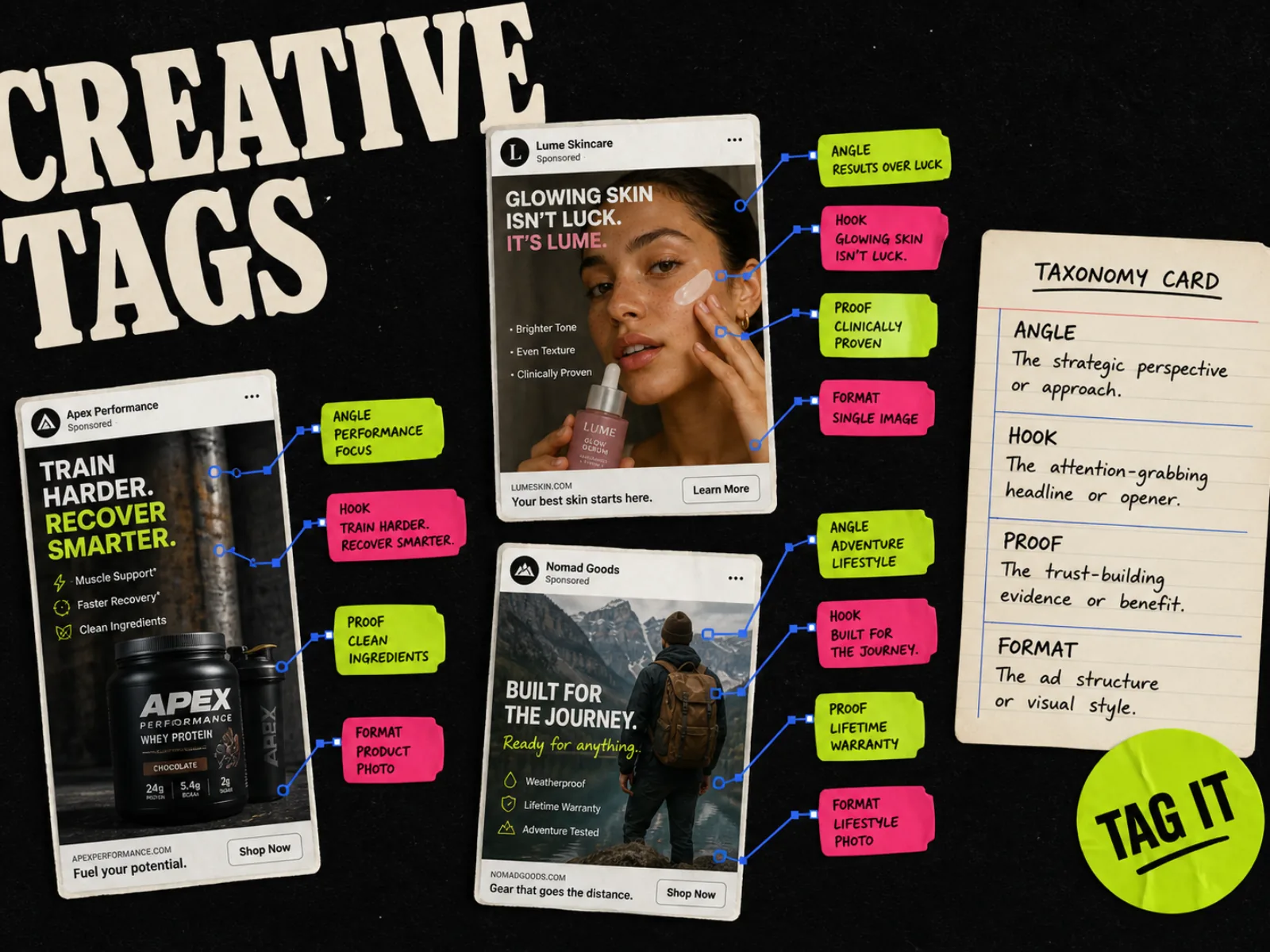
Creative tags should answer a question you will ask later. Which proof style works best? Are founder-led ads wearing out? Have we tested the skeptic angle in video, or only in static images?
If a tag cannot help with a decision like that, it is probably admin work in disguise.
An AI creative tagging system can take the first pass through a large ad library. Its usefulness depends on the taxonomy: a short, stable set of labels that describes what an ad is trying to do. A sound taxonomy saves hours. A loose one produces a faster mess.
The short answer
A workable creative tagging system needs to capture the ad itself and its place in the plan:
- 1.What the ad says: angle, hook, offer, and proof.
- 2.How it says it: format, visual style, and call to action.
- 3.Where it sits in the plan: audience, awareness stage, concept, and lifecycle status.
Start with one label per field. Let AI suggest the labels, then have a person review new or uncertain cases. Keep performance metrics out of the tags themselves. CTR, CPA, and ROAS change; the creative's ingredients do not.
What creative tagging actually means
Creative tagging is the process of labeling ads by their strategic and visual ingredients. A tag might describe a comparison angle, a question hook, customer proof, a discount offer, or a product-demo format.
This is different from a campaign naming convention. A name helps you find one ad in Ads Manager. A taxonomy helps you compare many ads that share an ingredient, even when they live in different campaigns or were made months apart.
It is also different from a folder system. Folders force an ad into one place. Tags let the same ad belong to several useful groups at once. A skincare ad can be a problem angle, a review-proof ad, a product close-up, and a prospecting concept without four duplicate files.
The payoff comes after launch. Instead of asking whether Ad 17 beat Ad 23, you can ask whether review proof beat ingredient proof across the ads that received enough spend. That is a much more reusable lesson.
A creative taxonomy that stays usable
The temptation is to tag everything visible in the frame. Resist it. A 40-field taxonomy looks impressive in a spreadsheet and becomes impossible to maintain by Friday.
Start with the fields below. Add another only when someone can name the decision it will support.
| Field | What it describes | Example values |
|---|---|---|
| Concept | The central creative idea | bathroom mirror, unboxing, side-by-side test |
| Angle | The buying argument | problem, outcome, comparison, mechanism, skeptic |
| Hook | The opening device | question, claim, confession, demonstration |
| Proof | What makes the claim believable | review, rating, demo, ingredient, before-and-after |
| Offer | The commercial frame | no offer, percentage off, bundle, free trial |
| Format | The media structure | static, carousel, UGC video, product demo |
| Visual style | The dominant visual treatment | product close-up, text-led, creator-led, editorial |
| Awareness | What the viewer probably knows | problem aware, solution aware, product aware |
| CTA | The requested next action | shop now, learn more, get quote |
| Status | Where the creative sits now | planned, live, winner, fatigued, retired |
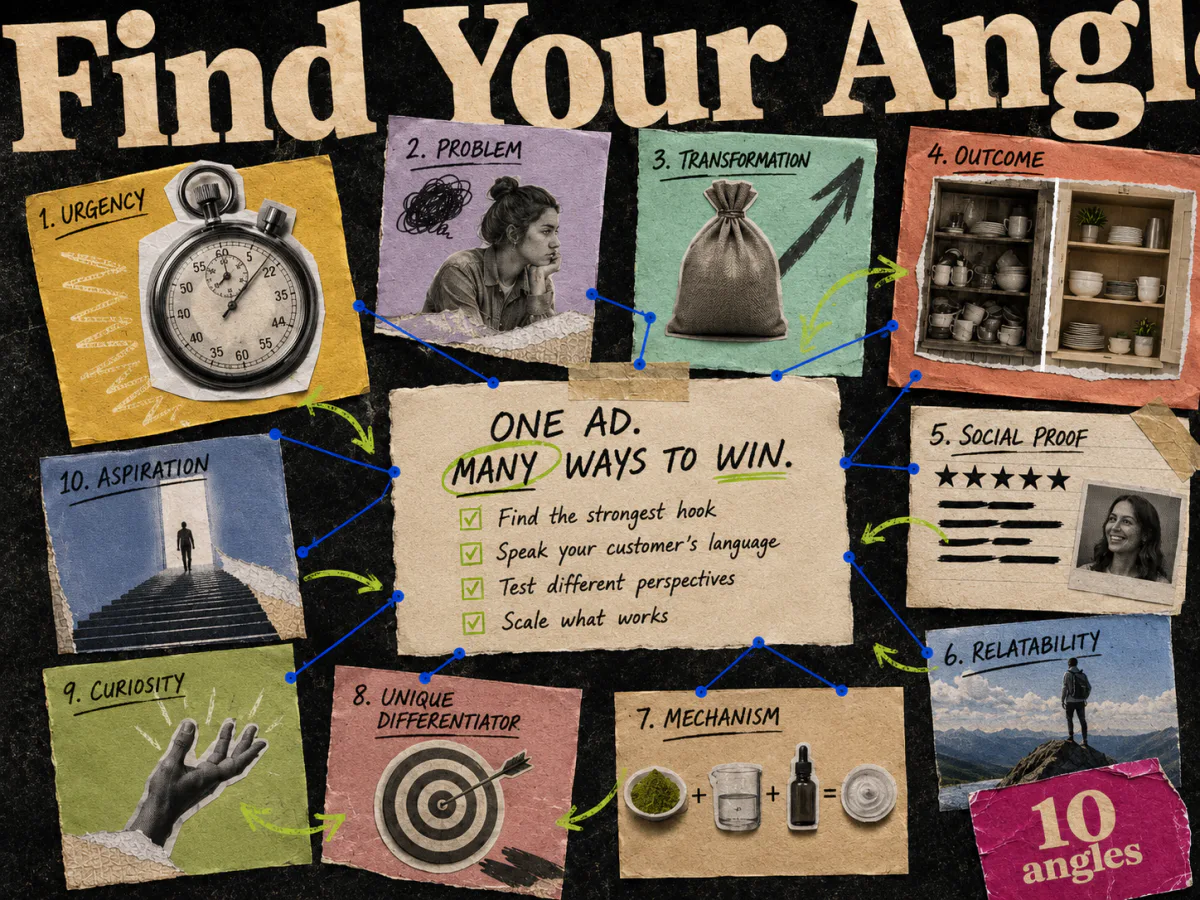
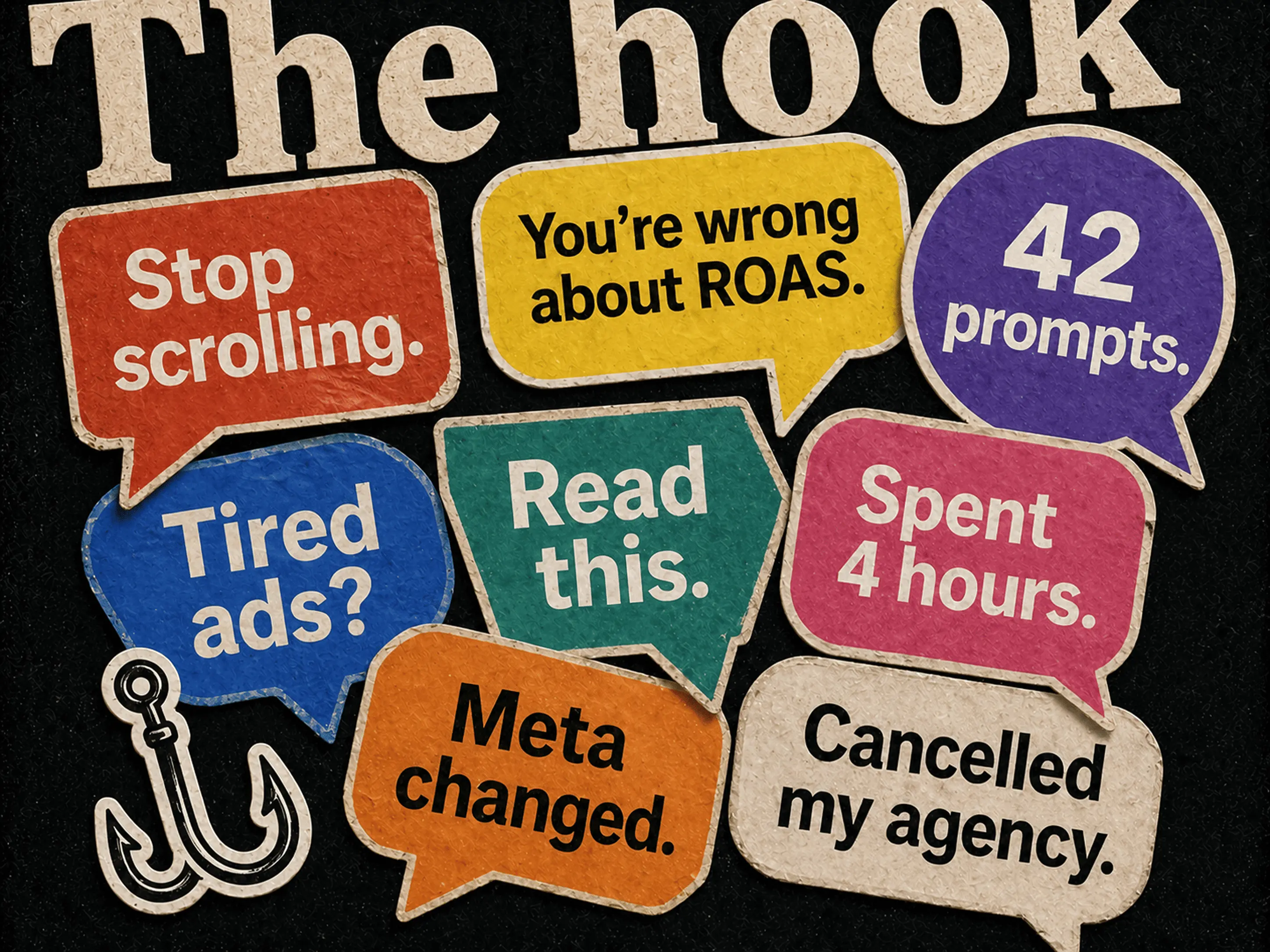
Angle and hook are the two fields teams mix up most often. The angle is the argument. The hook is how the ad earns attention for that argument. "Stop wasting half the bottle" could be a problem hook attached to a mechanism angle about a pump design. Our guide to Facebook ad angles has more examples, while the advertising hooks guide separates the common hook types.
Concept deserves its own field too. It is the creative idea a viewer would recognize, not the filename and not every small variation. Three ads that use the same bathroom-mirror setup with different headlines are usually one concept with three variants.
Give every field controlled values
Free-text tags are where taxonomies go to die. One person writes , another writes , and the AI invents . Now the same tactic has three labels.
Use a controlled list for each field. It does not need to be perfect on day one. It needs to be short enough that two people looking at the same ad usually choose the same value.
Good labels share a few traits:
- mutually clear enough to choose without a debate;
- written in one consistent form;
- broad enough to appear across several ads;
- specific enough to support a real comparison.
Keep and as honest escape hatches. They are better than forcing a bad label. Review those cases once a month. If the same new pattern keeps appearing, promote it into the controlled list.
Do not turn results into permanent creative tags. , , and can live in the status field because they describe workflow state, but should be calculated from current performance data. Otherwise yesterday's result becomes today's misleading label.
Example: tag one skincare ad
Imagine a 15-second vertical ad. A creator holds up a moisturizer, opens with "My makeup stopped separating when I fixed this," shows the texture, then puts a customer rating and a bundle discount on screen.
A clean record might look like this:
| Field | Tag |
|---|---|
| Concept | creator bathroom routine |
| Angle | outcome |
| Hook | confession |
| Proof | rating |
| Offer | bundle |
| Format | UGC video |
| Visual style | creator-led |
| Awareness | solution aware |
| CTA | shop now |
| Status | live |
There are other defensible readings. Someone might call the hook a claim rather than a confession. That is fine if the team has a written rule for the boundary and applies it consistently. Taxonomy quality is not about finding one universal answer. It is about making your own answers comparable.
The concept name should stay human-readable. IDs and dates belong in separate columns or in the asset name. tells a strategist what the idea is. does not.
Where AI helps and where it guesses
AI is good at the repetitive first pass. It can read ad copy, inspect the visual, choose from an allowed label list, and return the result in a fixed schema. That is especially useful when importing a competitor library or cleaning up a backlog.
Give the model the taxonomy rather than asking it to invent tags ad by ad. A useful instruction looks like this:
Review the ad and return one value for each field. Use only the allowed labels. If the evidence is weak, return "unclear" and explain the uncertainty in one sentence. Do not infer performance, audience demographics, or claims that are not visible in the ad.
The last sentence matters. A model can see a testimonial layout; it cannot know that the ad is a winner unless performance data says so. It may also infer an audience from the person in the image, which is both unreliable and unnecessary. Tag the message and creative treatment, not a guess about who clicked.
AI also struggles when one ad contains several ideas. A carousel may use a comparison on card one, ingredient proof on card two, and a review on card three. Decide in advance whether you tag the dominant treatment, tag each card, or allow multiple values. For most small teams, one dominant value plus a notes field is the easiest system to keep clean.
A review workflow that does not become a second job
Do not manually approve every field forever. Review the cases most likely to damage the dataset:
- 1.Start by checking every AI-tagged ad for a small calibration batch.
- 2.Record disagreements and tighten the definitions that caused them.
- 3.Move routine labels to spot checks once agreement is stable.
- 4.Keep reviewing , , and newly introduced labels.
- 5.Recheck a random sample after changing the model, prompt, or taxonomy.
Store a confidence value if the tool supports it, but do not treat confidence as truth. A model can be confidently wrong. The more useful signal is disagreement: which fields humans keep correcting and which labels get confused with each other.
A one-page tagging guide helps more than a longer prompt. Give each field a definition, its allowed values, and two boundary examples. For instance: use when the ad quotes a customer's experience; use when it shows a score or star count without a substantive quote.
Turn tags into creative decisions
Tags become useful when they sit beside spend and outcome data. The basic report groups ads by one field and shows delivery, cost, and conversion metrics for each value. You can then drill into the ads behind the average.
Be careful with the conclusion. If comparison ads received most of the budget and review ads barely delivered, their average CPA is not a fair head-to-head test. Tags help you find a pattern; they do not remove selection bias or make uneven tests clean.
Use the report to write the next hypothesis:
- Review proof has enough delivery to justify a new variant against ingredient proof.
- Product close-ups are common in the account, but creator-led concepts have barely been tested.
- The skeptic angle works in static images, so the next test is whether the same argument survives in video.
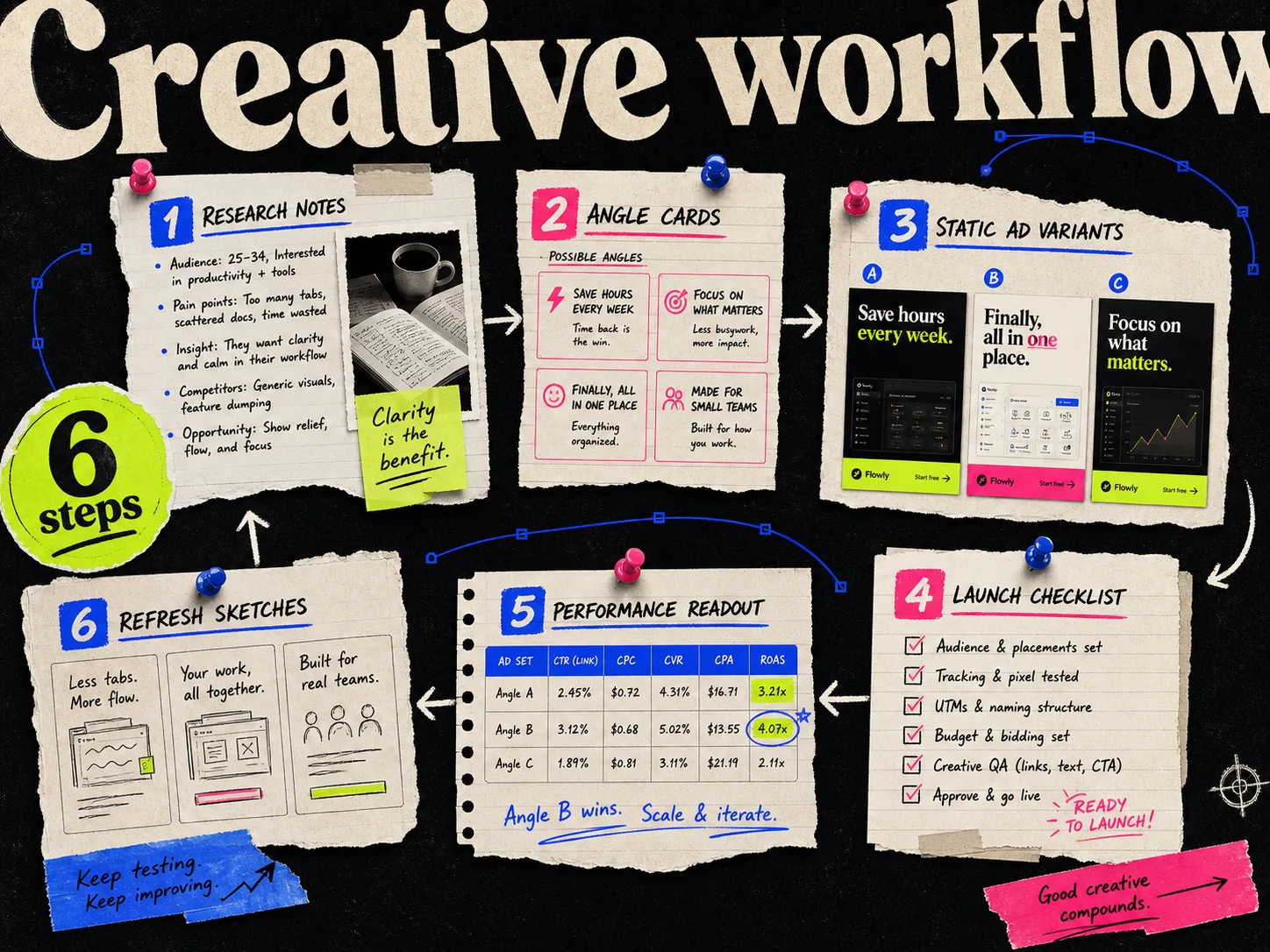
That last step is the point. A tagging dashboard should end in a brief, not in another dashboard. The Meta ad creative workflow shows how research, angles, production, launch, and reading fit together. If the team needs a cleaner test structure, start with the creative testing framework.
Common ways tagging systems break
Uncontrolled synonyms are the usual first failure. Tagging details nobody plans to analyze creates more upkeep, and changing labels without preserving old values breaks historical comparisons.
Catch these problems early:
- Keep observation separate from judgment. is observable; is an opinion.
- Use the same core labels in research, production, and analytics so the handoff survives.
- Do not make filenames store the whole taxonomy. They become unreadable once they carry ten fields.
- When a label changes, keep a mapping from the old value to the new one.
- A tagged slice still needs enough delivery before it can inform a decision.
If people stop tagging, the system is too heavy. Remove fields before adding automation. AI cannot rescue a taxonomy nobody trusts.
Where Adrio fits
Adrio uses AI analysis to break competitor ads into searchable facets such as angle, visual format, hook tactic, proof type, offer, CTA, and awareness stage. That makes the research library useful for questions like "show me review-proof ads with a comparison angle" instead of relying on filenames or manual folders.
The same vocabulary can carry into the next step: save references, compare patterns, build an angle, and turn it into editable Meta static concepts. Adrio is a pre-launch research and production tool, not a replacement for post-launch creative analytics. Performance data still needs to come from the system where your campaigns run or from the analytics stack you already use.
If you are comparing the wider category, the Facebook Ads Library alternatives guide separates research tools from analytics tools and production tools.
FAQ
What is an AI creative tagging system?
It is a system that uses a model to label ad creatives by fields such as angle, hook, proof, offer, format, visual style, and awareness stage. The labels make a large creative library searchable and allow teams to compare patterns across ads.
Which creative tags should I start with?
Start with concept, angle, hook, proof, offer, format, visual style, awareness stage, CTA, and workflow status. Remove any field your team cannot connect to a later search, report, or creative decision.
Should an ad have more than one tag per field?
Usually, start with one dominant value per field. It is easier to review and compare. Use a notes field for secondary tactics. Multi-value tags can help with complex carousels or videos, but they make reporting and quality control harder.
Can AI tell whether an ad is a winner?
Not from the creative alone. AI can describe visible ingredients, but winner status requires campaign data and a definition tied to your goal. Keep creative classification separate from performance results.
How often should a creative taxonomy change?
Change it when repeated or cases reveal a real missing category, or when a field no longer supports a decision. Keep a mapping for renamed or merged values so older ads remain comparable.
What is the difference between creative tagging and creative analytics?
Tagging describes what is in each ad. Creative analytics joins those labels to delivery and outcome data so you can compare patterns. You need consistent tags before the grouped analysis means much.