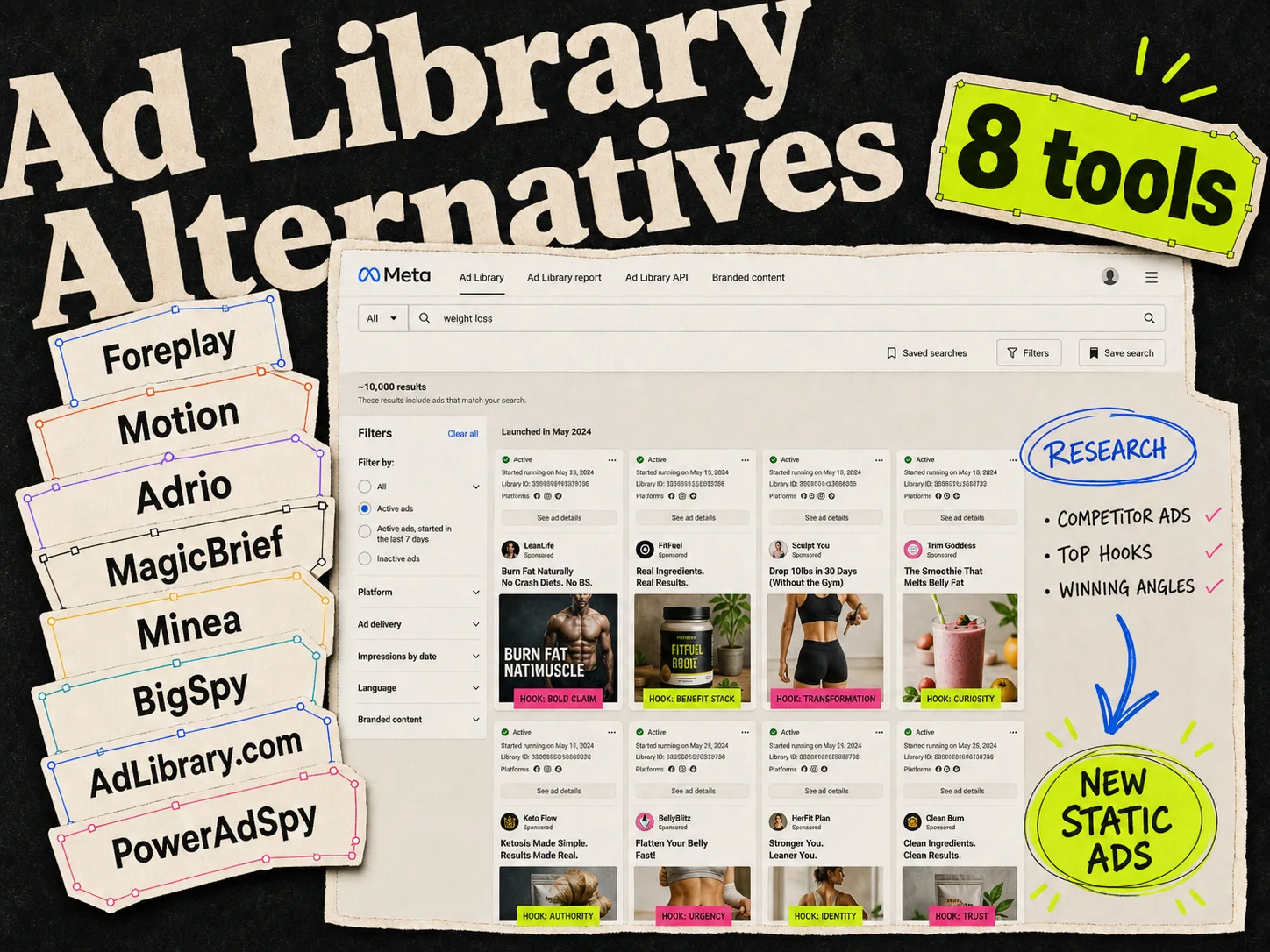
The Facebook Ads Library should still be your first stop when you want the official record of what a brand is running on Meta. It is free, it comes from Meta, and it shows active ads across Facebook, Instagram, Messenger, and the rest of Meta's ad network.
If you already know the brand, you can also search Facebook ads by advertiser in Adrio and preview ten recent creatives without an account.
If you need ad data in code rather than a better research interface, use our guide to Meta Ad Library API alternatives and data providers. This page is about tools a marketer can browse and use day to day.
It is also a bad place to do real creative work. Saving ads is awkward. Links disappear from your notes. There is no good way to tag hooks, compare angles, or see why a competitor keeps pushing the same offer for six weeks.
Best Facebook Ads Library alternatives: quick answer
Foreplay is the best Facebook Ads Library alternative for swipe files and competitor tracking. Motion is best for creative analytics. Adrio is best when you want the full loop: track competitors, analyze angles, generate Meta static ads, learn from results, and decide what to make next.
Trying to choose between Foreplay and SwipeKit? Foreplay has the broader research and briefing workflow. SwipeKit is the leaner option for saving ads and tracking a smaller competitor set. Our Foreplay vs SwipeKit vs Adrio comparison covers the practical differences, including where each workflow stops.
| Tool | Best for | Main tradeoff |
|---|---|---|
| Foreplay | Swipe files and competitor tracking | Stronger for research than ad creation |
| Motion | Creative analytics and competitor inspiration | Works best once you have enough spend and tests |
| Adrio | Competitor research-to-creative feedback loop | Meta-focused; direct image and video publishing |
| Canva Grow | Advertising inside Canva | New successor workflow after MagicBrief closed |
| Minea | Ecommerce and dropshipping ad research | Big database, easy to wander |
| BigSpy | Budget multi-platform ad search | Less polished workflow |
| AdLibrary.com | Cross-platform ad search | Better as search than as a creative system |
| PowerAdSpy | Heavy ad spy filters | More manual, older-school workflow |
How we picked the tools
We reviewed the eight ranked tools on May 25, 2026, using their public product and feature pages. On August 6, we added the direct Foreplay and SwipeKit comparison and clarified the difference between browsing tools and programmatic data access.
We did not rank by database size alone. A huge ad database is useful only if your team can turn the search result into a decision.
What a good alternative should fix
A real Facebook Ads Library alternative should solve at least one painful job: saving ads before they vanish, tracking competitors, tagging hooks and offers, searching faster than Meta's interface, turning research into a brief, or comparing creative patterns against your own performance.
No tool does all of that equally well. A founder checking five competitors does not need the same setup as an agency building weekly creative reports for ten clients.
1. Foreplay - best for swipe files and competitor tracking
Foreplay is the cleanest upgrade for teams that already save a lot of ads.
Its core job is simple: save ads, organize them, track competitors, and turn references into creative direction. The product includes Swipe File, Spyder, Discovery, Lens, and Briefs, so it covers both research and handoff.
Pick Foreplay if your team lives in boards, folders, comments, and hand-picked examples. It gives messy research a proper home.
The catch: Foreplay still assumes someone is doing the thinking. It helps you collect and structure the evidence. It is not mainly the place where the finished static ad gets built.
If SwipeKit is also on your shortlist, read the direct Foreplay, SwipeKit, and Adrio comparison before paying for a larger research stack.
Best for: agencies, creative strategists, and teams that maintain serious swipe files.
2. Motion - best when you need creative analytics too
Motion makes the most sense once you have enough live ads for performance analysis to matter.
Motion is closer to a creative analytics platform than a basic ad spy tool. It helps teams read performance by creative, format, hook, and angle, then connect those patterns to spend, CPA, ROAS, or hook rate.
Use Motion if your weekly creative meeting needs evidence instead of opinions.
The catch: Motion can be more tool than you need if you are early, scrappy, or only checking a few competitors. Its value compounds when you already have a steady testing engine.
Best for: growth teams, brands with creative volume, and agencies that report on performance creative.
3. Adrio - best for closing the competitor research feedback loop
Adrio is not trying to be the biggest ad database. It turns competitor research into a creative learning system.
The workflow starts with your company and competitors. Adrio pulls in competitor ads, breaks them into primitives like angle, hook, format, offer, CTA, visual style, layout, and proof type, then helps decide what to test.
You can ask questions like:
- What new angles did our competitors start using this week?
- Which competitor patterns keep showing up?
- Which hooks have we already tested?
- What should we make next based on what worked and what failed?
- Generate a new static batch from this competitor pattern, but make it fit our product.
Motion also describes AI strategy and competitor research. Adrio connects research and performance learning to static and video production and the next testing decision. Compare Adrio and Motion against the work your team needs.
Today, Spark creates static and video ads, reads connected Meta performance, and helps plan the next test. Both image and video ads can be published directly to Meta with approval by default. Static creatives remain editable in the studio. The bigger idea is the loop: research, generate, launch, learn, improve.
The catch: Adrio is not Foreplay for huge swipe files, and it is not Motion for standalone reporting. It is best when research becomes creative action.
If your main goal is taking an ad you found and rebuilding it with your own product and brand, see our comparison of tools that turn Meta Ad Library ads into on-brand creatives.
Best for: DTC founders, media buyers, and teams that want competitor tracking, creative generation, and recommendations.
4. MagicBrief has closed: evaluate the replacement workflow
MagicBrief closed on July 31, 2026. Its team built Canva Grow, which connects generation, publishing, and performance insights inside Canva. It is a new product to evaluate, not a direct transfer of every old collection or workflow.
If saved references are the primary job, compare a research-focused tool separately. Our MagicBrief replacement guide explains the options for research, reporting, and production.
5. Minea - best for ecommerce product and ad research
Minea is built around ecommerce ad research. It covers Facebook, TikTok, and Pinterest, and its own product page positions it around a 100M+ ads database, product discovery, competitor tracking, and performance signals.
That makes Minea useful when the ad is only part of the research. Dropshippers and ecommerce operators often care as much about the product, offer, and market timing as the layout.
The catch: a large database can become a time sink. Go in with a query, niche, product type, or angle in mind.
Best for: ecommerce operators, dropshippers, and product researchers.
6. BigSpy - best budget multi-platform ad database
BigSpy is a broad ad spy database with coverage across Facebook, Instagram, Google, YouTube, TikTok, Twitter, Yahoo, Pinterest, and Unity. Its own site describes coverage across 71 countries, 23 languages, and 10 channels.
BigSpy is the practical budget pick when you want platform coverage and filters more than a polished creative workflow.
The catch: it is less opinionated. That can be good for power users, but it also means more sorting and judgment on your side.
Best for: budget-conscious marketers and broad competitive research.
7. AdLibrary.com - best for cross-platform ad search
AdLibrary.com is best understood as a unified search layer. Its public page lists databases for Google ads, Meta ads, TikTok, YouTube, LinkedIn, and other platform libraries.
Use it when you want to check how a brand shows up across channels without opening five different official ad libraries.
The catch: search is not the same as workflow. If your team needs boards, briefs, approvals, analytics, or ad creation, you will probably pair AdLibrary.com with another tool.
Best for: fast cross-platform ad checks.
8. PowerAdSpy - best for old-school ad spy filters
PowerAdSpy is one of the older tools in the category. It covers Facebook, Instagram, TikTok, Google, YouTube, native, Reddit, Quora, Pinterest, and LinkedIn ad research.
Its appeal is the traditional ad spy workflow: search, filter, inspect, export, repeat.
The catch: the interface and positioning feel heavier than the newer creative workflow tools.
Best for: power users who want lots of filters and do not mind manual work.
Which Facebook Ads Library alternative should you choose?
Choose the tool based on the job:
| If you need... | Pick |
|---|---|
| The official free source | Meta Ad Library |
| Swipe files and competitor tracking | Foreplay |
| Creative analytics for your own ads | Motion |
| Competitor research, creative generation, and iteration | Adrio |
| Creator briefs and scripts | Foreplay; evaluate the former MagicBrief workflow separately |
| Ecommerce product research | Minea |
| Cheap broad ad search | BigSpy |
| Cross-platform search | AdLibrary.com |
| Deep manual filters | PowerAdSpy |
For most teams, the stack is simple: use the Meta Ad Library for source checks, Foreplay for manual swipe files, Adrio for the research-to-creative loop, and Motion once your own testing volume needs deeper analytics.
FAQ
What is the best Facebook Ads Library alternative?
Foreplay is the best all-around Facebook Ads Library alternative for swipe files and competitor tracking. Motion is better for analytics. Adrio is better when you want competitor tracking, AI analysis, static Meta ad generation, and a system that helps decide what to test next.
Is the Facebook Ads Library still worth using?
Yes. The Facebook Ads Library is still worth using because it is the official free source for active ads across Meta products. Use it first to confirm whether a brand is running ads right now, then use another tool when you need saving, tagging, tracking, analysis, or production.
What is the best free alternative to Facebook Ads Library?
The best free option is still the Facebook Ads Library itself. Most serious alternatives charge because they add storage, tracking, search, tagging, estimates, collaboration, or creative workflow features on top of the public library.
Is Adrio a Foreplay alternative?
Adrio can replace light competitor research and some swipe-file work if your goal is to analyze competitor ads, generate new static Meta variants, and keep learning from what works. Foreplay is stronger for large manual swipe files, boards, client sharing, and deep research organization.
Is Adrio a Motion alternative?
No, not as a pure analytics dashboard. Motion is stronger for post-launch creative reporting. Adrio is built around closed-loop creative execution: find the opportunity, make the ads, learn from the result, and make the next batch.
Can ad spy tools show exact competitor spend?
Usually no. Treat competitor spend numbers as estimates or directional signals. Ad longevity, repeated offers, creative refreshes, and placement patterns are often more useful than a fake-looking exact spend number.