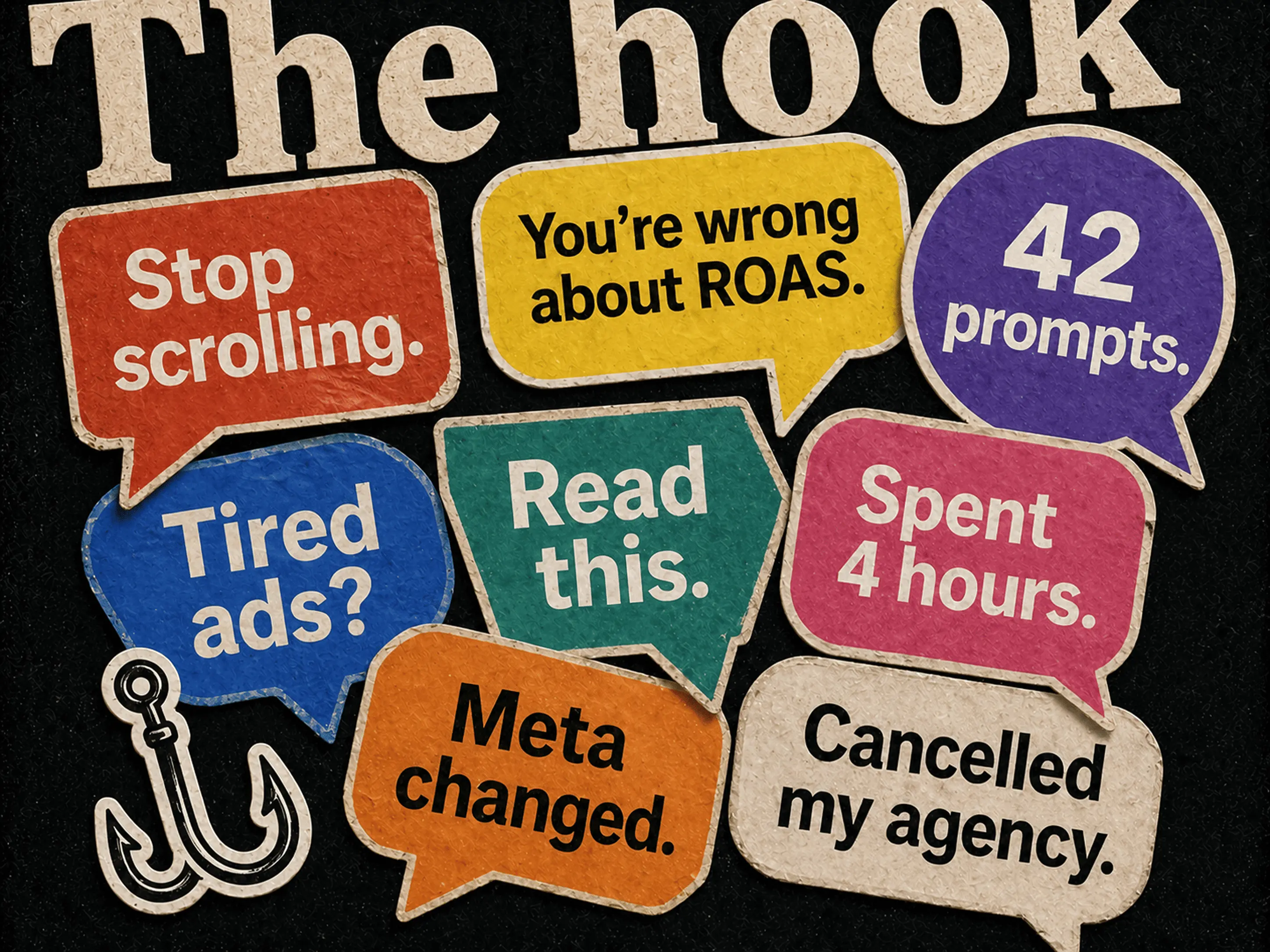
A hook is the first thing in your ad that makes someone stop scrolling. On Meta, you have less than a second to earn the next second. The hook is what gets it. Without one, your offer, your design and your CTA do not matter, because the user already scrolled past.
This guide covers what a hook is, why it decides ad performance, the 8 hook types that work most often on Meta in 2026 and how to test which one wins.
TL;DR
A hook is the opening line of an ad that stops the scroll. The 8 hook types that work most often on Meta in 2026 are problem callout, contrarian claim, before/after, specific number, question, named target, urgency and pattern interrupt. Pick one per ad and test 3 to 4 hook variants per concept.
What is a hook?
The hook is the first 3 to 5 words of the headline, or the first frame of the creative. Its only job is to stop the scroll. If a user reads past the hook, the rest of your ad gets a shot. If they do not, nothing else you wrote matters.
Why hooks decide creative performance
Meta's auction rewards ads with high early engagement. A strong hook lifts CTR, higher CTR lifts CPM efficiency and CPM efficiency lifts ROAS. In our tests, swapping the hook on the same offer changes CTR by 30 to 80% with no other change.
That makes hooks the highest-leverage thing to test in static ads.
The 8 hook types that work in 2026
1. Problem callout
"Your ROAS drops every Friday."
Names the pain in 6 words or less. Works best on a problem-aware audience.
2. Contrarian claim
"You do not need more ad spend."
Goes against what the reader expects, makes them pause to argue. Works on cold audiences who think they already know the answer.
3. Before/after
"Spent 4 hours on reports yesterday. Today it took 9 minutes."
Sets up a transformation in two short lines. Pairs well with screenshot creatives.
4. Specific number
"42 prompts I use every week to run my Meta ads."
Numbers are concrete. Vague claims are not. The more specific the number, the more it earns the click.
5. Question
"Are your ads tired or are you?"
Forces an internal answer. Use it sparingly, since it gets formulaic fast.
6. Named target
"Media buyers running over $50k a month, read this."
Pre-qualifies the audience. Lower CTR, higher CPM efficiency, because the wrong people skip.
7. Urgency
"Meta changed how ad reporting works on April 29."
News pegs work better than fake countdown timers. They borrow attention from a real event.
8. Pattern interrupt
"I cancelled my agency and it fixed our ROAS."
Story-shaped. Breaks the pattern of what an ad usually sounds like.
How to pick a hook for your offer
| Audience or context | Hook types that fit |
|---|---|
| Problem-aware | Problem callout, before/after |
| Solution-aware | Specific number, named target |
| Cold | Contrarian, pattern interrupt |
| Time-bound offer | Urgency |
| Crowded market | Contrarian, pattern interrupt |
Pick one. Do not stack three hooks into one headline. Stacked hooks read as fake.
How to test hooks
A simple test plan that works:
- 1.Write 4 to 6 hook variants for the same concept
- 2.Keep the body copy, image and CTA the same
- 3.Run all variants as separate ads in the same ad set
- 4.After 7 to 10 days, kill the bottom 2 by CTR and CPA
- 5.Iterate the winner with 3 more variants
For more on running tests cleanly, see our creative testing framework.
What weak hooks look like
Four patterns that almost always lose:
- Generic: "Looking for a better way?"
- Internal: "Introducing our latest update"
- Vague benefit: "Save time and money"
- Brand first: "At Adrio, we believe..."
If your hook would fit in any other brand's ad without changes, it is not yours yet.
Where Adrio fits
Hook testing is a creative supply problem more than a strategy problem. You need 4 to 6 hook variants per concept, every week, for every active campaign. Most teams run 2 hooks because that is all they had time to make. We built Adrio so media buyers can ship hook variants without designing each one from scratch.
FAQ
Should the hook be in the image or the copy? Both. Visual hook in the first frame, text hook in the headline. They reinforce each other.
How many hooks should I test per concept? 4 to 6. Two gives noise. Three is the floor. Six is plenty.
How long until I know which hook won? 7 to 10 days at $50 to $100 per day per ad set, on cold audience.
Can the same hook work on cold and warm audiences? Sometimes. Test separately. Warm audiences usually need more specific hooks since they already know the brand.
Do hooks differ by platform? Yes. Meta hooks are shorter than LinkedIn or YouTube hooks because the scroll is faster. Keep Meta hooks under 6 words for the strongest effect.