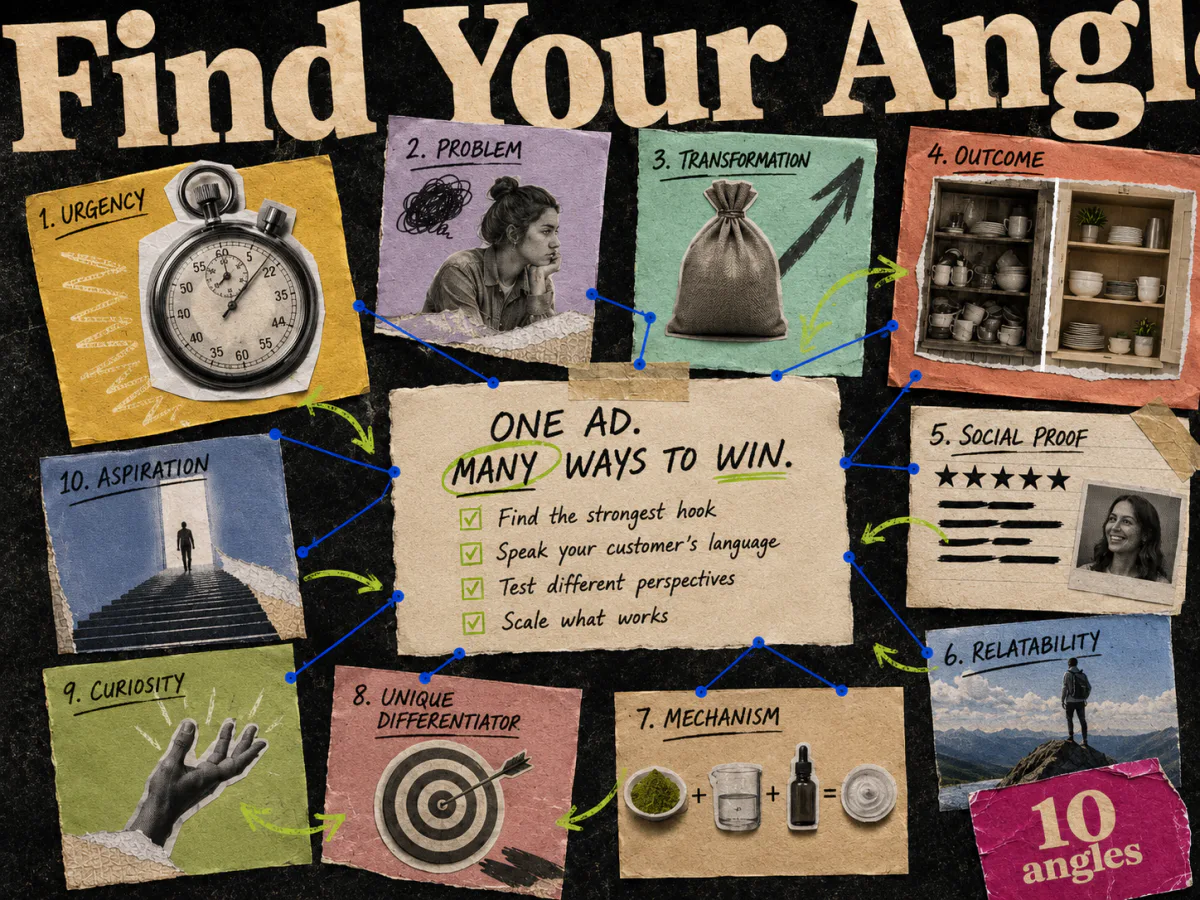
An ad angle is the reason the customer should care about the product. "Save time" is an angle. "Still wasting Friday afternoon on reports?" is a hook. A screenshot-style static is a format.
Teams mix these up constantly, then wonder what their creative test proved.
This guide gives you ten Facebook ad angles that are different enough to test, with a briefing prompt for each one.
Facebook ad angles at a glance
| Angle | The argument |
|---|---|
| Problem | This fixes a frustration you already feel |
| Outcome | This gets you to a better state |
| Comparison | This is better than the way you solve it now |
| Social proof | People like you already trust this |
| Skeptic | This changed the mind of someone who doubted it |
| Mechanism | This works for a specific reason |
| Objection | The reason you have not bought is no longer true |
| Identity | This fits the kind of person you are |
| Offer | This is the right moment to buy |
| Founder POV | We built this because the existing options were wrong |
One product can support several angles. That does not mean every angle belongs in one ad.
Angle, hook, concept, and format
Here is the cleanest way I know to separate the terms.
The angle is the argument. The hook is the opening line or image that earns attention. The concept is the full creative idea. The format is how the idea appears in the feed.
Take a meal-delivery product:
- Angle: saving time after work
- Hook: "Dinner should not start with another decision"
- Concept: an exhausted person staring into an empty fridge at 7:14 PM
- Format: a screenshot-style static ad
Change the hook and you have an iteration. Change the angle from time saving to nutrition and you have a new strategic test.
1. The problem angle
The problem angle starts with the frustration the product removes. It works best when the customer already recognizes the pain.

The example asks, "Still recording 5 times?" The product appears after the complaint, where it belongs.
Briefing prompt:
What annoying task, cost, delay, or failure happens right before someone looks for this product?
Do not inflate a mild inconvenience into a crisis. A believable problem beats a dramatic one.
Good hook directions:
- The task people keep repeating
- The thing that takes longer than it should
- The workaround everyone hates
- The moment the old method breaks
2. The outcome angle
The outcome angle sells the customer's life after the product works. It is broader than a feature and more concrete than "transform your life."

This cookware ad sells an organized kitchen. The pans matter because they create that state.
Briefing prompt:
What becomes easier, calmer, faster, cleaner, or more predictable after the customer buys?
Use one outcome. "More organized, healthier, happier, and wealthier" is a wish list, not an angle.
3. The comparison angle
Comparison gives the customer a reference point. The product can compete with another tool, a manual process, an agency, or doing nothing.

The visual contrast explains the product before the feature list begins.
Briefing prompt:
What does the customer use today, and where does that method cost them time, money, control, or quality?
Make the comparison fair. If you compare your best-case result with a deliberately broken version of the old way, the ad feels rigged.
4. The social-proof angle
Social proof says the product is less risky because other people have used it and found value.

The most useful part of this example is the specificity of the quote. It connects the case to an outfit, which tells us who the customer is and what she cares about.
Briefing prompt:
Which customer quote names a real situation, objection, or result?
"Love this" gives you almost nothing. A line about the exact moment the product helped is much easier to believe.
5. The skeptic angle
The skeptic angle starts with doubt:
I thought this category was a waste of money.
That opening works because many buyers feel the same way.

The person and product make the quote feel attached to someone. The ad still needs genuine permission and a real experience behind it.
Briefing prompt:
What did a current customer believe before trying the product?
Do not invent a conversion story. A fake skeptic is just a testimonial wearing different clothes.
6. The mechanism angle
Mechanism explains why the product should produce the result. This is useful when every competitor promises the same outcome.

Instead of another generic wellness promise, this example focuses on traceable ingredients and the formulation.
Briefing prompt:
What material, process, model, formulation, or workflow makes this product work differently?
The mechanism needs to matter to the result. "Powered by AI" is not persuasive when the customer only cares whether the ad is editable.
7. The objection angle
An objection angle answers the reason someone has not bought.
Common objections include:
- Too expensive
- Too complicated
- Will not work for my use case
- Takes too long to set up
- I already own something similar
- I will lose control
Briefing prompt:
What does a qualified buyer say immediately before "no"?
Then answer it with proof. If setup takes six minutes, show the setup. If the product is more expensive, explain the cost it replaces.
An objection ad should not introduce a fear the customer did not have. Research sales calls and support messages before choosing one.
8. The identity angle
Identity connects the product to how the buyer sees themselves or wants to be seen.

The fabric supports a wider identity: someone who treats movement as part of the day.
Briefing prompt:
What type of person chooses this product, and what do they refuse to compromise on?
Avoid empty labels such as "for winners." Useful identities are recognizable: the media buyer who still edits ads herself, the runner who wears the same shirt to work, the parent who reads every ingredient label.
9. The offer angle
The offer angle gives the customer a reason to act now. Discount is one version. Bundles, trials, guarantees, bonuses, and limited availability can also be offers.
Briefing prompt:
What changes about the deal if the customer buys today instead of next month?
The answer must be true. Fake countdowns teach customers to ignore the next one.
Offer-led ads work better when the buyer already understands the product. Cold traffic may need the problem or outcome before the price means anything.
10. The founder POV angle
Founder POV explains why the product exists and what the company believes the category gets wrong.
This angle is useful when the founder has direct experience with the problem. It falls flat when the story is a generic paragraph about "passion."
Briefing prompt:
What did the founder repeatedly see, try, or build around before deciding the existing options were not good enough?
A useful founder line sounds like an opinion:
Media buyers do not need another image generator. They need a way to turn research into editable tests.
That gives the creative team somewhere to go. "We believe in innovation" does not.
How to find angles for your product
Start with evidence, not a brainstorm.
Read:
- 1.Customer reviews
- 2.Sales-call notes
- 3.Support tickets
- 4.Competitor ads
- 5.Reddit threads and niche communities
Write down repeated problems, desired outcomes, objections, comparisons, and phrases customers use. Group similar notes. Each group is a possible angle.
The language matters. "Easy to use" is brand language. "I made the first one before my designer replied" is customer language.
For competitor research, look for angles that several brands repeat over time. Then look for the gap. If every supplement ad talks about energy, the more useful opening may be the afternoon routine, ingredient traceability, or taste.
How many angles should you test?
Start with three to five angles around one product and offer. Give each angle enough creative support to be understood.
A clean first batch could be:
- 1.Problem
- 2.Outcome
- 3.Comparison
- 4.Social proof
- 5.Mechanism
Use the same audience and conversion goal. Keep the offer stable where possible. If the comparison ad also has a different discount and landing page, you will not know what caused the result.
Once an angle shows promise, create several executions inside it. New hooks, images, layouts, and proof points are iterations of the winning angle.
How to write an angle into a brief
Do not send the designer a list of vague adjectives. Give them an argument.
Weak:
Make it bold, modern, and conversion focused.
Useful:
Angle: manual reporting steals Friday afternoon. Show a media buyer switching between spreadsheets, then replace the mess with one clean report. The ad should make saved time visible. Do not lead with AI.
The second brief defines the problem, customer, visual move, and message boundary. The designer can make decisions without guessing the strategy.
Use our ad creative brief template for the full structure.
Develop Facebook ad angles in Adrio
Adrio lets you research competitor ads, choose an angle, and build several static executions without starting over for every idea.
The goal is to test different arguments, not recolor one layout ten times. Once you find an angle that earns attention and conversions, you can iterate the hook and visual while keeping the strategy stable.
For visual references, browse the Facebook static ad examples.
Questions about Facebook ad angles
What is an ad angle? An ad angle is the argument used to make a product relevant to a customer. It can focus on a problem, outcome, comparison, mechanism, objection, identity, or another reason to buy.
What is the difference between an ad angle and a hook? The angle is the argument. The hook is the opening line or image used to introduce it. One angle can support many hooks.
What is the difference between an angle and a creative concept? The angle says why the customer should care. The concept turns that argument into a full ad idea with a setting, visual, hook, proof, and format.
How many Facebook ad angles should I test? Three to five distinct angles is a practical first batch. After one shows promise, test several executions within that angle.
Where do good ad angles come from? Reviews, sales calls, support tickets, competitor research, and customer communities. Repeated language usually points to a real problem or desired outcome.
Can two ads look different but use the same angle? Yes. A testimonial, comparison table, and product demonstration can all sell the same time-saving angle. They are different executions of one argument.