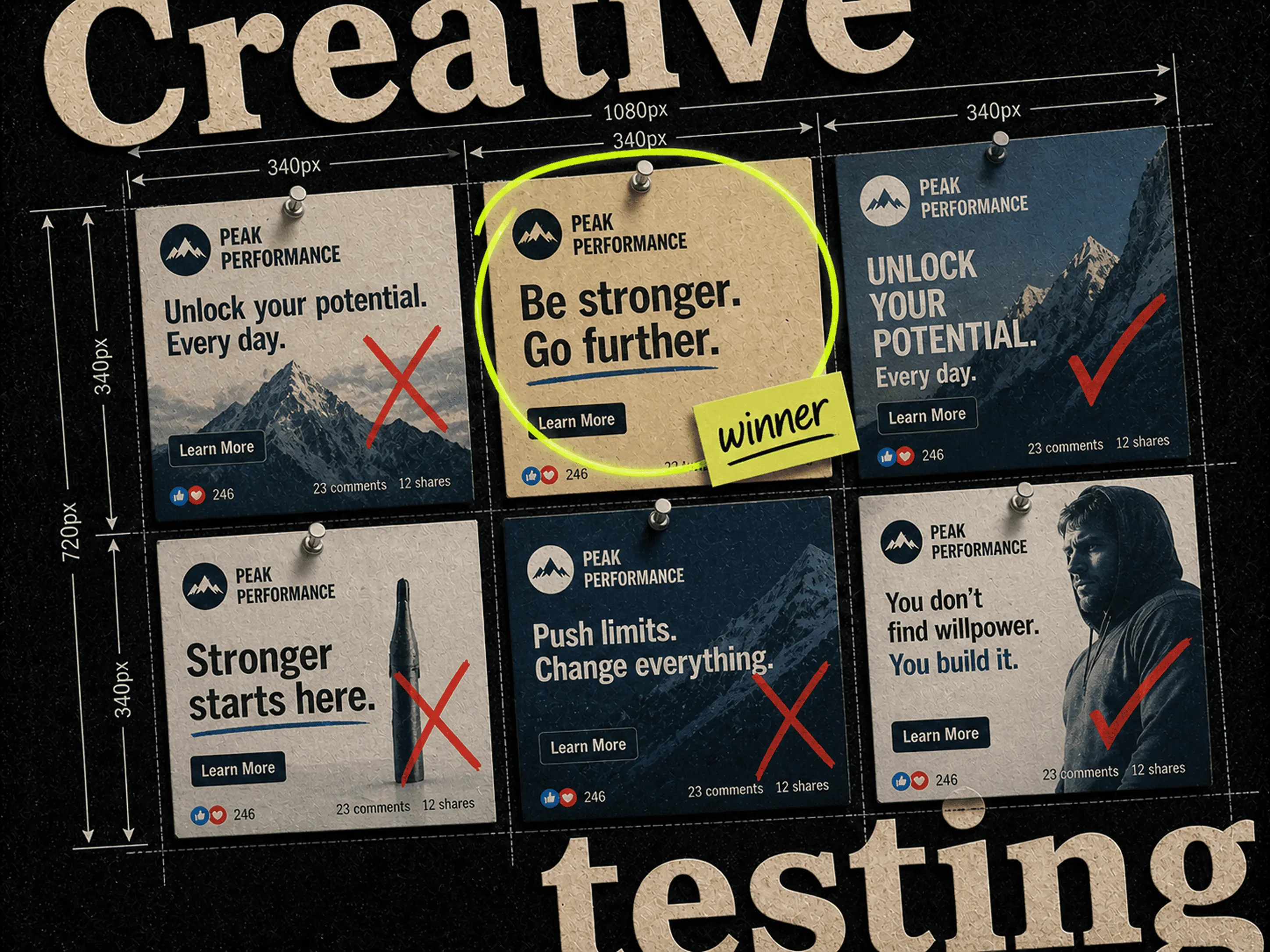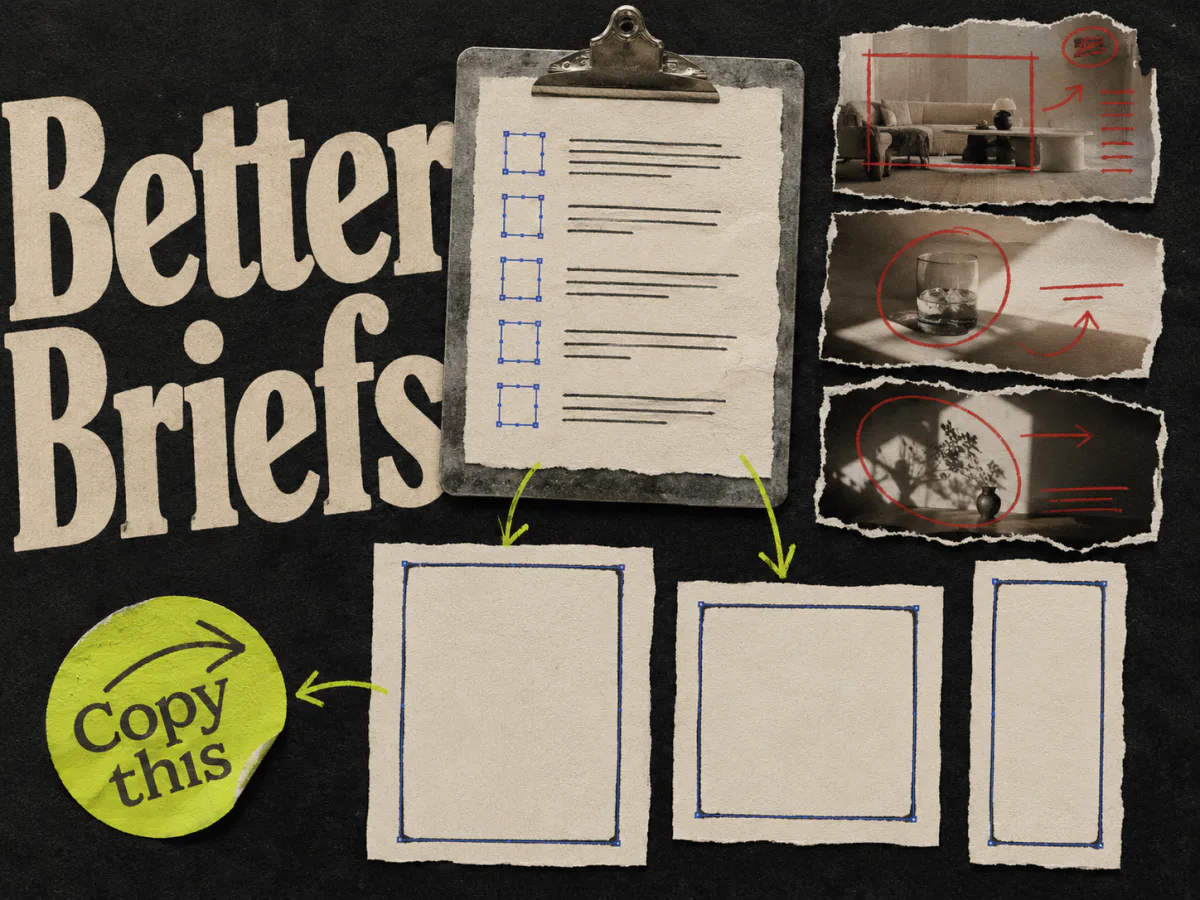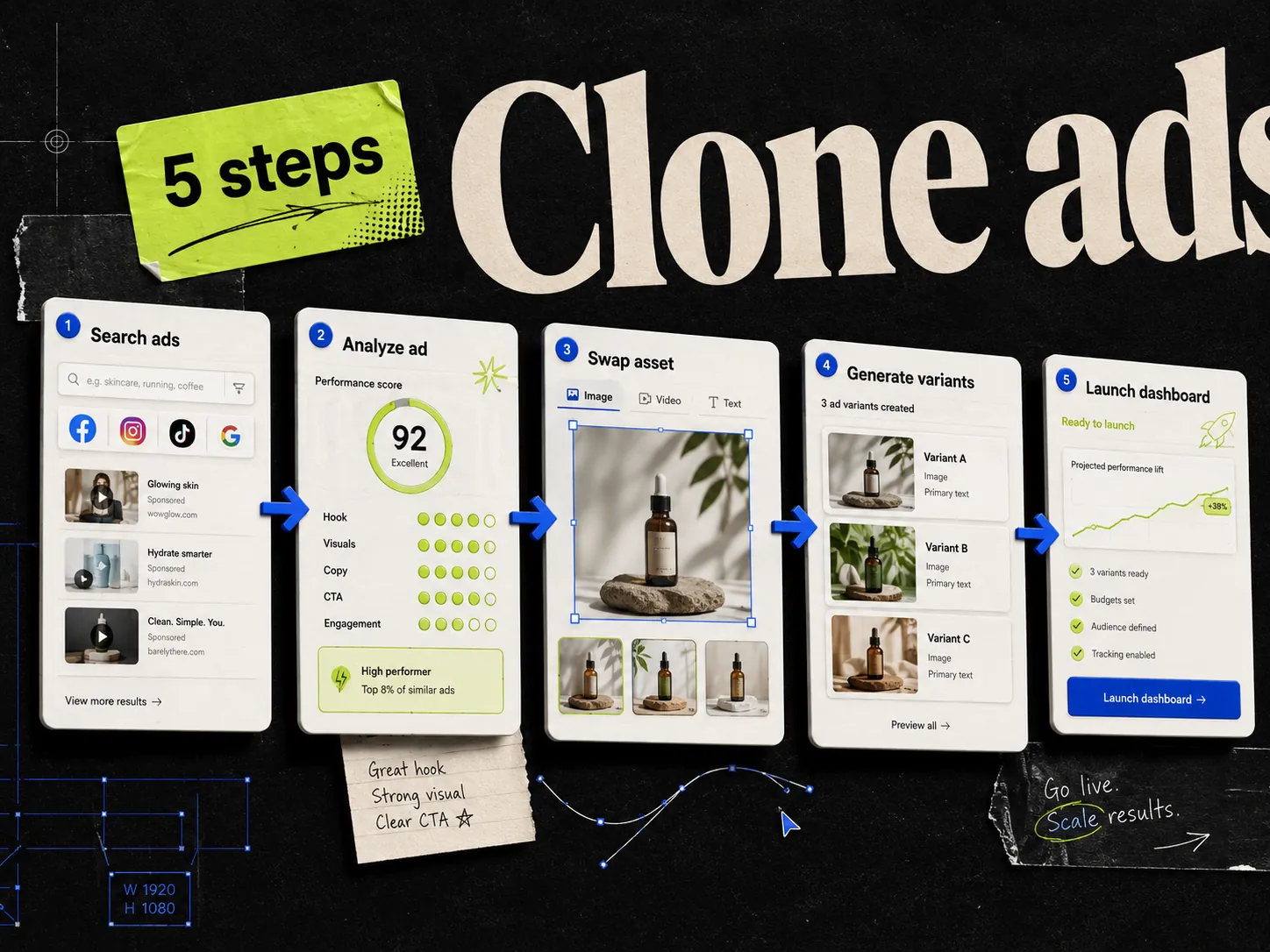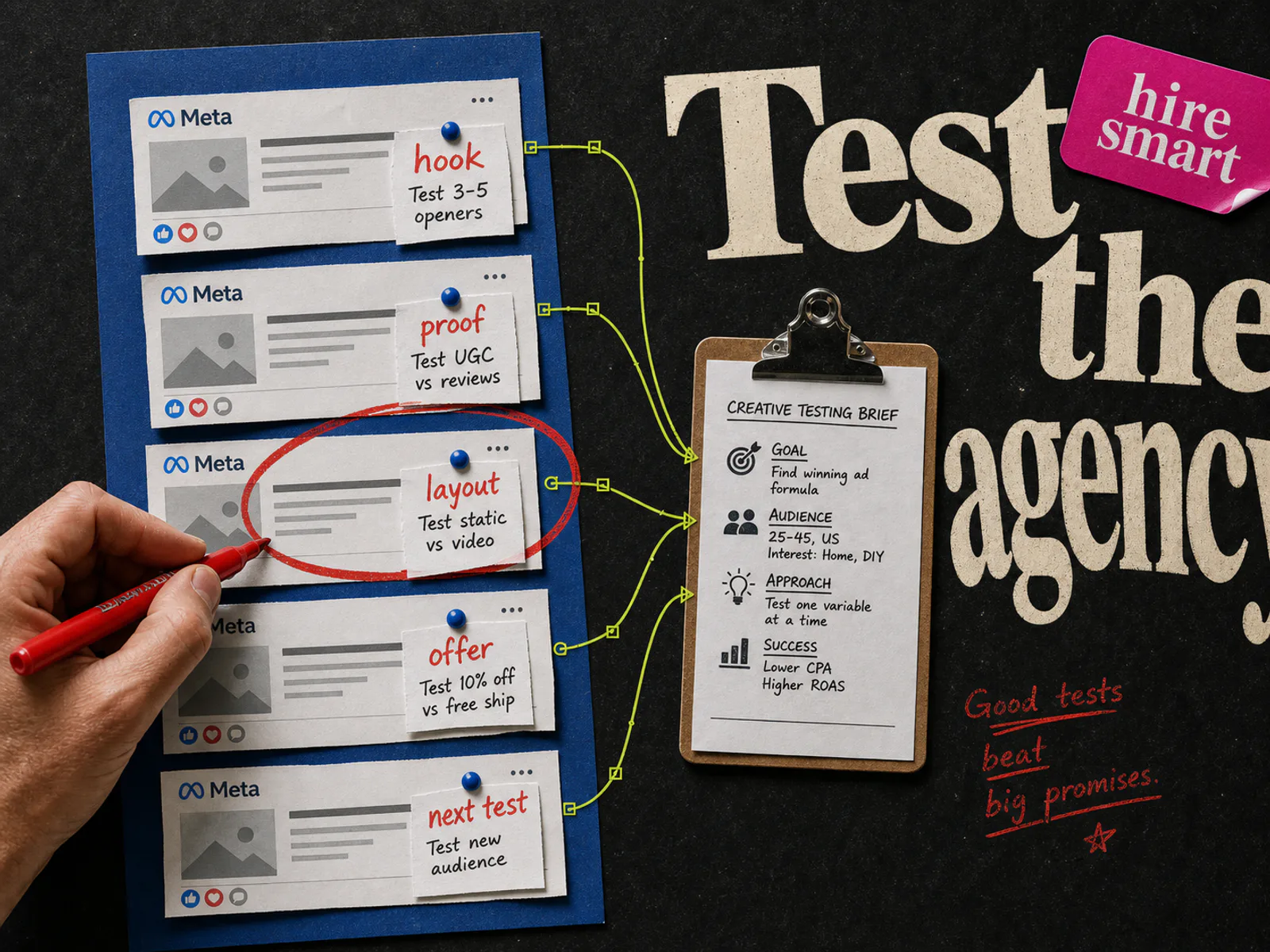
Hiring an ad creative testing agency can fix a real production problem. It can also leave you with a folder of polished ads and no clearer idea of what your customers respond to.
The difference is the operating model. A useful partner does more than make assets. They help turn a business question into a small, readable set of ads, then use the result to decide what to make next.
This guide is for teams choosing a partner for Meta ads, especially when the in-house media buyer has more ideas than the creative team can ship. If you need a process before you start comparing agencies, read our creative testing framework.
What an ad creative testing agency should actually do
An agency may call itself a creative testing agency when it provides any combination of strategy, production, media buying, reporting, and iteration. Those jobs are related, but they are not interchangeable.
Before you take a sales call, decide which gap you are trying to fill.
| If your real problem is... | You need the agency to own... |
|---|---|
| You have plenty of ideas but not enough finished ads | Production capacity and a dependable approval process |
| Your team keeps making random variations | Test design, briefs, and a naming system |
| You can launch ads but cannot explain the results | Creative-level reporting and a review cadence |
| You need more angles grounded in the market | Research, customer insight, and creative strategy |
| Your account needs someone to manage spend too | Media buying, with clear ownership for testing decisions |
Be suspicious of a vague promise to "test more creative." Ask what they will change, what stays constant, and who decides whether a test has produced enough signal. A batch of unrelated ads is content production. It is not a test.
Choose the kind of partner first
There are three common arrangements. None is automatically better; the right one depends on what your team can already do.
Creative production partner
This team makes the assets. You supply the strategy, test plan, and performance readout. It works well when you have a capable in-house media buyer or creative strategist, but design throughput is the bottleneck.
Ask for a sample handoff. Can they deliver the source files, all required Meta ratios, and clearly named variants? Do they have a way to handle feedback without turning a three-day request into a two-week thread?
Creative strategy and production agency
This is the most common fit for a growth team that knows its numbers but needs help turning account data, reviews, competitor ads, and offers into better hypotheses. The agency should bring a point of view about what to test, then make the variants.
The risk is outsourcing judgment completely. Keep someone on your side close to the customer, the offer, and the landing page. An outside team can spot patterns, but it cannot invent product truth.
Full-service paid social agency
This agency manages media buying as well as creative. It can reduce coordination, since the people who see delivery and conversion data also direct the next batch.
The trade-off is visibility. Make sure the agreement spells out whether creative testing gets a regular budget and review slot, rather than being squeezed between campaign maintenance and reporting.
Questions to ask before you hire
The strongest questions are concrete enough that the agency has to explain its working habits.
- 1.What does one testing cycle look like from brief to readout?
- 2.Which creative variables do you usually test first: angle, hook, proof, layout, offer, or visual treatment?
- 3.How many variants do you recommend at our spend level, and why?
- 4.What information do you need from us before you make the first batch?
- 5.Who reads the result with us, and what does a useful readout include?
- 6.How do you distinguish a new concept from a small iteration of a winner?
- 7.What files, ratios, and naming conventions will we receive?
- 8.Can we keep and edit the source files after the engagement ends?
- 9.How do you handle claims, regulated categories, and brand approvals?
- 10.What would make you recommend fewer ads, not more ads?
That last question is revealing. A good agency should be willing to say when your budget cannot support a large batch. The right number of ads depends on delivery and conversion volume, not on how many designs fit in a monthly retainer. Our guide to how many ad creatives to test on Meta can help you sanity-check the proposed volume.
What a good first-month plan looks like
You do not need a 40-slide strategy deck before anyone makes an ad. You do need a short plan with decisions attached to it.
For a first month, ask for something like this:
| Week | Agency work | Your team's job | Output |
|---|---|---|---|
| 1 | Audit recent ads, gather customer and market inputs, agree on the test backlog | Share account context, product facts, offers, and approval rules | Prioritized hypotheses |
| 2 | Turn the first hypothesis into a brief and build variants | Approve claims, product treatment, and landing-page alignment | Launch-ready creative batch |
| 3 | Watch delivery and flag obvious production or placement issues | Keep media setup and offer stable where possible | Early-read notes |
| 4 | Review the result and propose the next iteration | Decide what to continue, cut, or challenge | Readout and next brief |
The plan should name the decision-maker. If the agency waits for feedback from five people, it will either miss the testing window or make choices by committee.
Give the agency a brief they can test
Creative agencies cannot test a feeling. "Make it punchier" and "show the value" are feedback notes, not a testing brief.
A useful brief gives them a customer problem, an argument, and a boundary around the experiment. It can fit on one page.
| Brief field | Example |
|---|---|
| Customer problem | Our paid-social team has new angles but waits on static production |
| Hypothesis | A speed-focused hook will outperform a generic AI hook for in-house media buyers |
| Variable | Opening hook |
| Keep stable | Offer, product proof, CTA, base layout, and landing page |
| Proof | Editable outputs and three Meta placement ratios |
| Audience | In-house Meta media buyers at brands with a weekly creative cadence |
| Deliverables | Four static variants in 4:5, 1:1, and 9:16, with editable source files |
| Decision rule | After enough delivery for a useful comparison, keep the stronger hook and create close variants |
This is deliberately plain. It gives the agency room to make good work without asking them to guess what success means.
For a fuller version, copy the fields from our Meta ad creative brief template. If you are pulling examples from competitors, keep the note specific: borrow the reading order or proof treatment, not the logo, copy, or product imagery. Our guide on how to clone competitor Facebook ads without copying them covers that line in more detail.
Red flags in an agency proposal
Some warning signs show up before the work starts.
A fixed number of ads with no testing logic
"Thirty ads per month" may be a perfectly reasonable production agreement. It tells you nothing about whether the ads will teach you anything. Ask how those assets become concepts, variants, and next steps.
Reporting that stops at a gallery
A gallery of winners and losers is not enough. You need the agency's read: which message, visual treatment, proof point, or offer deserves another pass, and what they want to hold stable next time.
No distinction between inspiration and copying
Competitor research is useful. Copying competitor assets or claims creates legal, brand, and platform risks. The agency should be able to explain how it translates a reference into a new execution.
Source files are unclear
Ask this in writing. If your team cannot edit a successful concept, resize it, or adapt it for a new offer, you may be renting your own learning.
Every recommendation is "more variety"
Variety has a place, especially when an account has exhausted one angle. But early testing needs contrast you can explain. If every ad changes the message, image, offer, and format, you will struggle to say what worked.
Keep the relationship useful after the first win
The first winning ad is where many agency relationships get lazy. The account keeps running the same asset until it fades, while the next batch starts from scratch.
Ask the agency to create a follow-up set around the thing that won. If the hook was strong, try new proof. If the product treatment was strong, try a second hook. If a static asset worked, decide whether it deserves a video treatment rather than assuming video will be better. Our comparison of static ads versus video ads for Meta is useful when that question comes up.
Keep one shared record of tests. It can be a spreadsheet, a project board, or your agency's system, but every entry should make it easy to find the angle, hook, asset, audience, offer, outcome, and next action. That record becomes more valuable than any single ad.
Where Adrio fits
An agency does not have to make every variation by hand. When the strategy is clear and static production is the slow part, Adrio can help your team turn approved directions into editable Meta ad variants and export them in 1:1, 4:5, and 9:16.
That works best when the agency owns the brief and test logic while your team keeps access to the assets. You can start with Adrio for the production layer, or compare the broader options in our guide to ad creative testing platforms.
FAQ
What does an ad creative testing agency do?
It may handle creative strategy, production, media buying, reporting, or some combination. The important question is whether it can turn a hypothesis into readable variants and explain what to make next.
How much creative should an agency make each month?
There is no useful universal number. The batch should fit your spend, approval speed, and ability to learn from the result. Start with the number of concepts and variables you can actually evaluate.
Should the agency run Meta ads too?
It can be helpful when media buying and creative decisions need tight coordination. If you keep media buying in-house, agree on who owns launch setup, reporting, and the final test decision.
What should we own at the end of the engagement?
Confirm ownership of final assets, editable source files, research, briefs, and reporting before you sign. You should also be able to understand what was tested and why.