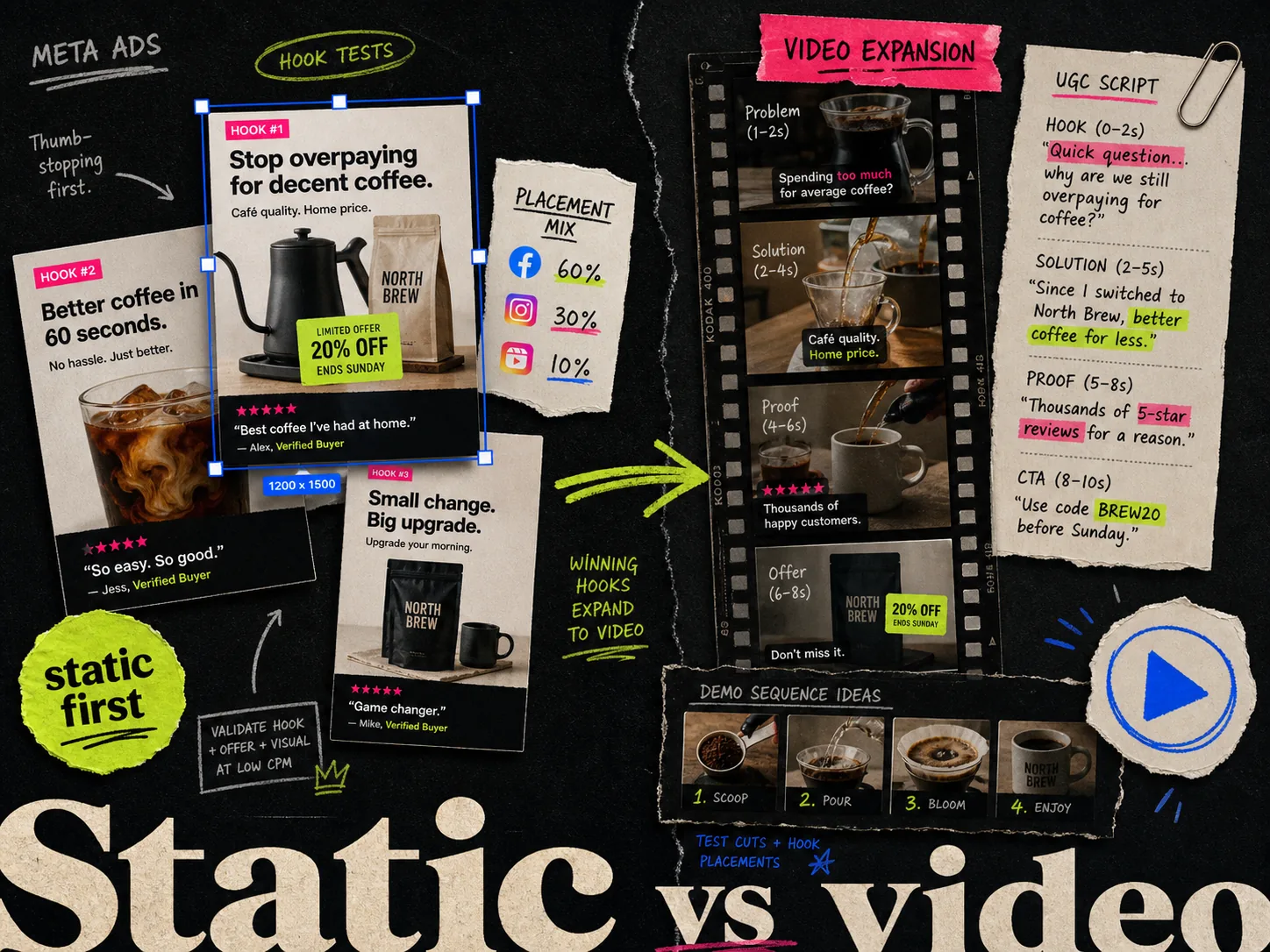
Static ads and video ads both work on Meta. The better choice depends on what you need to test. Static ads are usually better for speed, offer clarity, and weekly refreshes. Video ads are usually better for demos, UGC, education, and story.
Most accounts should use both. Static ads are often the fastest way to test a message. Video can then expand the messages that already show promise.
TL;DR
Use static ads when you need fast testing, clear hooks, simple offers, and high creative volume. Use video ads when the product needs to be shown in use or explained over time.
| Format | Best for | Watch-out |
|---|---|---|
| Static ads | Fast tests, offers, reviews, comparisons, refreshes | Must be clear in one glance |
| Video ads | Demos, UGC, education, story | Slower and more expensive to produce |
| Mixed workflow | Testing messages with static, expanding winners with video | Needs clear naming and reporting |
When static ads are better
Static ads are useful when the team needs speed and clarity. A static ad has one frame to get attention and explain the offer.
Use static ads for:
- Hook testing
- Offer testing
- Review ads
- Before-after layouts
- Product close-ups
- Comparison ads
- Weekly creative refreshes
Static ads are also easier to read in a test. If the team changes the headline and performance changes, the result is usually easier to understand.
When video ads are better
Video is useful when the product needs motion, sequence, voice, or a person on screen.
Use video ads for:
- UGC
- Product demos
- Tutorials
- Founder videos
- Customer stories
- Complex offers
- New category education
Video can explain more, but it can also make testing harder. If the ad works, the reason could be the script, creator, first three seconds, product shot, edit, caption, or offer.
Static vs video by testing job
| Testing job | Better first format | Why |
|---|---|---|
| Hook testing | Static | Faster to create several versions |
| Offer testing | Static | Easier to isolate the offer |
| Product education | Video | More room to explain |
| UGC proof | Video | Delivery from a person matters |
| Review proof | Static | A quote can carry the ad |
| Layout testing | Static | Easier to compare visual order |
| Product demo | Video | Motion shows use better |
| Fatigue refresh | Static | Faster turnaround |
Why static ads still matter on Meta
Static ads matter because creative testing often needs volume. A team can usually produce more static variants than video variants in the same time.
Static works well when the team needs to test:
- 5 hooks
- 3 layouts
- 2 offers
- 3 proof points
- 3 placement ratios
Doing all of that with video can be slow. Static ads help the team learn which message is worth deeper production.
Why video still matters
Video is still important for many brands. It can build trust, show the product in use, and explain details that do not fit in one frame.
Video is usually worth producing when:
- The product needs a demo
- The buyer needs education
- The offer needs explanation
- A person on screen improves trust
- The winning static angle needs a stronger version
A static-first testing workflow
A simple workflow is:
- 1.Research competitor ads and customer language.
- 2.Create 4-10 static ads around different hooks and offers.
- 3.Launch a controlled Meta test.
- 4.Find the strongest angle.
- 5.Turn that angle into more static variants and video scripts.
This reduces wasted video production because the team is not guessing which message to film.
A mixed creative system
Use each format for the job it does best.
| Weekly input | Purpose |
|---|---|
| Static hook tests | Find messages worth testing further |
| Static proof tests | See which evidence matters |
| Static offer tests | Find the strongest buying trigger |
| Video demos | Explain product value |
| UGC videos | Add human proof |
| Static refreshes | Keep winners supplied with new versions |
The goal is not static or video. The goal is a creative system that keeps learning.
Where Adrio fits
Adrio focuses on static Meta ads. It is built for teams that need high-quality static variants without waiting on a full design or video cycle.
Tools like Creatify can be useful when a team needs broader creative formats, including video and UGC-style ads. Adrio is a better fit when the main job is static Meta ad quality: clear hooks, editable layouts, competitor-informed structures, and fast placement exports. For the full breakdown, see the Adrio vs Creatify comparison.
FAQ
Are static ads or video ads better on Meta? Neither is always better. Static ads are better for fast testing and clear offers. Video ads are better for demos, UGC, education, and story.
Do static ads still work on Facebook and Instagram? Yes. Static ads still work when the hook is clear, the layout is readable, and the account tests enough variants.
Should I test static ads before video ads? Often yes. Static ads are a fast way to test hooks, offers, and proof points before investing in video production.
Why does Adrio focus only on static ads? Adrio focuses on static ads so it can produce better editable assets for Meta creative testing.