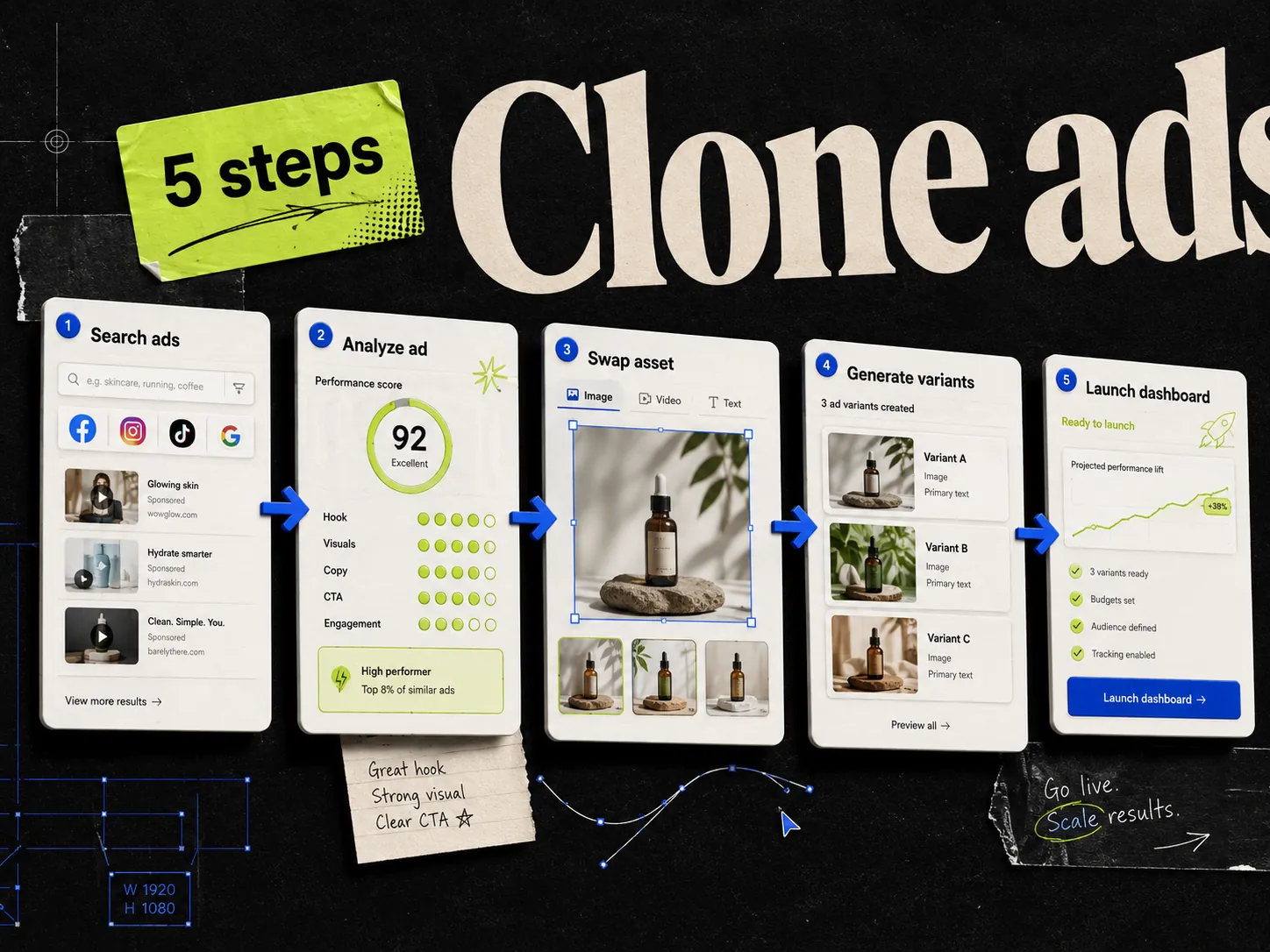
To clone a competitor's Facebook ad, find an ad that is already working, break down why it works, then rebuild that same structure with your own brand and product. You reuse the structure, not the assets.
The structure is the hook, the layout, the offer, and the type of proof. Those parts are fair game. The competitor's photos, logo, and exact words are not. Keep that line clear and cloning stays safe. (More on that in clone vs copy.)
Here is the five-step version.
TL;DR
| Step | What you do |
|---|---|
| 1. Find an ad | Pick a proven competitor ad from the Meta Ad Library or an ad library tool |
| 2. Break it down | Note the hook, layout, offer, and proof |
| 3. Make it yours | Swap in your product, brand, and your own images |
| 4. Build variants | Create 3-5 versions that keep the structure but change one thing |
| 5. Launch and read | Run the test, see what wins, refresh the winner |
Step 1: Find an ad worth cloning
Start in the Meta Ad Library. It is free and shows every ad a brand is running right now.
Search a few competitors. Then look for ads that have been live for a while, or ads the brand is running in many small variations. Long-running ads usually make money. Brands do not keep paying for ads that lose.
Do not pick an ad just because it looks nice. Pick it because there is a reason to believe it works.
Step 2: Break the ad down
Once you have an ad, write down the parts that make it work. You are looking for the skeleton, not the paint.
- Hook: the first line or the first thing your eye lands on
- Layout: where the product, text, and proof sit
- Offer: the deal, the price framing, or the promise
- Proof: a review, a stat, a before and after, or a founder claim
- Format: feed square, portrait, or story
A simple note is enough:
| Part | What the competitor did |
|---|---|
| Hook | Leads with a price comparison |
| Layout | Product on the left, three benefits on the right |
| Offer | Free shipping over $50 |
| Proof | A five-star review under the headline |
| Format | 4:5 feed |
Now you have a recipe you can follow, not a picture you have to trace.
Step 3: Make it yours
This is the step people get wrong. They lift the competitor's image, change the logo, and ship it. That is copying, and it can get the ad rejected or worse.
Instead, rebuild each part with your own material:
- Write the hook in your own voice, for your own product
- Use your product photos or your own reference images
- Put in your real offer
- Use your own reviews and proof
- Keep the layout idea, but make the design yours
The goal is an ad that follows a proven pattern and still looks like you.
Step 4: Build a few variants
One ad is a guess. A small batch is a test.
Keep the same structure and change one thing per version:
- Hook variant: same layout, new opening line
- Proof variant: swap the review for a stat or a before and after
- Offer variant: test free shipping against a bundle
- Visual variant: product close-up against lifestyle
For most accounts, 3 to 5 variants per concept is a good range. Enough to learn something, not so many that your budget gets spread thin. (See how many creatives to test.)
Step 5: Launch and read
Run the batch as a clean test. Keep the audience, offer, and landing page steady so the creative is the main thing changing.
Give each ad enough delivery before you judge it. Early click-through rate tells you if the hook is landing. Cost per result and ROAS need more time. When one version wins, make close variants of it and keep the loop going.
Where Adrio fits
Adrio is built for this exact loop, for static Meta ads.
You can browse competitor ads right inside Adrio. Everything is searchable by meaning, so you can look up a topic, find an ad, and pull up similar ones next to it. You can also add your own reference images. Or you can hand the job to Spark, our creative agent, which searches Google Images, Pinterest, and our database of 100k+ ads to find references for you.
From there, Adrio does the rebuild. One agent reads the reference, another writes the copy, another handles the design. You are not filling in a template. You get a real static ad you can edit by hand: headline, image, layout, and CTA. Export it in 1:1, 4:5, and 9:16, and launch straight from Adrio.
You bring your own product and images. Adrio brings the structure and the speed.
FAQ
Is it legal to clone a competitor's Facebook ad? Reusing the structure of an ad, like the hook style, layout, and offer framing, is normal competitive practice. Copying their actual photos, logo, or text is not. See clone vs copy for the full breakdown.
How do I know which competitor ad to clone? Look for ads that have run for a long time or appear in many variations in the Meta Ad Library. Those are the ones likely making money.
How many cloned variants should I launch? For most accounts, 3 to 5 per concept. Keep the structure and change one element per version so you can tell what worked.
Can I clone an ad without a designer? Yes. Tools like Adrio rebuild the static for you from a reference image or a brief, and you edit the result. You do not need to start from a blank canvas.