Most ad creative testing platforms handle one part of the job. Some help you make variants. Ads Manager runs the spend. Analytics tools make the results easier to read. Buying the wrong layer leaves the original bottleneck untouched.
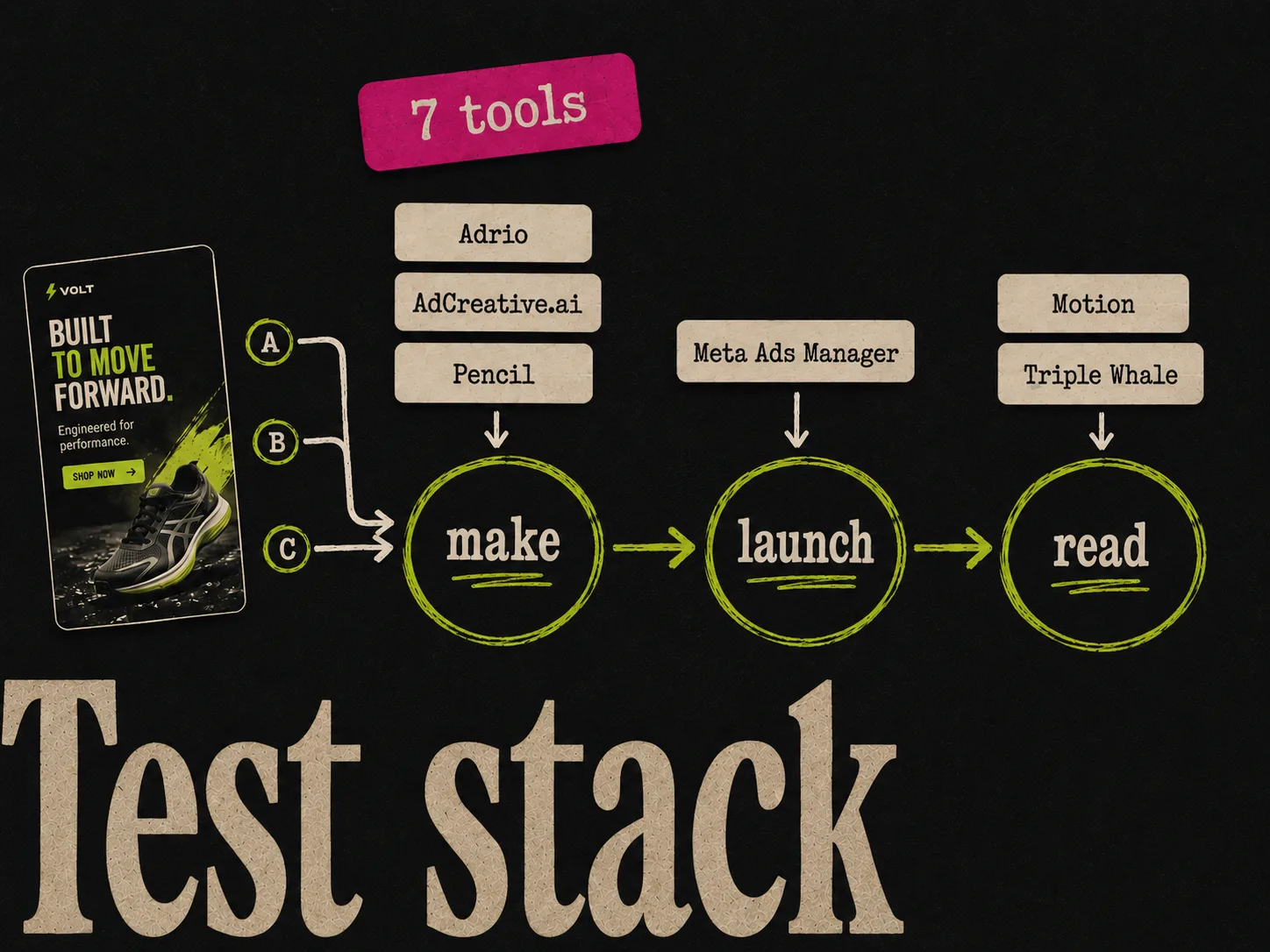
For Meta ads, a small stack usually works better than one oversized platform. If you are still defining the process, start with our creative testing framework. If the process is clear but production is slow, compare the tools below by the stage they actually support.
TL;DR
Use Adrio when the bottleneck is turning research into static and video creative, approved image-ad launches, and the next testing decision. Meta remains the source of campaign delivery and spend. Use Motion or Triple Whale when you need cleaner creative-level reporting. Use Marpipe when you have enough budget for multivariate testing. Use Foreplay for research and briefs. MagicBrief closed on July 31, 2026; evaluate Canva Grow for its successor workflow.
| Tool | Best for | Stage |
|---|---|---|
| Adrio | Static and video creation, approved image and video publishing, and performance-led iteration | Research through the next test |
| Meta Ads Manager | Running the actual test | Launch and delivery |
| Motion | Creative performance reporting | Read and iterate |
| Triple Whale Creative Cockpit | Ecommerce creative analysis | Read and attribute |
| Marpipe | Multivariate testing | Structured test design |
| Canva Grow | Creative generation, publishing, and analytics inside Canva | Creation through reporting |
| Foreplay | Swipe files and references | Before launch |
What counts as a creative testing tool?
A real creative testing tool helps with at least one of these steps:
- 1.Research: Find angles, hooks, formats, and competitor patterns worth testing.
- 2.Production: Make enough variants to create a meaningful test.
- 3.Launch: Run the ads with controlled variables.
- 4.Measurement: Read performance by creative, not only campaign.
- 5.Iteration: Turn the winner into the next test.
If a tool only makes one pretty ad, it is not a creative testing tool. If it only reports ROAS by campaign, it is not enough either. Creative testing lives at the level of the ad: hook, visual, layout, proof, offer, and CTA.
1. Adrio - best for producing Meta static ad variants
Adrio is the best creative testing tool when the bottleneck is volume. Most tests do not fail because the idea was bad. They fail because the team only had two ads, changed too many variables, or could not produce enough distinct variants to get a clean read.
Use Adrio to:
- Generate 4 to 20 static ad variations from one product or angle
- Clone the structure of competitor ads without copying their assets
- Keep product images, text, logo, and CTA elements editable
- Export for Meta feed, Stories, Reels, and square placements
- Build a weekly backlog of testable concepts
Spark also reads connected Meta performance and helps plan the next creative test. Publishing image or video ads directly to Meta asks for approval by default. Production volume must fit the account’s available testing budget.
Best for: Meta static ads, hook tests, layout tests, offer tests, and agencies shipping creative every week.
2. Meta Ads Manager - best for running the actual test
No reporting tool replaces the source of spend. Meta Ads Manager is still where the actual test runs, budget is allocated, and delivery decides what gets impressions.
Use Ads Manager for:
- Campaign setup
- Budget control
- Ad-level delivery
- Initial CTR, CPA, ROAS, CPM, and frequency reads
- Placement previews
The weakness is analysis speed. Ads Manager can tell you what happened, but it is not built to tag creative concepts, summarize hook patterns, or run a clean weekly creative review for a team.
Best for: live testing and source-of-truth campaign metrics.
3. Motion - best for creative performance reporting
Motion pulls creative and performance data from Facebook, TikTok, and other platforms into visual reports. Its product page emphasizes dashboards that show creative assets and performance metrics side by side.
Motion is useful when your account has enough ads that spreadsheet analysis slows the team down. It helps connect visual patterns to performance, which makes the next creative sprint sharper.
Use Motion to answer:
- Which hooks are winning?
- Which formats are scaling?
- Which ads are fatiguing?
- Which product treatments deserve more iterations?
- Which themes should creative and media teams discuss this week?
Best for: weekly creative reviews and visual reporting.
4. Triple Whale Creative Cockpit - best for ecommerce creative analysis
Triple Whale's Creative Analysis Dashboard supports creative analysis across Facebook, Google Ads, TikTok, and Twitter. Its help center describes creative-level drilldowns, platform previews, performance breakdowns, and segments for comparing groups of ads.
Triple Whale is strongest for ecommerce teams that already use it as their attribution and business intelligence layer. If you trust Triple Whale for contribution margin, blended metrics, and store performance, its creative dashboard can connect creative reads to ecommerce outcomes.
Best for:
- Shopify and DTC teams
- Brands already using Triple Whale
- Creative analysis tied to business performance
- Segmenting ads by concept, product, or campaign type
Watch-out: it is a broader analytics stack, not only a creative testing app.
5. Marpipe - best for multivariate creative testing
Marpipe is built around multivariate testing. Marpipe explains that multivariate testing measures combinations of creative variables such as images, headlines, and CTAs, which can mean testing tens or hundreds of ads instead of only two or three.
That is powerful when you have enough budget and traffic. It is overkill when your account barely has the spend to test five variants.
Use Marpipe when:
- You need element-level creative learning
- You have repeatable product or catalog structures
- You can afford many variations
- You want to know which headline, image, CTA, or layout element drove the result
Best for: structured creative testing programs with enough volume.
6. Canva Grow - the successor workflow for MagicBrief teams
MagicBrief’s shutdown notice says the service closed on July 31, 2026. Its team built Canva Grow, a new product rather than a direct port.
Canva Grow combines generation, editing, publishing, and performance insights. Evaluate it when your design team already works in Canva. Compare its account connections and reporting needs against a real campaign. Our MagicBrief replacement guide separates research, analytics, and production needs.
7. Foreplay - best for swipe files and references
Foreplay is built for saving, organizing, and sharing ad inspiration. It lists swipe files, folders and boards, live ad status, comments, advanced filters, transcription, discovery, and competitor tracking.
Foreplay is a strong first layer for teams that already have a testing process but need better reference management. It helps the team remember why an ad was saved and where it belongs in the creative backlog.
Best for:
- Swipe files
- Reference organization
- Creative inspiration
- Team collaboration around examples
The best creative testing stack by team size
For a solo media buyer:
- Meta Ad Library for research
- Adrio for static variants
- Meta Ads Manager for testing
- A spreadsheet for reads until volume grows
For a DTC growth team:
- Foreplay for references and briefs
- Adrio for Meta static production
- Meta Ads Manager for tests
- Motion or Triple Whale for reporting
For an agency:
- Foreplay for briefing; evaluate Canva Grow for the former MagicBrief workflow
- Adrio for fast static production
- Motion for client-ready creative reporting
- Marpipe for high-spend accounts that justify multivariate tests
Creative testing tool mistakes to avoid
Do not buy analytics before you can produce ads. If you only launch two creatives a month, better reporting will not fix the bottleneck.
Do not use AI scoring as a substitute for spend. A predicted score can help prioritize variants, but Meta's delivery data is still the real read.
Do not test too many variables at once. If the image, hook, CTA, and offer all change, you learn which ad won, but not why.
Do not judge a creative only by ROAS on day two. Early ROAS is noisy. Read CTR, CPC, CPA, spend, and conversion quality together.
Where Adrio fits
Adrio is the production layer in a creative testing stack. It helps you create enough Meta static ads to make the rest of the testing process worth doing.
If your team already has research and reporting, Adrio fills the missing middle: turning ideas into editable creative variants fast enough to keep testing every week.
FAQ
What is the best creative testing tool for Meta ads? Compare Adrio for static and video creation, approved image and video publishing, and performance-led iteration. Meta Ads Manager remains the source of delivery and spend. Motion and Triple Whale offer specialist reporting workflows.
Is Meta Ads Manager enough for creative testing? It is enough to run the test, but not always enough to manage creative learning. Once you launch many ads, a creative analytics layer helps you see patterns faster.
How many creatives should I test at once? For most Meta accounts, 4 to 10 variants per concept is a practical range. Use fewer if spend is low and more only if the account has enough budget to get signal.
What is the difference between A/B testing and multivariate testing? A/B testing compares full ads. Multivariate testing compares combinations of elements, such as images, headlines, CTAs, and layouts.
Which metric should decide a creative test? Use CTR and CPA together for early reads, then ROAS or contribution margin once there is enough conversion data. One metric alone can mislead you.