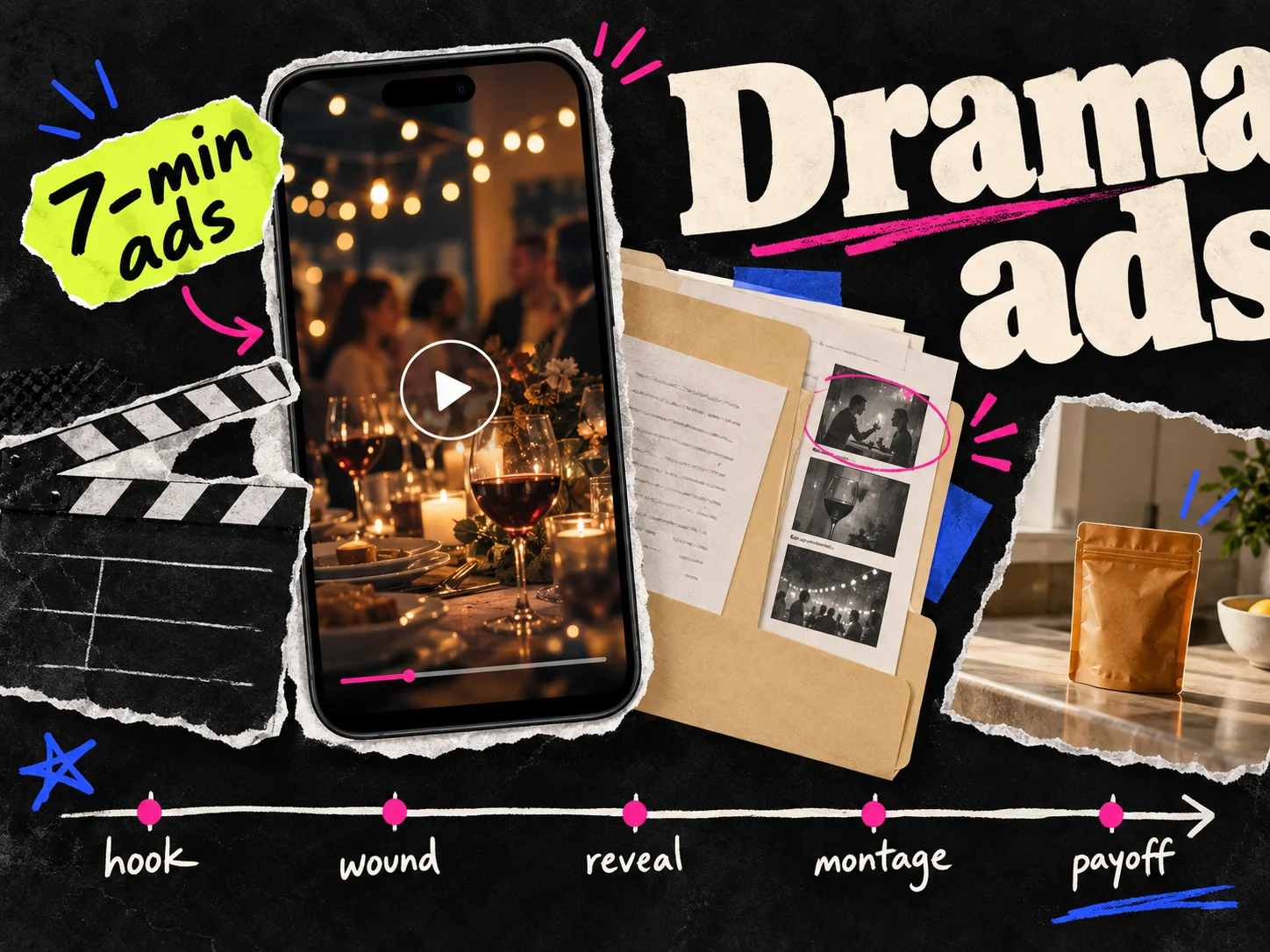
A short drama ad is a video ad that tells a scripted, episode-style story with a conflict, a turning point and a payoff, and only reveals the product once the viewer is invested.
That sentence sounds like a screenwriting exercise. It isn't. We pulled 1,000 live ads from Resilia, a supplement brand on Meta that runs almost nothing else, and most of them follow that shape: a betrayal, a public humiliation, a relative who flies in with a pouch, and a product that waits two minutes before it shows its face. Below you'll find what the format is, the numbers from one brand running it at scale, five videos to watch with their beat timelines, the structure underneath all of them, and a clear list of what not to copy.
What are short drama ads?
A short drama ad is not a testimonial with a bigger budget. In a UGC testimonial, the creator holds the product in the first five seconds. In a classic 15-30 second direct response video, the product is on screen before your thumb finishes its flick. In a short drama ad, the product may not appear for two or three minutes, and by then you have watched a marriage fall apart. The story is the delivery vehicle. The story is also the thing you stayed for.
The format borrows its furniture from micro-drama apps, which spent the last few years proving people will watch tabloid stories in minute-long episodes. From them, these ads take the cliffhanger hook, the villain you can hate within seconds, and the public payoff scene where the wronged party wins in front of a crowd. What they add is a sales job at the end.
| Format | Length | Where the product appears | What holds attention |
|---|---|---|---|
| UGC testimonial | 20-45 s | First seconds, usually in hand | The person and the claim |
| Classic direct response video | 15-30 s | Immediately | Problem, solution, offer |
| Short drama ad | 4-11 min | Minutes in, once the story has you | The story itself |
The last row is the one that changes how you budget. If the story holds attention, your money goes into scripts and variants, not into filming a new demo every week.
Resilia's short drama ads by the numbers
Resilia sells Oil of Oregano softgels with black seed oil through resilia.shop. The Facebook page has 56k likes, and its advertiser page in our library held 1,000 captured ads when we pulled it on October 21, 2026, 964 video and 36 image. Meta reported about 1,667 total ads for the page. We ran our ad analysis on 942 of the videos, which gives each one a transcript, a beat timeline, hook text and style tags.
| Metric | Value |
|---|---|
| Ads captured | 1,000 (964 video, 36 image) |
| Meta-reported ads for the page | about 1,667 |
| Video ads analyzed | 942 |
| Median length | 392 s (about 6.5 min) |
| Length range | 3 s to 669 s (about 11 min) |
| Running 3 minutes or longer | 800 of 942 (85%) |
| Tagged animated (3D, Pixar-like) | 797 of 942 (85%) |
| Burned-in word-by-word captions | 890 of 942 (94%) |
| Product/solution beat, median start | 133 s, about 37% into the ad |
| Distinct storylines | about 40 |
| Distinct hook-text variants | 354 |
| Largest storyline | "My whole circle knew my husband was cheating" (111 ads) |
| Male mirror of it | "My whole crew knew my wife was cheating" (96 ads) |
| Distinct headlines | 9 |
| Distinct primary texts | 7 |
| Main headline | "Feeling heavy, puffy, sluggish, or stuck?" |
| Offer tags | discount 496, guarantee 186, BOGO 129, bundle 92, no offer 57 |
| CTA button | Learn more, to a product page |
Read that table as one design decision. Almost every ad is long, animated, and captioned word by word, and the product waits until about 133 seconds in. In a typical ad, the first two minutes contain no product at all. That only makes sense if the story is what's doing the selling.
The offers stay boring on purpose. A plain discount leads (496 ads), then guarantee, BOGO and bundle behind it, and the CTA button is Learn more, linking to a product page. Meanwhile the stories and hooks churn: about 40 storylines re-cut into hundreds of ads, 354 hook texts, and one storyline that even opens with "Resilia Oil of Oregano is a scam," narrated by a man who says he grows oregano, before flipping the objection. They are testing stories and hooks, not offers.
One caveat before you build a slide on this. Every captured ad started between October 13 and October 21, 2026. This is a fresh, high-volume launch, not a set of proven long-runners. A thousand ads in nine days tells you the brand is committed and can produce at volume. It is not proof of profit. We don't see spend or performance for Resilia, and we'd treat any outside number about their results as a guess.
5 short drama ad examples to watch
All five come straight from our library, each with its link into the Meta Ad Library. Watch the first 30 seconds of each and the pattern will teach itself.
1. "My whole circle knew my husband was cheating"
Source: Meta Ad Library, ID 1108390371837171
What to notice first: the hook does two jobs in one breath. "My whole circle knew my husband was cheating" is the wound, and "my sister flew in from Okinawa," delivered inside the first 18 seconds, is the promise that a fix exists. You know both before you know there is a product. Then the beats land on schedule. From 18 to 159 seconds, she overhears her husband and her best friend at Thanksgiving, tries the gym and the diets, and reports that her doctor told her to lose 15 pounds or get on Ozempic. At 159 seconds the sister puts a pouch on the kitchen counter and delivers the line the whole format turns on: "you don't have fat weight, you have waste buildup." That's the ad's claim, not a fact we're endorsing, and we'll come back to it. A week-by-week montage runs to 308 seconds. The payoff is a New Year's dinner: she walks in wearing an emerald dress and serves divorce papers. The last 48 seconds are the money-back guarantee and "link is below."
2. The same story, told by the husband
Source: Meta Ad Library, ID 28591012047227975
Same skeleton, genders flipped, nothing else moved. The narrator's best friend Deshawn has been with his wife Alicia, and he finds out at his father's funeral, which is a crueler choice of venue than Thanksgiving. His brother flies in with "a dark amber pouch." The week-by-week section is identical in shape. The CTA reads "70% off right now, 30 day money back guarantee" and lands on "the man in the mirror." We counted 96 ads on this male version against 111 on the female original. That is a second flagship, with almost as many cuts as the story it was copied from.
How to use it: when a story fits, cast it twice. Resilia re-casts across women around 38, men with a "dad bod," and a mother over 60 who hears it from her daughter. Same wound, different narrator. Delivery data decides which casting wins with which audience.
3. "When are you due?" "I'm not pregnant."
Source: Meta Ad Library, ID 1367339455477380
This one opens on dialogue instead of narration. Two lines, "Lisa, look at you, how exciting, when are you due?" and "I'm not pregnant," and the humiliation has already happened in public. It's a different hook mechanic from video 1, where a narrator summarizes a betrayal; here you witness it. The problem beat twists further: her labs come back fine and the doctor shrugs, which is a failure-of-authority beat aimed at anyone who has ever been told "your tests are normal." The ad's reveal claims the real cause was "parasites." We would not make that claim, you shouldn't either, and the section below explains why in detail. The proof scene is a party where guests ask "wait, that's Mark's wife?" and the CTA comes from a friend: "I'll send you the link, promo up to 70% off."
4. "My dad's side piece showed up to the anniversary party"
Source: Meta Ad Library, ID 2131666637486396
The narrator here is the daughter, and the heroine is her 62-year-old mother. That casting is the trick: it puts an older buyer in the story without making her narrate a revenge fantasy about herself. The daughter tells it for her. Her aunt brings "a gold pouch," and notice how every mentor in this catalog carries a pouch or something like it. The prop does real work. The secret has to be physical, something a relative can set on a kitchen counter, or the reveal loses its scene. The payoff is the mother in a gold dress while the other woman does a double take, and the closing line is "my mama didn't have to say a single word." The offer attached to this storyline is buy two get one free plus the 30-day guarantee, so this is where the BOGO lives.
5. "A guy grabbed my wife at a party" (the 3.5-minute cut)
Source: Meta Ad Library, ID 1744704676792406
This is the compressed cut: 3 minutes 30 seconds against the 7-minute versions of the same machinery. The narrator is 38, self-described dad bod, and a guy from his wife's college friend group grabs her from behind at a Fourth of July party in front of 80 people. His brother flies in from Brazil and says "you don't need to learn how to fight." The brother's arrival and the product reveal run from 123 to 141 seconds, so the pouch is on the counter about 20 seconds sooner than in video 1, which reaches its reveal at 159 seconds. In relative terms it comes later, about 60% of the way through instead of 37%. The short cut saves time by trimming the backstory and the payoff, not by rushing the product. The payoff lands at a Labor Day party where the same guy calls him "big man." The offer is 70% off plus the guarantee. The closing line, "don't let them sell you TRT or Ozempic," attacks approved treatments, and it's the first thing you should strip out if you borrow this script.
The beat structure behind every short drama ad
Strip the five videos and you're left with one skeleton, run at slightly different speeds. Timings below are for a 6-7 minute cut.
| Beat | Typical timing in a 6-7 min cut | Job | Resilia example |
|---|---|---|---|
| Hook | 0-20 s | Promise the wound and the fix | "my sister flew in from Okinawa" |
| Wound / problem | 20 s to about 2:30 | Humiliate the narrator in public | overheard at Thanksgiving |
| Failed fixes | about 1:30 to 2:30 | Burn the normal solutions | "doctor said lose 15 pounds or get on Ozempic" |
| Mentor and reveal | about 2:15 to 4:00 | Hand over the product with a mechanism | pouch on the counter |
| Transformation montage | about 4:00 to 5:30 | Show the change week by week | week-by-week beats |
| Public payoff | about 5:30 to 6:30 | Win in front of a crowd | emerald dress, divorce papers |
| CTA and offer | last 30-60 s | Close with discount and guarantee | "70% off, 30 day money back guarantee" |
The beats overlap on purpose. Failed fixes sit inside the problem window, and the mentor can arrive before the last failure lands, which is what you'd expect from scripts cut by different editors off one template.
One comment on the hook, because it's the beat people get wrong. In most of these ads, the opening promises the conflict and the resolution together: the affair and, inside 18 seconds, the sister from Okinawa; the side piece at the party and "my mom looked better. Let me tell you how." A viewer who came for drama needs to believe a fix is coming, or they'll churn the moment a supplement appears at minute two. A viewer who came for the fix needs to hear in second one that a fix exists. A hook that only promises the problem buys suspense you never cash in. We go deeper on hook mechanics in what is a hook in advertising, and if you're measuring yours, the difference between thumbstop rate vs hook rate vs hold rate tells you which beat is failing.
Why the story changes but the ad copy doesn't
Here's the number that surprised us most: 1,000 ads, 9 distinct headlines, 7 distinct primary texts. The main headline, "Feeling heavy, puffy, sluggish, or stuck?", does the same job on every single ad. Meanwhile about 40 storylines run across the catalog with 354 hook-text variants. The copy is a constant. The video is the variable.
That's a testing design worth stealing wholesale. Copy and offers are cheap to change and expensive to evaluate, because if you change the story, the headline and the discount at once, delivery data can't tell you which move did anything. Freeze everything except the story and every result answers one question: which story holds? Resilia does exactly that, then rotates hooks inside a winning storyline, which is what 354 variants on 40 storylines looks like in practice. When you test drama ads, copy it: fix the copy and the offer, rotate full stories first, then rotate hooks within the winner.
How to make a short drama ad
- 1.Pick a wound your buyer actually has. The wound is the product's problem translated into a public humiliation. Resilia's is "people can tell I've gained weight, and they say it to my face." If your product's problem can't be humiliated in public, the format has no payoff scene, and you should pick a different format.
- 1.Write the hook as the last scene. Write the payoff first: the dinner, the reunion. Then compress it into one sentence that carries the conflict plus a hint of rescue. "My whole crew knew my wife was cheating" plus "my brother flew in with something" is the whole test. If your first sentence can't do both jobs, keep cutting.
- 1.Cast a mentor with a believable reason to know. The reveal lands because it comes from a person with a source: a sister from Okinawa, a brother from Brazil, an aunt who works at a clinic. The mentor also carries the trust transfer, since the narrator doubts the claim until someone she loves swears by it. Choose a mentor your buyer would actually believe, not a celebrity cameo.
- 1.Place the product after the viewer is invested, then test a shorter cut. The catalog median puts the product beat at 133 seconds, about 37% in. In a 7-minute ad that's patience you have to pay for, and Resilia's own library contains the hedge: a 3.5-minute cut that reveals around 2:20. Script long, cut short, and let hold data show you where the drop-off sits.
- 1.Produce with AI animation and burned-in captions. About 85% of these ads are 3D-animated with a consistent Pixar-like look, and 94% carry word-by-word captions with a highlighted word. Animation keeps the same characters identical across hundreds of cuts, at a cost per cut that live action can't touch; nobody shoots 1,000 versions of an affair drama on location. Captions matter because most feed viewing is muted, and a dialogue-driven ad watched muted is just shapes. Our current tool list lives in best AI video generators for Facebook ads.
- 1.Cut 3-5 lengths and several hook variants from one script. One script is not one ad. Resilia cuts the same story into a 3.5-minute and a 7-minute version, slices 18-second promo snippets like "Limited time 70% off," and swaps hook lines within a storyline. Plan for each script to yield five or six assets before you write it, or the production math never closes.
What not to copy from these ads
We'll be direct: the format is fine, and several of the claims inside these ads are not. If you borrow the structure, you're borrowing from a brand whose creative sits on top of four policy regimes at once.
Meta's health and wellness ad standards restrict weight-loss ads to 18+ targeting, prohibit implying negative self-perception of body image, and do not allow side-by-side before-and-after comparisons after using a weight-loss product. Meta's unrealistic outcomes policy bans claims of unrealistic results within specific timeframes. The FTC's rule on fake reviews and testimonials, in effect since October 21, 2024, bans testimonials that misrepresent that they come from a real person or misrepresent that person's experience, including AI-generated ones, with civil penalties up to about $51,744 per violation. And in December 2025, a bipartisan coalition of 35 state attorneys general urged Meta to crack down on misleading AI-generated weight-loss ads.
Now put a first-person "this happened to me" story told by an animated character next to those four rules, add week-by-week pound counts, a "when are you due?" opening wound, a mechanism claim nobody can verify, attacks on Ozempic and TRT, and an "almost sold out" close. Every one of those touches at least one regime, and several touch more than one.
The avoid list, specifically:
- Week-by-week pound counts, or any specific result inside a specific timeframe. That's the unrealistic outcomes policy, and it's also the kind of number you'd have to substantiate to the FTC.
- Mechanism claims you can't substantiate. "It's not fat, it's waste" and the parasite reveal are the ad's claims. If a mechanism isn't in your substantiation file, it doesn't belong in your script.
- Attacking approved treatments. "Don't let them sell you TRT or Ozempic" steers viewers away from prescribed treatment, which is a fast way to attract scrutiny from Meta review and regulators.
- A fictional character presented as a real customer. An animated narrator saying "this happened to me" reads as fiction when it is labeled as a dramatization and as a fake testimonial when it is not. The FTC rule covers AI-generated testimonials.
- Scarcity you cannot back up. Only say "almost sold out" or "small batches" if it is true when the ad runs.
What to do instead: borrow the beat structure and replace the claims with ones you can substantiate. Label the story as a dramatization. Keep the transformation modest and verifiable, or skip it. Keep before-and-after imagery out entirely, since side-by-side comparisons after using a weight-loss product are already banned under Meta's standards, and target 18+ only. None of this costs you the format. What makes these ads watchable was never the parasite line; it's the dinner scene and the aunt with the pouch.
When short drama ads are a bad fit
A short list, because the answer is mostly common sense. If your product solves a problem nobody can see, there's no public payoff scene, and the payoff is the beat the format is built around. B2B buyers don't binge betrayal stories on their lunch break, and the tabloid tone will cost you credibility with them. Low-priced impulse products often sell better on a 15-second demo than on a 6-minute story; the story has to be worth more to the viewer than the demo for the format to pay for itself. Some brands can't carry a soap-opera tone next to the rest of their marketing, and that's a constraint worth respecting. Regulated categories get the worst of it, because the claims surface grows along with the storytelling. And if a static image or a plain demo would do the job, start from static ads vs video ads on Meta and pick the cheaper format first.
Where Adrio fits
Everything in this article came from Adrio's public Facebook Ads Library. Open an advertiser like Resilia and you can watch every live cut, see when each ad started, and jump from any video to its source in the Meta Ad Library.
Adrio's ad analysis is how the numbers above were produced. Each video comes back with a transcript, a beat timeline with timings, hook text and style tags, which is how you get statements like "the product beat starts at a median of 133 seconds across 942 ads" without watching 942 ads. Save the strongest structures to a swipe file and brief your own version against them. That's the whole workflow.
FAQ
What is a short drama ad?
A video ad that tells a scripted, episode-style story with a conflict, a turning point and a payoff, and reveals the product only after the viewer is invested. It borrows its structure from micro-drama apps: a cliffhanger opening and a public payoff scene. On Meta it usually runs several minutes and relies on burned-in captions.
How long should a short drama ad be?
Longer than feels reasonable, shorter than you scripted. In Resilia's catalog the median is about 6.5 minutes and 85% of the ads run 3 minutes or longer, but the same stories also exist as 3.5-minute cuts that reach the product about two minutes sooner. Script long, cut several lengths, and let hold data decide.
Do short drama ads work on Meta?
For Resilia specifically, nobody outside the brand can say. All 1,000 captured ads launched within one week in October 2026, and we don't see spend or performance data. What the format clearly buys is minutes of watch time in a feed where most video loses the viewer in seconds. Treat it as a testable hypothesis with a clean design: fixed copy and offer, rotated stories.
Are AI-generated drama ads allowed on Facebook?
The animation isn't the problem; the claims are. Meta's health and wellness standards (18+ targeting, no negative self-perception, no side-by-side before-and-after comparisons) and its unrealistic outcomes policy apply to an AI-generated character exactly as they apply to footage. The FTC's fake testimonial rule adds a federal layer, with penalties up to about $51,744 per violation for an AI character presented as a real customer. Thirty-five state attorneys general pushed Meta on misleading AI weight-loss ads in December 2025.
What is the difference between short drama ads and micro-drama app ads?
Micro-drama app ads, like the ones for ReelShort, promote an app that plays episodic content, so the ad works as a trailer for a series. A short drama ad uses the same storytelling machinery to sell a product, so the story resolves inside the ad and ends on a CTA. Same furniture, different destination.