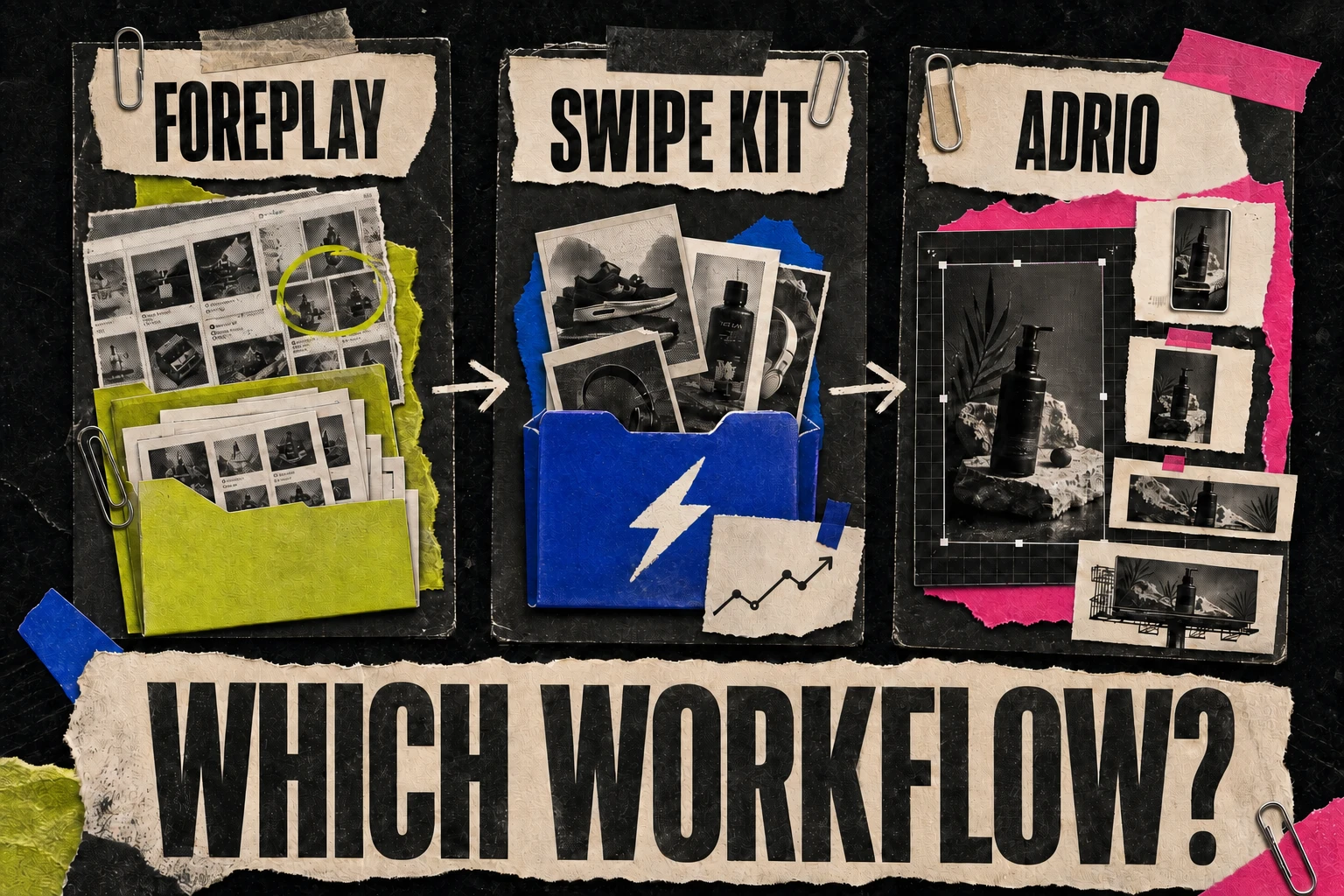
Foreplay, SwipeKit, and Adrio overlap at the start of the job: all three help you learn from ads that already exist. They split apart after that.
Foreplay is a broad creative-research system. SwipeKit is a lower-cost way to save, organize, and track ads. Adrio is for the media buyer who wants to take a useful reference and make new static Meta ads from it.
That last step matters. If your team already has designers and only needs better research, buying a generation tool solves the wrong problem. If you have 200 saved ads and still cannot get a fresh test out by Friday, another swipe-file feature will not rescue the week.
The short answer
Choose Foreplay when competitor tracking, research depth, briefs, and creative analytics need to live in one system. It is the most complete research workflow of the three and the most expensive.
Choose SwipeKit when the job is simpler: save ads from several libraries, keep the assets and landing-page context, organize boards, and track a manageable list of brands without paying for a larger creative-operations suite.
Choose Adrio when the bottleneck comes after research. It turns competitor-informed structures into editable static ads for Facebook and Instagram, so the output is creative you can test rather than a board someone still has to brief.
| Tool | Best fit | Starting price checked August 2, 2026 | Where the workflow ends |
|---|---|---|---|
| Foreplay | Agencies and research-heavy creative teams | $59 monthly or $49/month billed annually | Research, analysis, and briefs |
| SwipeKit | Solo marketers and smaller teams saving ads | $39 monthly or $26/month billed annually | Organized references, tracking, and scripts |
| Adrio | Media buyers producing Meta static variants | $29 monthly or $23/month billed annually | Editable, placement-ready static ads |
Pricing changes. Check the current Foreplay pricing, SwipeKit pricing, and Adrio pricing before deciding.
What Foreplay is good at
Foreplay has grown well beyond a browser extension for saving Facebook ads. Its current product covers swipe files, a community ad library, competitor tracking through Spyder, creative briefs, API and MCP access, and creative analytics through Lens.
The Foreplay pricing page lists a community library of more than 200 million ads and support for saving from Meta, TikTok, Instagram organic, and LinkedIn. You can organize references into folders and boards, add tags and ratings, keep landing-page screenshots, and see whether an ad is still active.
Spyder is the part agencies are most likely to care about. It tracks competitor Meta ads around the clock and keeps historical creative changes, media-mix analysis, landing-page insights, transcripts, and timelines. Foreplay also turns research into briefs and storyboards, so a strategist can move an idea to a creator without rebuilding the context in another document.
This breadth is the reason to buy it. It is also the reason not to buy it if all you need is a tidy swipe file. The monthly Workflow plan is $175, while Agency is $459. Annual billing lowers the effective monthly cost, but this is still a platform purchase, not a casual browser-extension subscription.
Foreplay fits when:
- Several people research and brief creative
- You track many competitors every week
- Video scripts and creator briefs are a large part of production
- Creative analytics belongs in the same workflow
- Clients need shared or white-label research
What SwipeKit is good at
SwipeKit feels lighter. That is a compliment.
Its extension saves ads from Meta, TikTok, Instagram, and LinkedIn, including the media, ad copy, carousel assets, landing-page link, screenshot, active days, and video transcript. The SwipeKit feature list also covers folders, boards, tags, public sharing, custom uploads, and multiplayer access.
The Brand Tracker watches a set number of competitors and records their current ads, format mix, landing pages, release timeline, and commonly used words. SwipeKit says useful tracking data builds over time, with the first brand data arriving within roughly 24 hours and a fuller picture after about 30 days.
Its AI Scripts feature can turn a saved ad into concepts, copy, or a video storyboard. The output is available in Markdown and JSON, which is handy if your next step happens in ChatGPT, Veo, Sora, or an internal production system. API and MCP access are included in the listed plans as well.
The Basic plan is listed at $39 on monthly billing or $26 per month when billed annually. It includes five seats, five tracked brands, and 150 AI script credits. That is a generous starting point for a small team.
SwipeKit fits when:
- You mainly need to save and organize ads
- Five to fifteen tracked brands cover the market
- Lower cost matters more than deep creative analytics
- Your team wants API or MCP access without an enterprise plan
- Scripts and storyboards are enough to hand off production
What Adrio is good at
Adrio starts where a typical swipe file stops.
You find a useful Meta ad, pull apart the structure, and rebuild the idea with your own product, offer, copy, and brand assets. The result stays editable on a visual canvas. You can then export the static in 1:1, 4:5, and 9:16 instead of sending a screenshot to a designer with the note, "something like this."
The distinction is production. Foreplay and SwipeKit can help a strategist find, save, analyze, and brief an ad. Adrio helps make the new ad. It is designed around static Facebook and Instagram creative rather than broad cross-platform research or creator-video workflows.
That focus brings a real tradeoff. If your account runs mostly UGC, creator scripts, and video, Foreplay or SwipeKit will support more of the research and briefing process. Adrio is not pretending to be a video editor. It earns its place when static creative volume is the problem.
Adrio fits when:
- A media buyer needs new static ads every week
- Research already happens but production gets stuck
- You want to test hooks, layouts, proof, and offers in controlled batches
- Final text, product imagery, colors, logo, and CTA need to stay editable
- Meta is the primary paid-social channel
For a closer look at the production side, read the AI static ad generator guide or the Meta ad creative workflow.
Feature comparison
| Capability | Foreplay | SwipeKit | Adrio |
|---|---|---|---|
| Save ads from browser libraries | Yes | Yes | Research happens inside Adrio |
| Community discovery library | 200M+ listed | 1.5M listed | Meta-focused competitor library |
| Competitor brand tracking | Spyder on higher plans | 5-15 brands by plan | Competitor research and analysis |
| Boards, folders, and tags | Yes | Yes | Saved research and project context |
| Landing-page screenshots | Yes | Yes | Reference-led production rather than archival |
| Briefs or scripts | Brief and storyboard tools | AI concepts, copy, and storyboards | Angles and generation instructions |
| API and MCP | Yes | Yes | MCP for ad research and workflows |
| Creative analytics | Lens on higher plans | Brand-level research insights | Focused on making the next static batch |
| Final visual ad editor | No | No | Yes |
| Placement-ready static generation | No | No | Yes |
| Strongest channel fit | Multi-platform research | Multi-platform saving | Meta static ads |
The library-size numbers come from each company's own pricing page. They are useful for understanding product scope, but a larger number does not guarantee better search results for your niche. Test the brands and keywords you actually care about during the trial.
Which one should an agency choose?
Foreplay is the strongest standalone choice for an agency with strategists, creators, and client reporting. The higher plans are built around multiple users, tracked brands, briefs, and analytics. If research needs to become a client-facing artifact before production begins, that structure makes sense.
SwipeKit works for a smaller agency that wants shared boards and brand tracking without paying for the full Foreplay workflow. Five seats on the Basic plan is hard to ignore. The question is whether five tracked brands is enough once every client brings a competitor list.
Adrio is the better purchase when the agency already knows how to research and brief, but static production keeps piling up. It is also reasonable to use Adrio beside either research tool. Save and analyze in Foreplay or SwipeKit, then move the useful pattern into Adrio for production.
Which one should a solo media buyer choose?
Start with the bottleneck, not the feature count.
If you keep losing ads you meant to study, SwipeKit is the cleanest starting point. If you already have a research habit and need to ship more statics, use Adrio. Foreplay Basic can still make sense for a solo strategist who wants the larger discovery library and briefs, but much of Foreplay's value shows up when several people share the process.
I would not pay for all three on day one. Use a trial to run the same job in each product:
- 1.Find three ads from a direct competitor.
- 2.Save the media, copy, and landing-page context.
- 3.Identify the hook and offer worth testing.
- 4.Turn one pattern into a brief.
- 5.Produce a finished 4:5 ad for your own brand.
Note where the work stalls. That tells you which product solves the problem you actually have.
Can you use them together?
Yes, although two tools are usually enough.
A research-heavy team might use Foreplay for discovery, tracking, briefs, and creative reviews, then Adrio for static production. A leaner team might use SwipeKit to save references and track brands, then Adrio to turn selected structures into testable variants.
The overlap is tolerable if each tool has a clear job. It becomes wasteful when the same ads are saved into three libraries and nobody owns the next step.
FAQ
Is SwipeKit a Foreplay alternative? Yes, especially for saving ads, building swipe files, tracking competitors, and sharing research. Foreplay is the deeper suite, with a much larger listed discovery library, more developed briefing, and creative analytics on higher plans. SwipeKit costs less and covers the core saving workflow well.
Is Adrio a Foreplay alternative? Only if your real need is producing static Meta ads. Foreplay is stronger for research operations, briefs, and multi-platform inspiration. Adrio is stronger when a reference needs to become an editable Facebook or Instagram static.
Which tool is cheapest? At the prices checked on August 2, 2026, Adrio starts at $29 monthly and SwipeKit at $39 monthly. Foreplay Basic starts at $59 monthly. Annual billing lowers all three starting prices.
Which tool has the largest ad library? Foreplay lists more than 200 million community ads. SwipeKit lists 1.5 million. Adrio's library is narrower and tied to Meta static-ad production rather than winning a database-size contest.
Which tool actually creates finished ads? Adrio creates editable static Meta ads. Foreplay creates briefs, scripts, and storyboards, while SwipeKit creates concepts, copy, and video storyboards. Those outputs still need a designer or production tool before launch.
What is the simplest choice? Choose SwipeKit to save ads, Foreplay to run a broader creative-research operation, or Adrio to turn research into static Meta ads. If the answer still feels fuzzy, run the five-step trial above. The step that hurts will make the choice obvious.