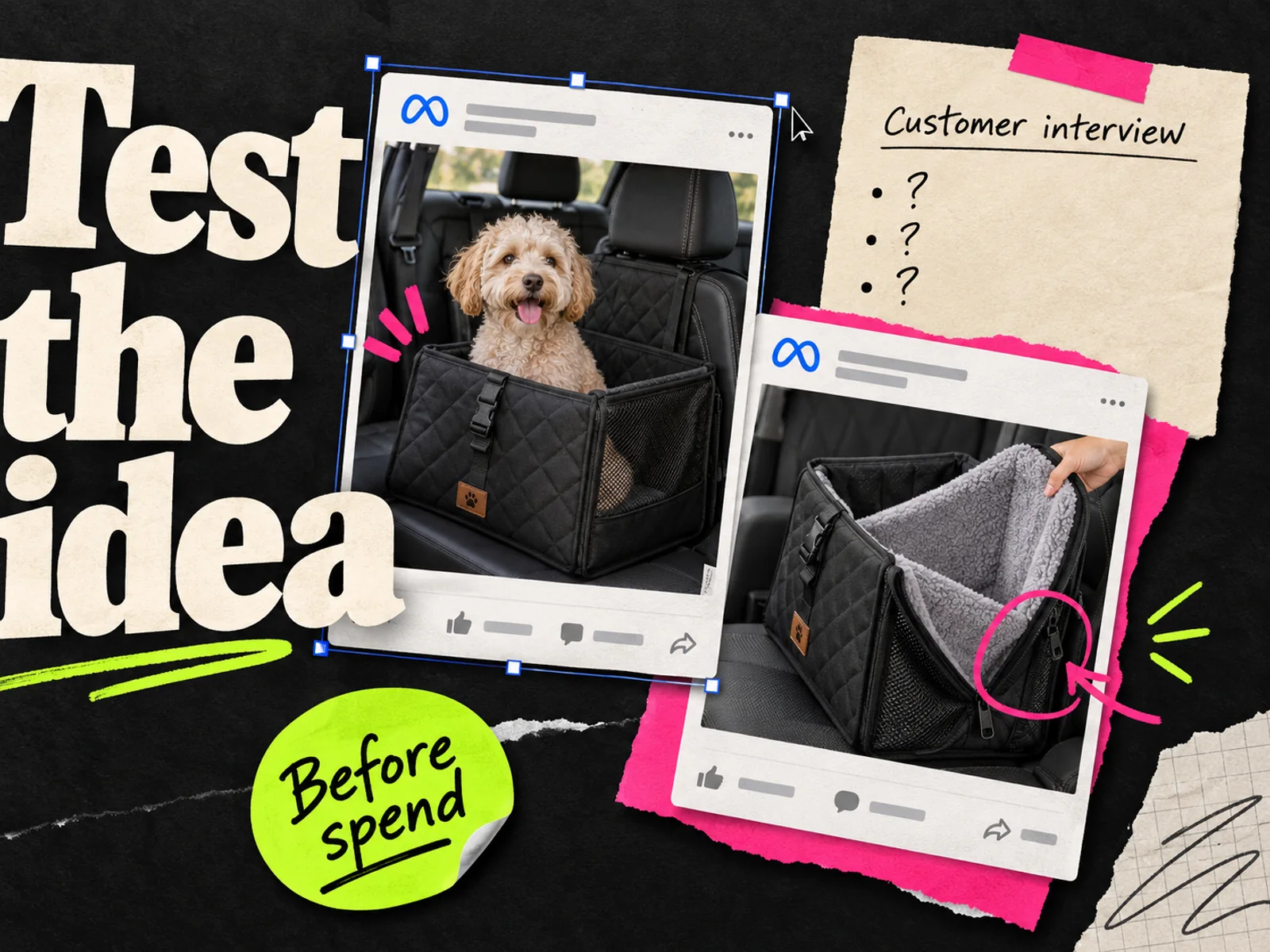
You have two ideas for a new ad. One shows how a pet carrier fits behind a car seat. The other leads with how quickly its liner can be cleaned. Which should the team make first?
An internal vote will tell you what your team likes. Ask potential buyers, and you may learn whether they understand either idea, believe the claim, or even care about the problem. That can improve a brief. It cannot name a sales winner.
The work here happens before production and media spend. If you already have finished ads, the creative testing guide covers the live test.
What ad testing in market research can answer
Prelaunch research is useful when the team is unsure about the message, the proof, or the way an idea reads at a glance. Show people rough but legible ad concepts and listen for what they understand without prompting.
It can answer questions such as:
- Which benefit do buyers notice first?
- What does the picture make them expect from the product?
- Which words or claims need evidence before they are used?
- What information is missing before someone would consider clicking?
It cannot tell you which ad will have the lower cost per acquisition. People responding to a mockup are in a different situation from people scrolling a feed and deciding whether to act. Treat stated preference as a clue about clarity and relevance, then make the performance decision with a live test.
Skip research for a minor color change. Use it when the answer could change the buying reason, the claim, or the asset you need to make. If both concepts say the same thing, sharpen the question before recruiting anyone.
Start with a decision, not a survey
Write the decision the research should support. For the carrier example:
We need to decide whether the first Meta static ad should explain car fit or easy cleaning. We have approved product photos for both. We do not yet know which problem buyers recognize sooner.
This is narrower than "Which ad do people like?" It also makes the next action visible. If car fit is interesting but the photo does not prove it, the team needs a better demonstration. If cleaning matters but the liner is hard to spot, the design needs work.
List the facts you can support before showing any concept. Confirm the product dimensions, the cleaning instructions, and what the approved images actually show. A respondent may repeat a claim from the ad even when that claim is wrong. That is a production error, not market validation.
The ad creative brief template gives those product facts and test boundaries a home once the direction is chosen.
Make concepts comparable without making them identical
Prepare one rough static for each buying reason. Use the same product, offer, brand treatment, and approximate level of finish. Change the message and the visual needed to explain it.
For example:
| Concept | Headline idea | Visual evidence | Question it should answer |
|---|---|---|---|
| Car fit | "Room for them. Space for you." | Carrier behind the actual car seat | Can I picture it in my car? |
| Easy cleaning | "The liner comes out." | Open carrier and removable liner | What happens after a messy trip? |
These are sample concepts, not claims about a real product. Replace them with your own verified details. If the liner is not removable, do not test a removable-liner ad.
Do not give one idea polished photography and the other a blank box with a headline. People will react to the difference in finish. Rough versions are fine if both give viewers enough to understand the promise.
Keep each image readable at phone size. If participants must zoom or hear a long explanation from the moderator, the concept is not ready to test. The Meta ad preview guide covers a separate check on finished placement previews before launch.
Ask for comprehension before preference
Show each concept on its own first. Rotate the order across participants if you can. Give them a moment to look, then ask open questions:
- 1.What is this ad offering?
- 2.What would you expect the product to do?
- 3.What, if anything, would you want to know before clicking?
- 4.Which part of the image or copy gave you that impression?
Only then put the concepts side by side and ask which feels more relevant to their situation, and why. A preference without a reason is difficult to turn into a brief. A specific misunderstanding is useful even when that person prefers the ad.
Do not ask, "Do you love that the liner is removable?" The question supplies the benefit. Ask what they noticed. If nobody mentions the liner, the team has learned something about the presentation.
Recruit people who resemble the intended buyer or face the situation the ad addresses. A colleague who already knows the product can catch a typo, but cannot give a clean first impression. Record who you asked and the limits of that group. A handful of conversations can reveal a confusing phrase; they cannot establish a population-wide preference or forecast a conversion rate.
Keep the evidence close to the decision
Use a short note for each participant: concept shown first, what they thought the ad meant, the questions they raised, and any direct wording worth keeping. Do not reduce everything to a thumbs-up count. Two people can choose the same concept for opposite reasons.
After the sessions, make a decision record:
| Observation | What it may mean | Next action |
|---|---|---|
| Buyers notice the carrier but miss the car-fit point | The visual may not show enough of the car | Reshoot the fit demonstration |
| People ask whether the liner can be washed | Cleaning could be a stronger angle, but the fact needs checking | Verify the care instructions before writing copy |
| Both ideas are understood, but people want size details | The destination or ad may need clearer dimensions | Add approved measurements and check the landing page |
Keep observation and interpretation in separate columns. "Three people asked about cleaning" is an observation. "Cleaning will win on Meta" is a prediction. The first can guide the next draft; the second still needs a live test.
Turn the research into one live question
Once the team has repaired confusing concepts, decide what is worth producing. An idea may drop out because its claim cannot be supported. People may raise a question the team had missed. Or both concepts may deserve a paid test.
Write the handoff in plain language:
Research found that people understood the cleaning idea but could not tell whether the liner was removable. We confirmed the product specification and made that action visible in the new image. The live test will compare cleaning with car fit while keeping the offer and destination the same.
The Meta ad testing backlog is where that question belongs. It keeps the research evidence, asset needs, and review rule attached to the idea. After launch, use the performance-to-next-test workflow to decide what the account data supports.
The concept with the warmest interview comments has not won a campaign. If you skip the live comparison, call it a production choice informed by research. That wording lets the team revisit the decision later.
Where Adrio fits
Adrio can help a Meta team collect ad references and turn a chosen angle into static creative for review. Use the research notes as the brief: product facts, the customer question, the claim that is approved, and the detail the image must show. Review the output against the actual product before exporting or launching it.
Adrio does not recruit respondents or run a market research study. Keep interview notes and consent in your research process, then carry only the relevant, approved learning into the creative brief. The swipe-file-to-brief guide shows how to use a reference without copying its claims or assets.
Common questions
Is ad concept research the same as A/B testing?
No. Concept research asks people how they understand rough ideas before launch. A live A/B test compares delivered ads and observed behavior under a defined setup. Both can help, but they answer different questions.
How many concepts should I show?
Show enough to answer a specific decision. Two genuinely different buying reasons are easier to discuss than a board of ten slight headline changes. If you have a larger backlog, narrow it using product evidence and the question each concept addresses before talking to buyers.
Can I use survey votes to pick a winning ad?
Use survey answers to spot confusion, missing proof, and language that resonates. A vote from people viewing mockups does not predict the result of a live Meta campaign. Note how respondents were recruited and what they saw before acting on the answers.
What if the research is inconclusive?
Write down what remains uncertain. Improve any obvious clarity problems, then either run a contained paid test or gather better evidence from the target buyers. An inconclusive screen is still useful if it stops the team from pretending an internal preference is a customer insight.