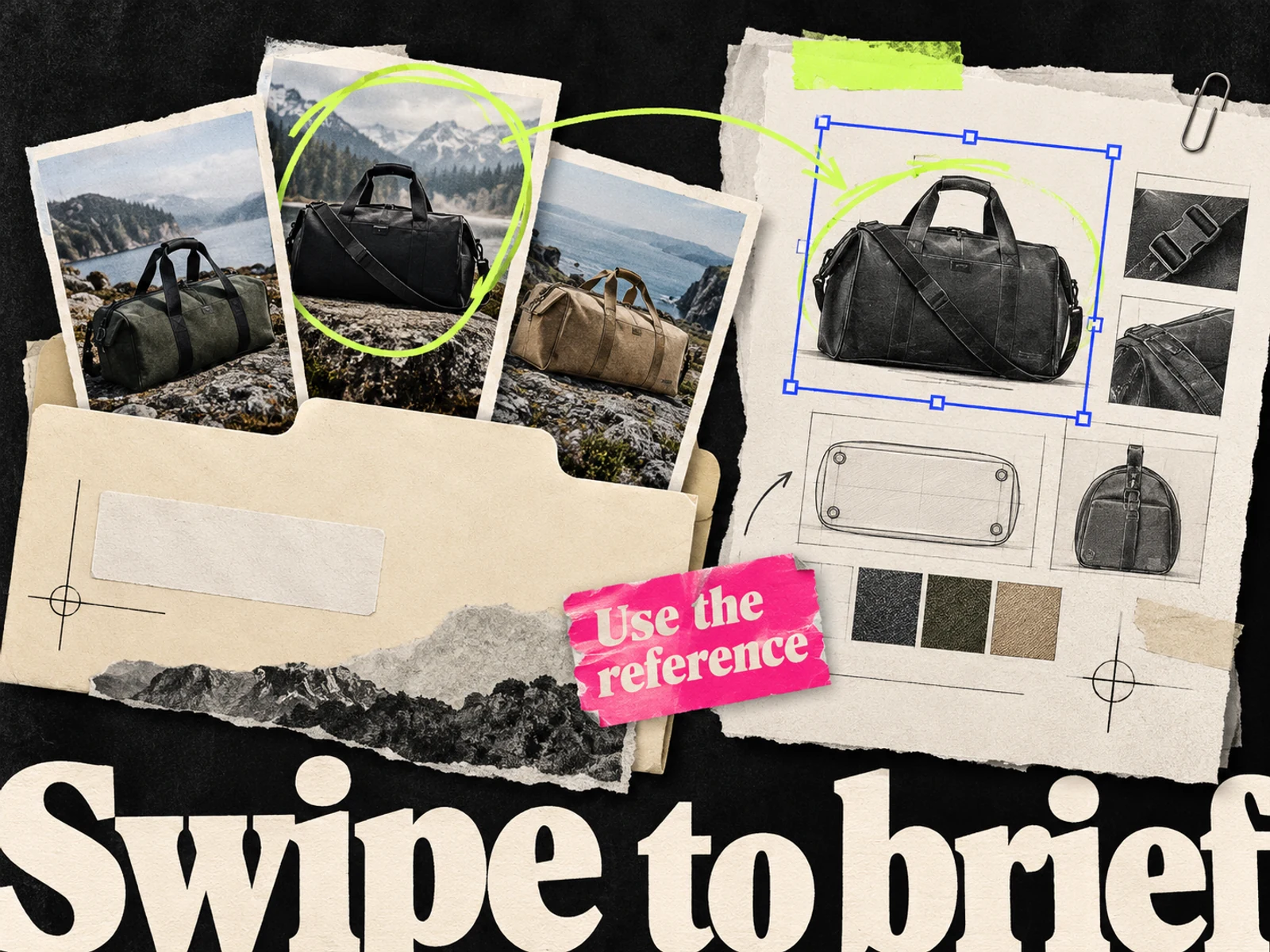
Turn a swipe file into a brief by choosing references for one testing question, recording what each ad actually shows, and translating the useful pattern into your own product and evidence. In Adrio, saved references can guide Spark's research and production. The brief should explain what to adapt, what to replace, and what the resulting test should teach you.
This guide covers the decision between saving an ad and commissioning creative. For the blank brief itself, use the creative brief template. For choosing a research tool, see Foreplay vs SwipeKit vs Adrio.
Why a board of good ads is not yet a brief
A reference can be attractive without being relevant. The price point, product, buying situation, or proof may differ from your brand. If the team sees only a screenshot, it must guess which part you want to use.
Start with an unfinished question. A travel bag brand might need to explain organization without making the ad look like a packing checklist. A reference showing product compartments could help with that problem; an unrelated promotional price card may not.
Choose two or three references that reveal useful approaches to the same problem. More examples can blur the direction and make the brief a collage of incompatible ideas.
Step 1: record the source and the observation
Keep the source URL, advertiser, observation date, and reason for saving. Distinguish what is visible from what you infer about its success.
| Record | Example for a travel-bag reference |
|---|---|
| Visible opening | A packed bag is opened to show separate compartments |
| Product treatment | Close-up with minimal background clutter |
| Message structure | A travel situation followed by a practical feature |
| Proof shown | The compartments holding recognizable objects |
| Adaptation question | Can our own bag demonstrate organization clearly? |
| Unknowns | Competitor CPA, audience, spend, and purchase performance |
An ad's active duration may justify looking more closely, but it does not establish profitability. Keep duration as an observation, not a label that converts the ad into a verified winner.
Step 2: identify the reusable pattern
Explain the reference in plain language. “Product detail removes a practical objection” is more useful than “make it premium.” “Show the organization before introducing the offer” gives the creator a sequence to work with.
Separate the concept from the execution. Organization is a buying reason. A close-up of the compartments is an execution. Reframing that close-up for a different aspect ratio is a placement adaptation.
Ask Spark to analyze the saved references without generating:
Compare these three references for our travel bag. Describe the visible hook, product treatment, proof, and CTA. Suggest the pattern relevant to our organization concept. Do not infer competitor sales or spend. Do not create assets yet.
Review the answer against the references. If the model attributes a performance result the reference does not establish, remove it from the brief.
Step 3: match the pattern to your own evidence
A competitor may show a feature your product does not have. Replace the feature and its proof with facts about your product, or choose a different reference.
For the bag example, use photographs of your actual compartments and approved dimensions. If the product cannot fit a claimed laptop size, do not retain that promise because it appears in an appealing reference.
The reference is direction for a new execution. Use your own approved assets, copy, offer, and evidence. If you need help making that distinction, review clone vs copy.
Step 4: write an executable brief
Give the creator the following decisions, not just the source images:
- 1.The product and variant to show.
- 2.The customer situation and buying reason.
- 3.The opening message and approved benefit.
- 4.The reference pattern to adapt.
- 5.Your own product assets and evidence.
- 6.The offer, CTA, destination, and intended placement.
- 7.What must remain fixed and what may vary.
For the travel bag, the brief could say: show the organization concept using the real interior photo; lead with the packing situation; retain the approved dimensions; keep the current price; and compare a product-close-up execution with a simple annotated layout.
That brief lets the reviewer tell whether the output followed the direction. “Make something like these ads” does not.
Step 5: ask Spark for the plan, then the asset
Use the selected ad in Spark and add your product context. Ask for the proposed direction before approving generation:
Use this reference's product-detail structure for our bag. Use our interior photo and approved dimensions. Propose the headline and composition first. Keep the offer unchanged and flag any missing input.
Confirm the plan and displayed generation cost. Spark can create static or video creative. Choose video when the pattern requires a sequence or demonstration, rather than adding movement to a message that is already clear as a still image.
Both image and video ads can be published directly to Meta with approval by default. Include the account, destination, and launch owner in the production plan, even when the brief begins with a saved reference.
Step 6: review against the brief
Compare the result with the brief, not the competitor's finished ad. Is the right product visible? Is the organization message understandable? Are the dimensions accurate? Did the offer remain fixed?
If the draft is off, request a specific correction. Keep approved elements in place so revision work does not erase the original testing question. Save the approved creative with its concept and source-reference record.
For video, inspect each scene and caption. A correct product in the first frame does not mean every generated scene retains it.
Step 7: retain the learning, not just the export
When the ad runs, connect the result to the concept and execution. A disappointing result does not prove that every product-detail reference is unusable. The message, audience, offer, and delivery all affect the observation.
Use the testing backlog to decide whether the next step is a revision, a different execution, a new concept, or more evidence. A growing swipe file is useful only when it helps the team make clearer decisions.
Frequently asked questions
How many references belong in a brief?
Use the fewest that explain the direction. Two or three complementary references can be clearer than a large board. Specify what each one contributes.
Can I label long-running competitor ads as winners?
You can record that they are long-running. Without verified performance data, you cannot establish their CPA or profitability from duration alone.
Can Spark make creative from a saved ad?
Yes. Use the reference in Spark with your product context and approved direction. Review the plan, generation cost, and finished asset.
What should the final brief hand back?
A clear product, buying reason, approved message, reference pattern, proof, offer, placement, and testing question. Use the brief template to capture those decisions.