A fashion catalog can contain 500 products, but the default ad may still look like the same product tile repeated 500 times. The feed solves distribution. It does not automatically solve art direction.
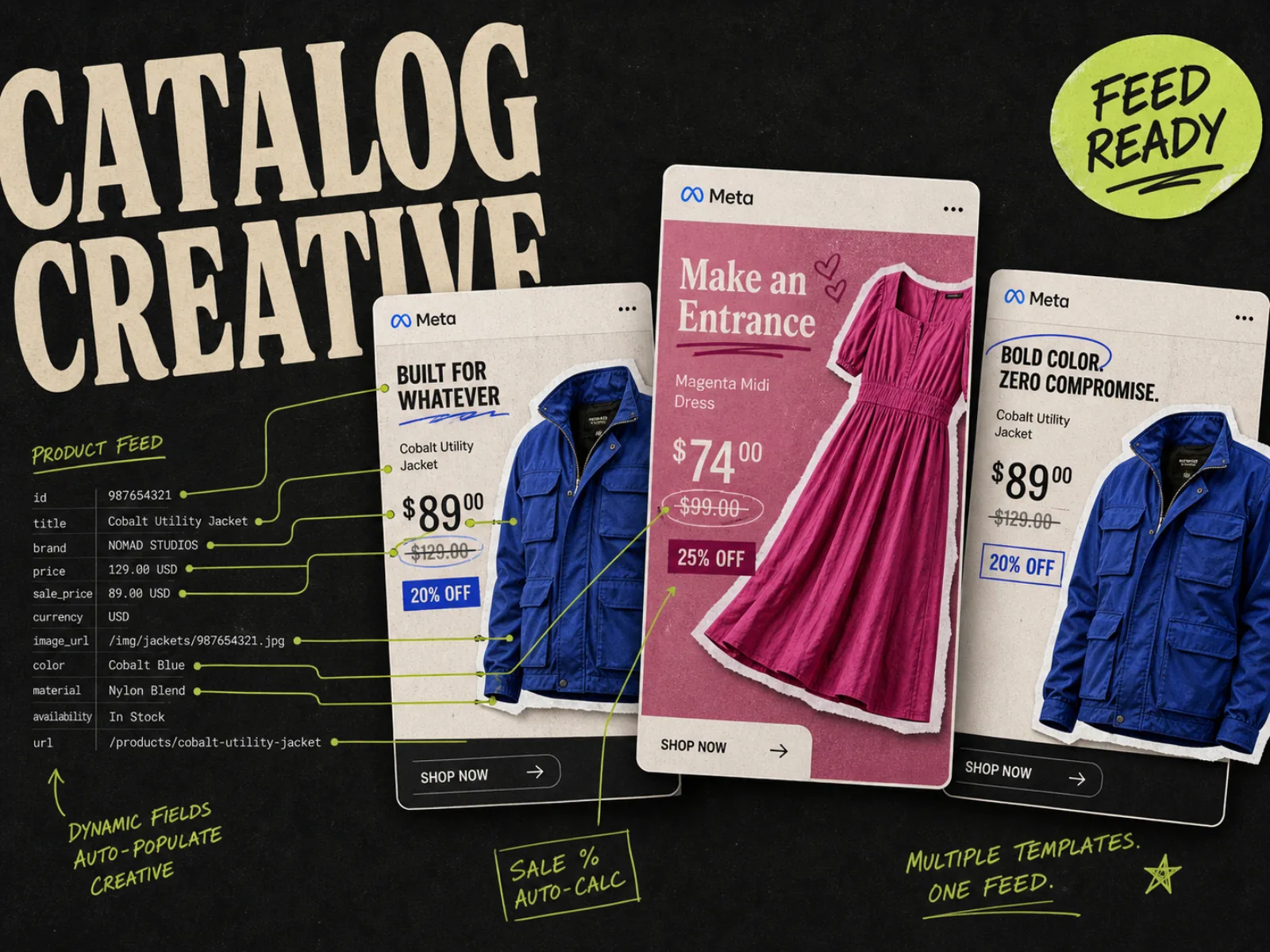
Catalog creative tools sit between the product feed and the ad platform. They pull fields such as image, price, sale price, color, stock status, and product name into a design template. One template can then produce a different ad for every SKU without asking a designer to rebuild each file.
This comparison is for brands already running Meta catalog campaigns, often called dynamic product ads or DPA. If you make a handful of concept-led static ads instead, a general AI ad creative tool is the better category.
The short answer
Marpipe is the broadest catalog-specific creative option in this group, with feed management, dynamic design rules, product-level video, SKU optimization, and creative testing. Confect is the most design-led choice for branded catalog ads. BigAtom is a focused option for live price, discount, urgency, and stock overlays. Hunch combines catalog creative with feed and campaign automation. Smartly is the enterprise pick when catalog production and media management need to span several channels.
| Tool | Best for | Useful fashion capability | Watch-out |
|---|---|---|---|
| Marpipe | Catalog creative and testing in one system | Conditional templates, multiple product images, product-level video | More system than a small catalog needs |
| Confect | Design control for branded catalog ads | Design rules, 9:16 layouts, video catalog ads | Worth it only when catalog creative affects meaningful spend |
| BigAtom | Offer and inventory overlays | Live price drops, discount, urgency, and stock messages | Narrower creative scope than a full production suite |
| Hunch | Feed, creative, and campaign automation | Dynamic templates, placement adaptation, catalog product video | Geared toward larger automation programs |
| Smartly | Enterprise, cross-channel catalog operations | Image and video templates with campaign management | Likely too heavy for a small DTC team |
There is no useful universal winner here. The right tool depends on whether your problem is design control, changing product data, video at SKU level, or managing catalog campaigns across markets.
What a catalog creative tool should handle
Meta describes Advantage+ catalog ads as a way to use a product catalog to scale creative and personalize which products people see. A specialist tool adds a controlled design layer on top of that feed.
For fashion, that layer needs to handle more than a logo frame. Check whether a tool can:
- read sale price, availability, color, category, and custom feed labels;
- show or hide an element when a feed condition changes;
- apply different templates to dresses, shoes, accessories, and sale products;
- keep portrait lifestyle shots and cutout product images framed properly;
- produce separate square, Feed, Stories, and Reels compositions;
- update creative when a price or stock field changes;
- preview many SKUs before anything reaches a live campaign;
- compare template performance without mixing unrelated product sets.
A weak feed will still produce weak ads. Missing sale prices, inconsistent image crops, and stale availability data should be fixed before the creative template gets blamed.
1. Marpipe: best all-round catalog creative system
Marpipe is the clearest fit when the team wants one catalog-specific workspace for design and testing. Its templates pull text, images, prices, descriptions, and other fields from a product feed. Conditional rules can switch a design by category, price tier, inventory status, or another feed attribute.
That matters in fashion because one layout rarely suits the whole range. A shoe photographed on white may need a different crop and proof treatment from a dress shown on a model. Sale products may need a price comparison, while new arrivals need a quieter frame that leaves more room for the product.
Marpipe also lists automatic background removal, placement adaptation, multiple product images, product-level video, SKU optimization, and feed management. Its creative-testing focus is the main reason to pick it over a simple overlay tool. You can build variations around one feed and learn whether price treatment, social proof, layout, or another element changes the result.
Marpipe makes sense when catalog creative is an ongoing testing program, not a one-time template job. A catalog small enough to manage with a few manually designed ads does not need this much machinery.
2. Confect: best for design-led catalog ads
Confect focuses squarely on making catalog ads look designed. It supports brand assets, multiple designs, design rules, native 9:16 layouts, and product-level video for Meta and TikTok.
The design-first approach fits fashion teams that care about how a collection reads, not just whether the current price appears. A brand can keep typography, color, spacing, and campaign art direction consistent while product data changes underneath. Rules can adapt the system to different products without making every SKU look as though it came from a separate campaign.
Confect is a sensible shortlist choice when the creative team wants direct control and the media team wants feed-scale output. It is less compelling if the only requirement is a small discount badge on otherwise acceptable catalog images.
Confect belongs on the shortlist when visual consistency and placement-specific design come first. If testing and feed operations matter as much as the canvas, compare it closely with Marpipe.
3. BigAtom: best for live offer and stock overlays
BigAtom takes a narrower, useful angle. Its catalog creative automation pulls price, discount, urgency, and stock data into visual overlays. The company lists examples such as price drops, limited stock, and deal messages, with templates that update as the feed changes.
This can solve a common fashion problem: the ad should say that a jacket is 30% off only while that sale price is real. Hard-coded promotional artwork goes stale. A feed rule can show the message for eligible products and remove it elsewhere.
The same logic applies to a new-arrival badge, low-stock treatment, or category-specific offer. The guardrail is important: urgency should reflect real inventory, not a permanent "only two left" graphic pasted across every SKU.
BigAtom fits a team that uses merchandising data as the creative hook and wants fewer manual updates. Deep layout testing, product video, or cross-channel campaign control call for a broader platform.
4. Hunch: best for catalog and campaign automation together
Hunch combines dynamic product creative with feed management, product insights, localization, and campaign automation. Its catalog workflow can connect a feed, map fields, build templates with dynamic data, and publish the resulting catalog into Meta. Hunch also supports Catalog Product Video and placement-specific catalog formats.
This is useful for fashion retailers operating across markets. Price, language, promotion, and inventory can vary by region, while the brand system needs to remain recognizable. A single template can pull the local fields rather than sending every regional change back through a manual production queue.
Hunch's Meta catalog documentation covers square and story artboards, dynamic media, and multiple templates. That makes it more than an overlay editor. It is an operating layer for a larger catalog program.
Hunch fits when creative automation sits inside a wider feed, localization, and campaign workflow. For one market and a modest SKU count, the setup may be more than you need.
5. Smartly: best for enterprise cross-channel operations
Smartly supports dynamic image and video templates for Meta, TikTok, Snapchat, and Pinterest. It pairs the creative layer with campaign launching, optimization, reporting, and cross-channel management.
The value is organizational. A global fashion retailer can use one platform to adapt catalog creative, maintain brand rules, and manage media across channels. That is a different buying decision from adding a design tool to one Meta account.
Smartly is the strongest fit here for enterprise teams with multiple markets, large budgets, and formal approval or reporting needs. Smaller brands should be careful not to buy an operations platform when their actual problem is one weak product-feed template.
Smartly earns a look when media and creative operations need to live together across channels. If the job is only Meta catalog design, start with a catalog specialist.
How to choose without sitting through five demos
Start with the failure in the current ads.
| Current problem | Capability to test first |
|---|---|
| Every product looks generic | Dynamic templates with full design control |
| Sale prices change faster than the creative team | Live feed fields and conditional overlays |
| Lifestyle and cutout images crop badly | Image rules, background removal, and SKU previews |
| Stories and Reels look like padded squares | Separate 9:16 artboards or placement adaptation |
| The team cannot tell which frame works | Template-level testing and reporting |
| Markets need different prices and languages | Localization and feed mapping |
| Static catalog ads miss video placements | Product-level video generated from the feed |
Ask each vendor to build a proof with your messiest 20 products, not a polished demo catalog. Include a sold-out SKU, a sale item, a product with a long title, two image styles, and at least one category that needs its own layout. Then preview the actual placement outputs.
A clean first catalog creative test
Do not launch five templates across the whole catalog and call the result a test. Start with one product set that has enough delivery and reasonably consistent margins.
Build a plain control plus two treatments:
- 1.a branded frame with no new claim;
- 2.a dynamic offer treatment using a real sale or price field.
Keep the product set, campaign setup, offer, and measurement window stable. If the tool supports a third treatment, test a genuinely different job, such as product-level video, after the first comparison has a readable result.
Judge the creative with click and conversion quality together. A large discount badge may raise CTR while attracting buyers who do not convert at the required margin. Catalog creative testing needs the same discipline as any other Meta creative test.
Where Adrio fits
Adrio is not a product-feed or DPA automation platform. It makes editable, concept-led static Meta ads from product inputs, competitor research, and creative angles. That is useful beside catalog ads, not as a replacement for the tools above.
A fashion account might use catalog automation for always-on SKU coverage, then use Adrio for collection launches, founder messages, comparisons, reviews, and other ads where the idea matters more than the feed row. Those statics should still be built for the correct Meta ad sizes.
Use a catalog creative tool when one system needs to render hundreds or thousands of product-specific ads. For a smaller set built around different hooks, arguments, and layouts, use a concept-led tool.
FAQ
What is a Meta catalog ad creative tool?
It is software that combines a product feed with design templates. Product images, prices, sale data, inventory, and other fields can be rendered into on-brand catalog ads without designing every SKU by hand.
Are dynamic product ads and catalog ads the same thing?
The terms overlap. Dynamic product ads, often shortened to DPA, is the older industry label. Meta now uses names such as Advantage+ catalog ads for campaigns that use a catalog to personalize product delivery.
Which catalog creative tool is best for fashion brands?
Marpipe is the broadest catalog-specific option in this comparison. Confect is a strong design-led choice, BigAtom suits live merchandising overlays, Hunch combines catalog and campaign automation, and Smartly fits enterprise cross-channel teams.
Can these tools add live prices and discount badges?
Yes, when the required fields exist in the feed and the tool supports dynamic or conditional elements. Check how often the feed and rendered creative update, and test what happens when a sale ends or a product goes out of stock.
Do small fashion brands need catalog creative software?
Not always. If the brand has a small range and does not rely on catalog campaigns, manually designed static ads may be faster and easier to control. Catalog software earns its place when SKU count, feed changes, placement volume, or market count makes manual production impractical.