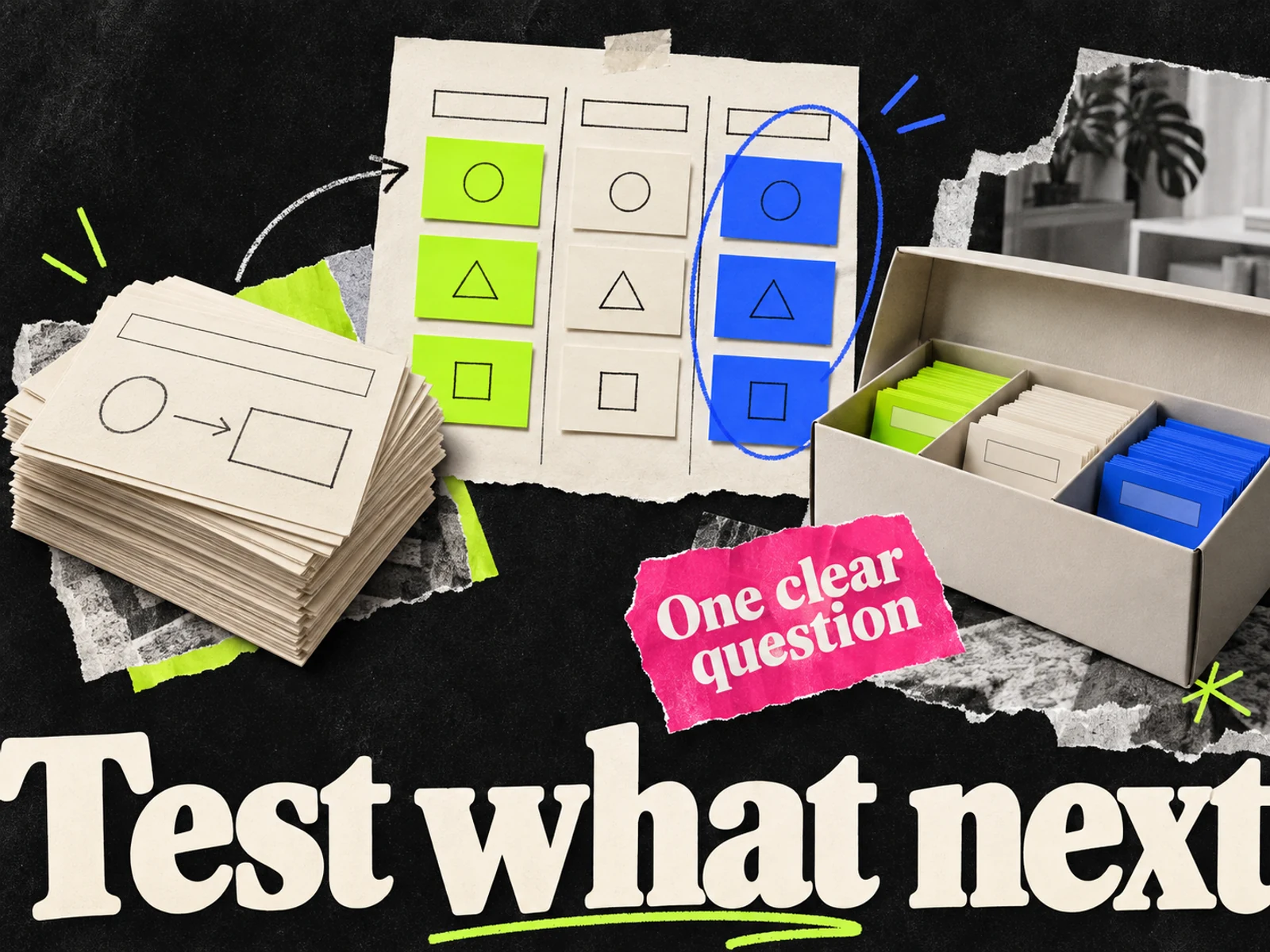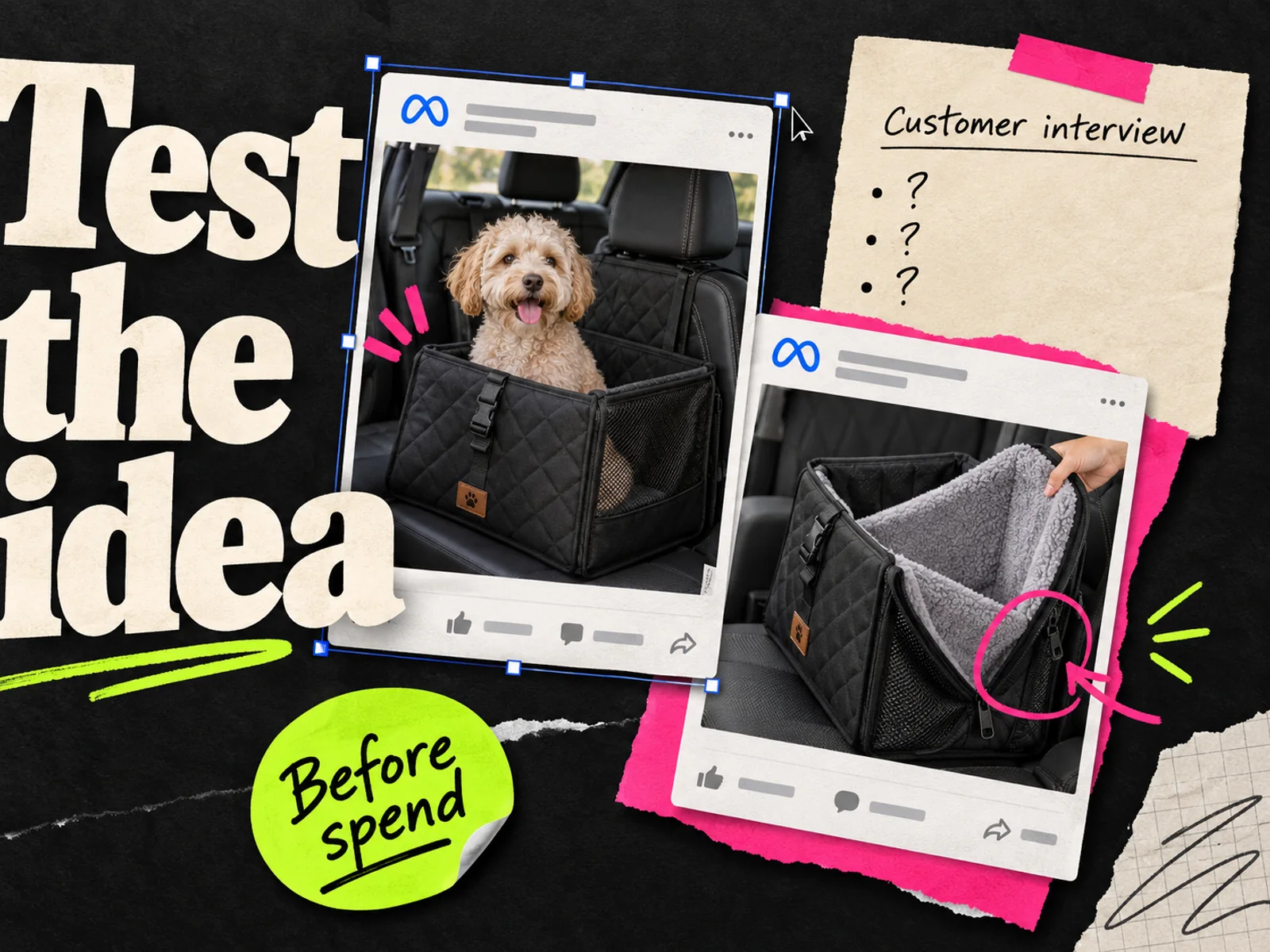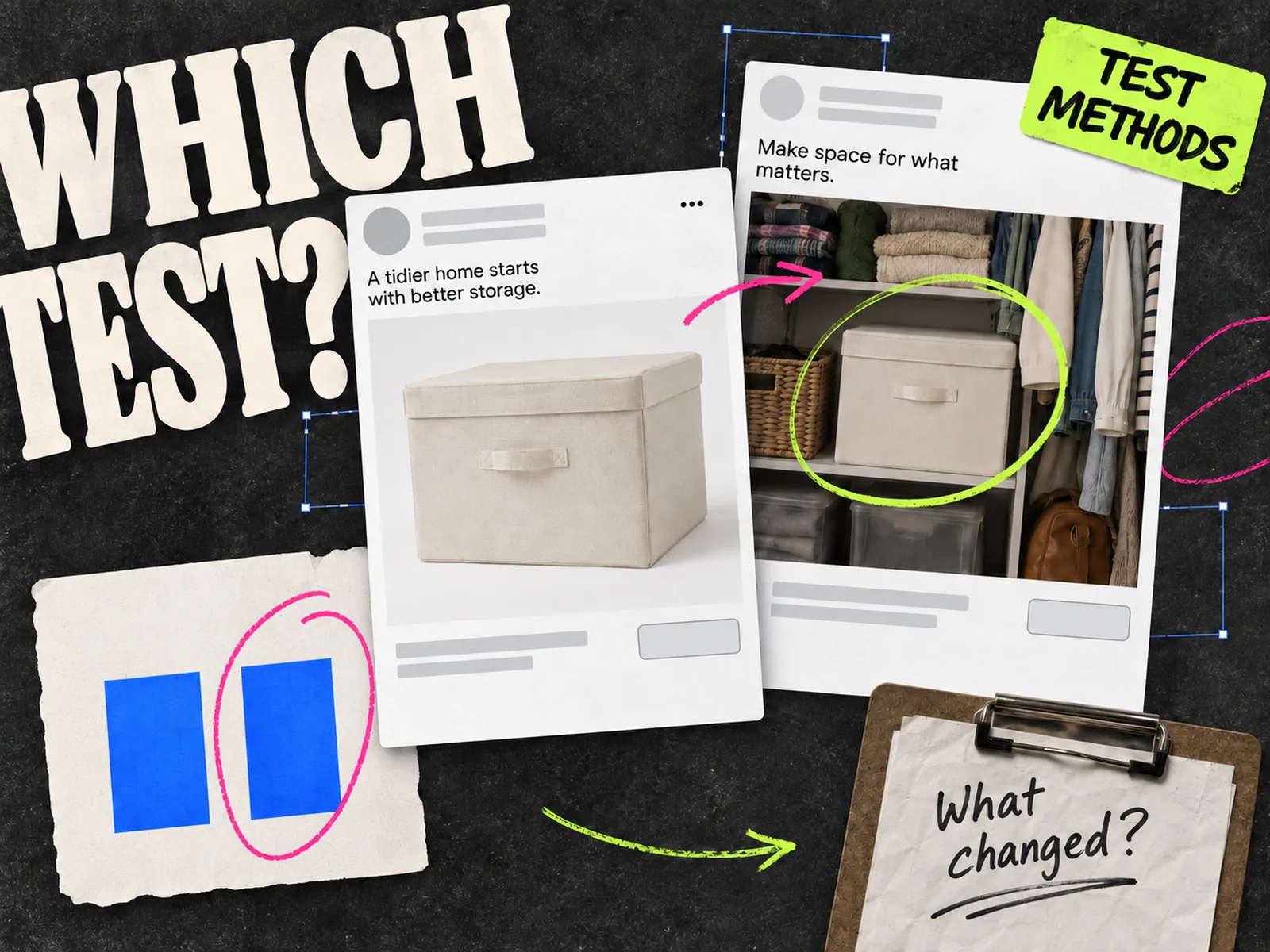
Someone says, "Let's test the ads." The designer wants to know whether buyers understand the offer. The media buyer wants to compare two images. The founder wants to know whether the campaign brought in sales that would not have happened anyway. They need different tests.
Below is a way to choose an ad testing method for a Meta campaign. If you need the basic creative-testing process first, start with what creative testing means.
Pick the method from the decision
| Question | Method | What it can tell you | Main limit |
|---|---|---|---|
| Do people understand the idea before we spend? | Concept screen with target buyers | Whether the message is clear and credible | Stated reactions do not predict campaign results |
| Did changing this one element improve the outcome? | Controlled A/B test | The difference between two defined versions under the test conditions | Requires enough delivery for the outcome you care about |
| Which concepts deserve more work? | Live creative comparison | How a small batch behaves in a real campaign | Uneven delivery makes a casual ranking hard to interpret |
| Did the advertising cause an incremental result? | Lift test | Difference against a holdout group | More setup and enough scale to read the result |
Start by deciding whether you need an answer before launch or from paid delivery. A concept screen can catch a confusing promise early. It cannot name a winning Meta ad. A live test measures response, though it is an expensive way to discover that customers misunderstood the offer.
Concept screening: find confusion before production
Show a rough concept to people who resemble your buyer. Ask what they think the product is, who it is for, and what the ad promises. Ask those questions before asking which version they prefer. Preference is easy to collect; comprehension is more useful when a campaign is still a sketch.
For example, a storage brand has two possible messages: "fit more in a small closet" and "set up without tools." Show each with the same level of finish. If viewers mistake the second for a permanent renovation, the team has learned something worth fixing before making a polished ad.
Record the wording people used and the confusion you observed. Do not turn a small interview group into a percentage claim about the market. Our ad testing in market research guide covers how to run this kind of screen and carry its findings into a live question.
Controlled A/B testing: isolate one change
Use a controlled A/B test when the decision concerns one defined difference. Keep the product, offer, destination, and primary outcome the same. Change the element you want to learn about: for instance, a product demonstration image versus a product-on-white image. Set the review outcome before launch, then compare the two versions under the test conditions.
Meta's creative-testing training covers A/B tests alongside lift tests. Meta's experiment-analysis example also describes creative tests with separate cells and a single ad in each cell. The point is the separation: if you change the image, headline, offer, and landing page together, you have compared two packages. You have not identified which element caused the difference.
Write the result in the same narrow terms as the test. "The demonstration version produced a lower cost per purchase in this test" is a defensible observation if purchase tracking and delivery support it. "People love demonstrations" is a story the test did not establish.
Even when you plan one creative change, the delivery system can reach a different mix of people in each test cell. Research on Meta experiments found this divergence in A/B tests. Treat the result as a comparison of the versions under Meta delivery, not a universal verdict on the image itself.
Before choosing how many variants to fund, use the Meta creative test volume guide. There is no useful universal spend or day count: your conversion frequency, budget, and the size of the difference matter.
Live creative comparisons: explore several ideas
Sometimes you do not know which single variable to isolate. You have three different buying reasons, each expressed in a finished ad, and want to see which is worth developing. Put the concepts into a small live batch and give each a name tied to its idea: space saved, quick setup, or room-specific use.
This is exploration. Under ordinary campaign delivery, Meta may give the ads different amounts of exposure and show them to different mixes of people. An ad with little delivery has not had a fair chance to lose. A strong click response may also fail to produce the outcome the business needs. Read spend, impressions, clicks, and the chosen conversion outcome together, with the campaign conditions attached.
If one concept earns enough evidence to justify a closer look, make the next test narrower. Try two executions of that concept while keeping the offer fixed. The ad testing backlog gives you a place to record the question, evidence, and next decision; the performance-to-next-test guide covers the handoff after a campaign read.
Do not call this a randomized A/B test just because two ads were live at once. That label promises more control than the setup supplied.
Lift tests: ask whether the ads caused a result
A lift test compares people eligible to see advertising with a holdout group. It asks about incremental effect: what happened because of the ads, beyond what might have happened anyway. Meta Blueprint teaches lift tests as a separate way to measure creative impact, and Meta's experiment documentation lists lift studies separately from split tests.
Use this method when the business decision is large enough to justify the setup and the account can supply enough signal. It is a poor shortcut for choosing between two headlines in a small batch. Also decide what outcome matters before the test. A lift result about one outcome does not automatically settle a different one.
If you cannot run a credible holdout, say what your available evidence actually shows. A campaign report can tell you about attributed results under its reporting settings. It cannot, on its own, prove the increment those ads created.
Write a decision record before the next test
Take one unanswered question from your account. Write it as a decision someone must make, not as "see what performs."
- 1.Name the decision: approve a message, choose between two executions, select a concept for further work, or assess incremental impact.
- 2.Choose the method that can answer it. If the team cannot fund or set up that method, narrow the question rather than pretending a weaker test proves the same thing.
- 3.Record the fixed conditions: product, offer, destination, audience definition, dates, and conversion event where relevant.
- 4.Decide what would count as useful evidence and what would make the result inconclusive.
- 5.Save the observation and the next action together. Leave a blank where the data is missing.
For production, Adrio's Spark can make static or video concepts from an approved direction. Review the output before launch. Give it a creative brief that states the question and the facts the ad may use. The team running the account chooses the test method and the decision rule.
If you cannot say what you will do with either result, rewrite the question before spending on the test.