The official Meta Ad Library API is the sanctioned way to pull ad data from Meta, and for some jobs it is the right one. For everyone else it tends to disappoint. Access has real friction, the fullest data is scoped to a narrow slice of ads, and the response is often thinner than what you can see in the browser.
If you searched for an ad library data provider, decide what output you need before comparing vendors. A browsable database, an API response, a scheduled scrape, and an answer inside Claude are four different products. The list below separates them instead of pretending they are interchangeable.
This page ranks the alternatives by the job you are actually trying to do, not by which one has the biggest logo. If you only need a better browsing interface rather than programmatic access, see the best Facebook Ads Library alternatives instead. That page is about UI tools. This one is about getting the data into your stack.
Best Meta Ad Library API alternatives: quick answer
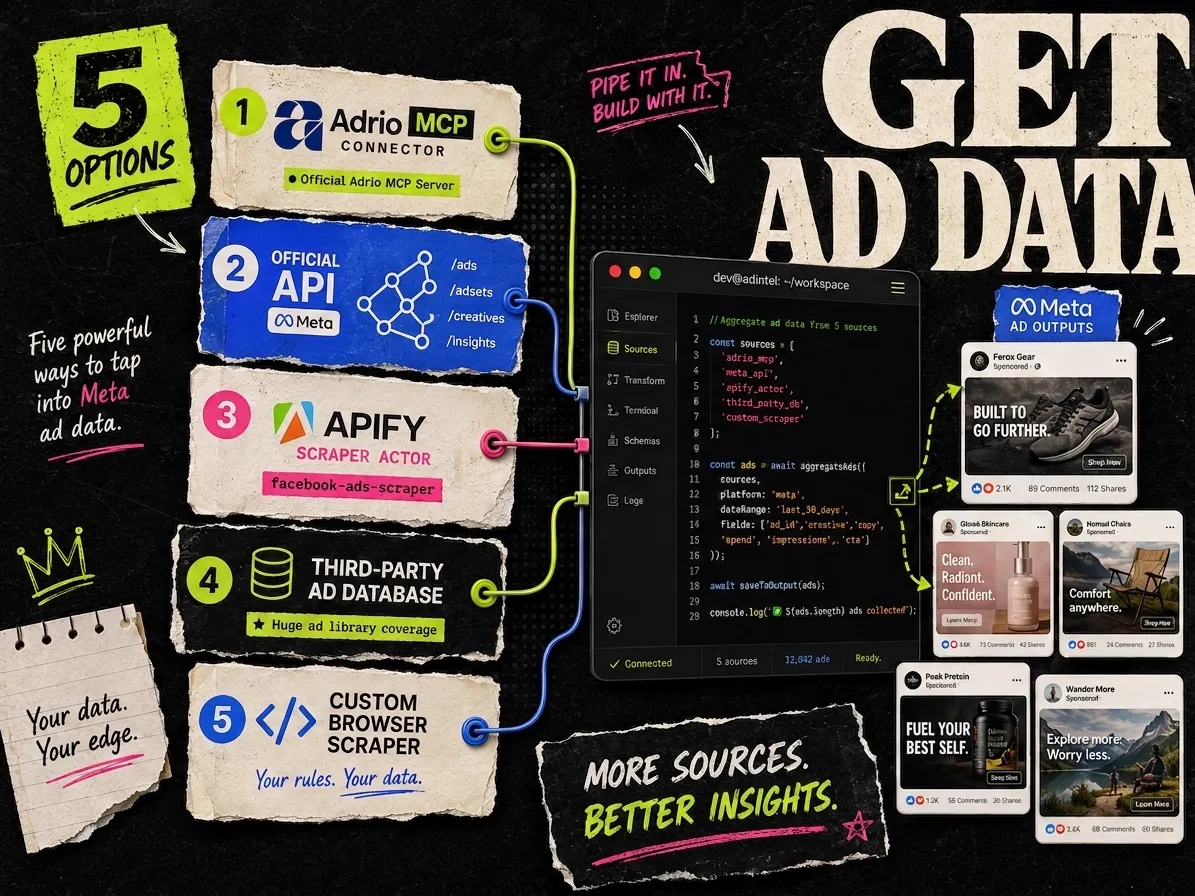
Adrio is the best Meta Ad Library API alternative when you want to query ad research from an LLM, because its MCP server lets Claude or ChatGPT pull ad data and analysis directly. The official Meta Ad Library API is still the right answer when you need Meta-sanctioned political and issue-ad data for compliance. Apify is best for flexible scraping you control. Third-party ad intel tools are best when you want enriched, cross-platform data without building anything. A custom scraper is best when you need total control and accept the maintenance.
| Tool | Access method | Best for |
|---|---|---|
| Adrio | UI, MCP server | LLM-native ad research and creative generation |
| Meta Ad Library API | Official API | Sanctioned political and issue-ad data |
| Apify | API, scraper actors | Flexible, self-directed scraping |
| Third-party ad intel tools | UI, some export or API | Enriched cross-platform ad data |
| Custom scraper | Your own code | Full control over fields and cadence |
Why the official Meta Ad Library API frustrates people
The complaints cluster around a few themes. Access is gated behind approval steps and identity checks, which slows down anyone who just wants to prototype. The richest, most complete data, with spend ranges, impressions, and demographic breakdowns, is available for political and issue ads, while commercial ads return a much thinner record. Coverage rules also differ by region, with the European Union getting broader visibility into all ads than most other markets. On top of that, developers routinely find the returned fields lighter than expected, so the creative detail and engagement signal they wanted is not there to query.
None of this makes the API useless. It makes it a poor fit for the common job: I want to programmatically research commercial ad creative and feed it into an app or a model. Here are the tools that fit that job better, ranked by how you plan to use the data.
1. Adrio - best for LLM-native programmatic access
Adrio approaches the problem from a different direction than a raw data feed. Instead of handing you a JSON dump to parse, it exposes ad research through an MCP server, so an LLM like Claude or ChatGPT can query it directly in a conversation or an agent workflow.
That matters if your real goal is analysis rather than storage. You can ask questions in natural language, and the model pulls the relevant ad data and reasoning back through the connection. Adrio also runs its own competitor ad library, breaking ads into primitives like angle, hook, format, offer, CTA, and layout, then generating editable Meta static creative from what it finds. So the same tool that answers a research question can produce the next batch of ads to test.
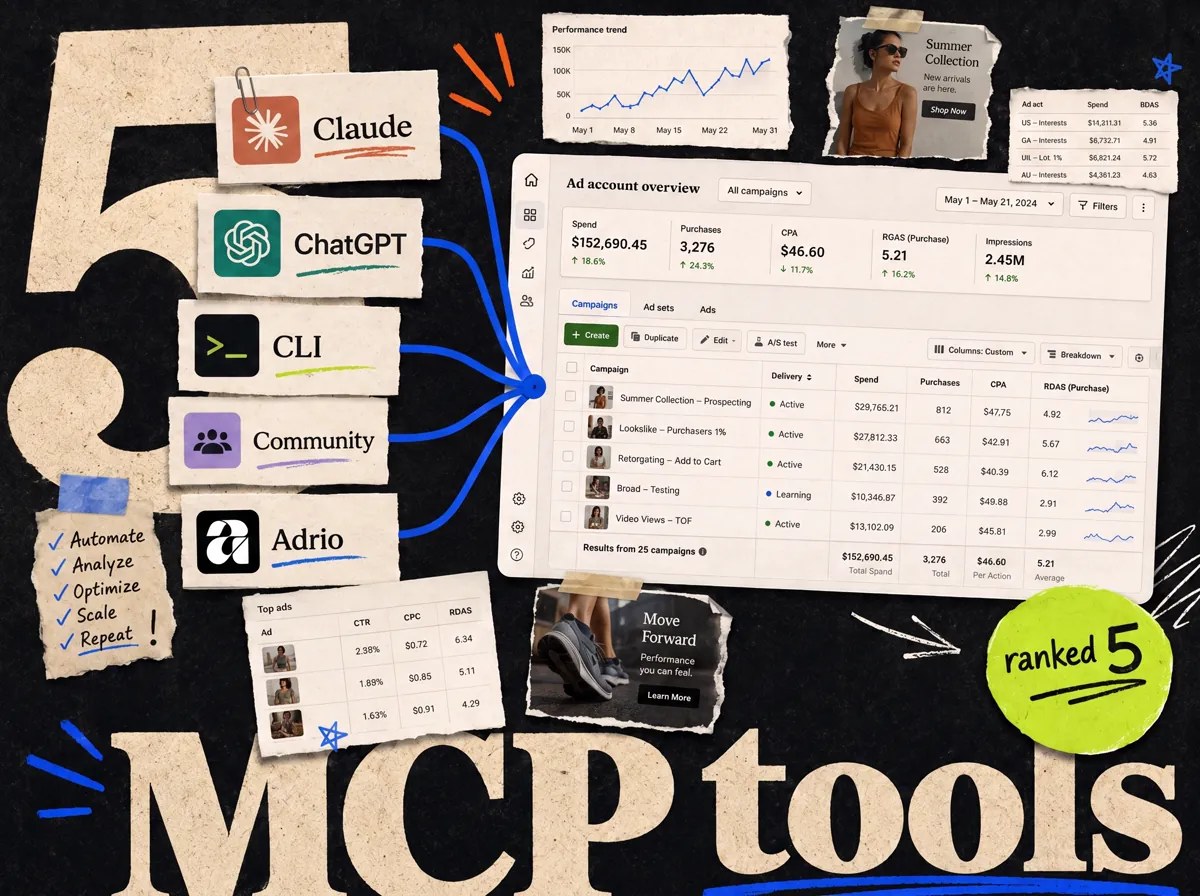
For setup, see the Meta Ads MCP setup guide. For how it compares to other connections, see the best Meta Ads MCP tools.
The catch: Adrio is built around Meta ad research and static creative, not a generic firehose of every ad field across every platform.
Best for: teams who want to research ads and generate creative from inside an LLM.
2. Meta Ad Library API - best when it is the sanctioned source
The official API earns its place for one clear job. If you need data that Meta itself vouches for, especially for political and issue advertising, this is the source of record. Academic researchers, journalists, and compliance teams who must cite an authoritative origin should start here.
It is also free, which matters for budget-limited projects that can live within its scope and access rules.
The catch: the approval friction, the region-dependent coverage, and the thinner data for commercial ads are the reasons this whole page exists. Use it when provenance beats convenience.
Best for: political ad transparency, academic research, and compliance work.
3. Apify - best for flexible scraping you control
Apify hosts a marketplace of prebuilt scrapers, called actors, including ones aimed at the Facebook and Meta ad libraries. You run them through an API, get structured output back, and schedule them as often as you need.
This is the practical middle ground between the official API and building everything yourself. You skip the work of writing and maintaining scraping logic, but you keep control over what you collect and how often. For a SaaS builder who needs ad data in a pipeline without a research team, it is a reasonable place to start.
The catch: scraping sits in a grayer zone than an official API, so review the terms and legal exposure for your use case. Actor behavior can also break when the source page changes, so expect some maintenance.
Best for: developers who want structured ad data on a schedule without writing scrapers.
4. Third-party ad intelligence tools - best for enriched data without building
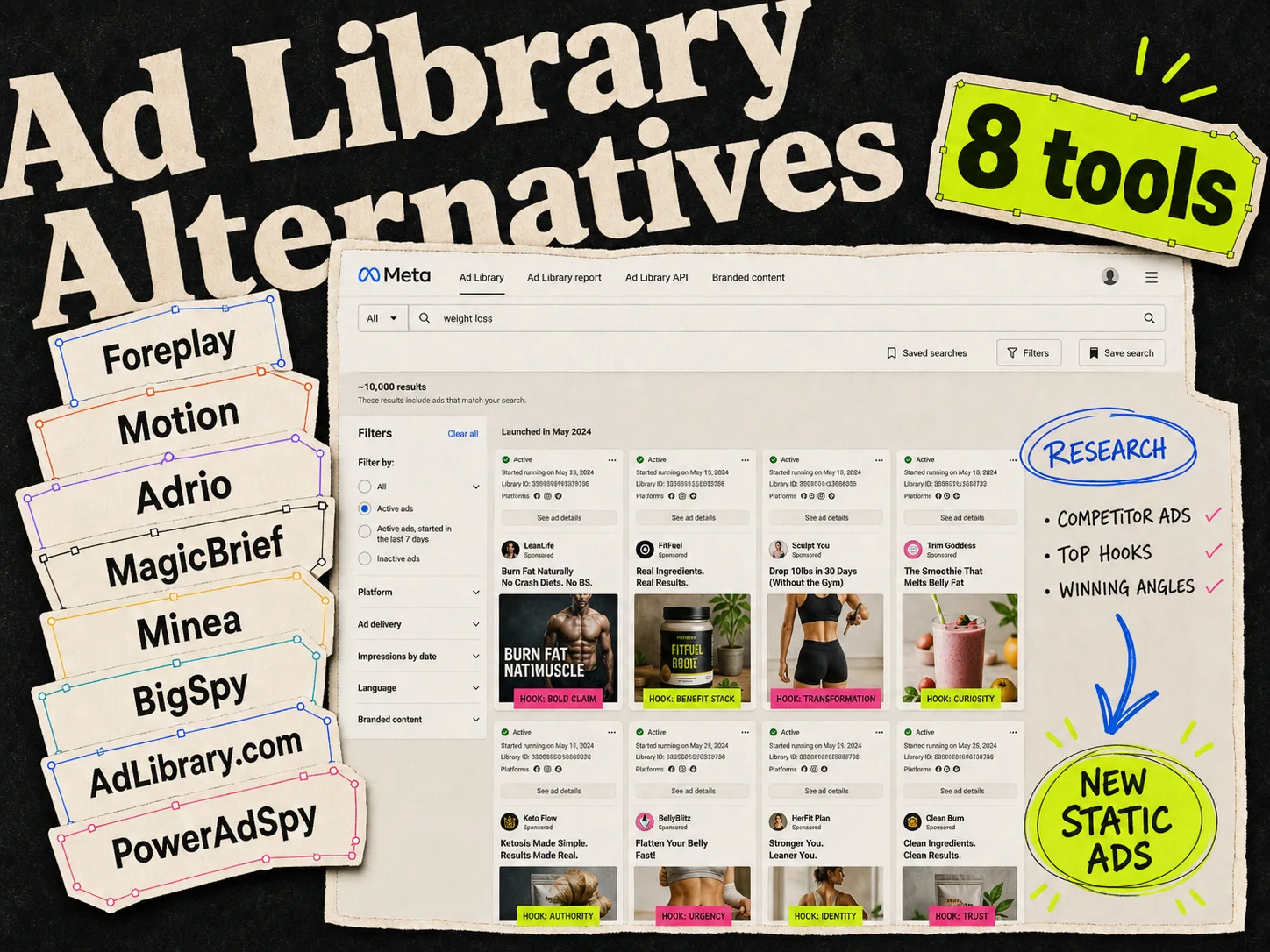
Tools like Foreplay, BigSpy, and Minea maintain their own large ad databases across Meta and other platforms, with tracking, filtering, and tagging layered on top. Their main surface is a UI, though several offer some form of export or integration for getting data out.
Reach for this group when you want enriched, cross-platform ad data and you would rather buy coverage than build it. The value is in the aggregation and the extra signal, like longevity and cross-platform presence, that the raw official API does not give you. For the UI-first breakdown of these tools, see the best Facebook Ads Library alternatives.
The catch: these are built for browsing first. Confirm what programmatic access each one actually offers before you plan a pipeline around it, since it varies by tool and plan.
Best for: researchers who want enriched, ready-made ad data across platforms.
5. Custom scraper - best for full control
If none of the above gives you exactly the fields, cadence, or coverage you need, you can build a scraper against the public ad library yourself. This is the maximum-control option: you decide every field, every source page, and every schedule.
It fits teams with engineering capacity and a specific requirement that off-the-shelf tools miss. It is the wrong choice if you want to move fast or avoid ongoing upkeep.
The catch: you own everything, including breakage when the source changes, rate limiting, and the legal review of scraping a platform you do not control. Most teams underestimate the maintenance.
Best for: engineering teams with a precise, unusual data requirement.
Which Meta Ad Library API alternative should you pick?
| If your job is... | Pick |
|---|---|
| Query ad research from an LLM | Adrio |
| Cite Meta-sanctioned political ad data | Meta Ad Library API |
| Scrape structured ad data on a schedule | Apify |
| Buy enriched cross-platform ad data | Third-party ad intel tools |
| Control every field and cadence yourself | Custom scraper |
Most teams do not need a single tool. A common setup is the official API for anything that must be Meta-approved, Adrio when the research happens inside an LLM or feeds creative generation, and a scraper or data provider for the raw volume in between. Start from the job, not the feature list.
FAQ
Does Meta Ad Library have an official API?
Yes. Meta provides an official Ad Library API, but access is gated behind approval and identity checks, and the fullest data, including spend and impression ranges, is available for political and issue ads rather than commercial ones. Coverage also differs by region. That scope is why many developers look for alternatives for commercial ad research.
What are the best alternatives to Meta Ad Library for SaaS research?
For SaaS research, the best alternatives depend on how you want to use the data. Adrio is strong when you want to query ad research from an LLM through its MCP server and generate creative from what you find. Apify works for scraping structured data into a pipeline, and third-party ad intel tools like Foreplay, BigSpy, and Minea offer enriched, cross-platform databases.
How do I get ad library data programmatically?
You have a few paths. The official Meta Ad Library API returns sanctioned data within its scope and access rules. Apify actors scrape structured ad data you can pull through an API. Adrio exposes ad research through an MCP server so an LLM can query it directly. A custom scraper gives full control at the cost of maintenance.
Is the Meta Ad Library API free?
Yes, the official Meta Ad Library API is free to use once you complete Meta's access and identity requirements. The tradeoffs are the approval friction, the region-dependent coverage, and the thinner data returned for commercial ads compared with political and issue ads.
Can I access Meta ad data from Claude or ChatGPT?
Yes. Adrio's MCP server lets Claude or ChatGPT query ad research directly, so you can ask about competitor ads and angles in a normal conversation and get answers back through the connection. See the Meta Ads MCP setup guide to connect it.
Is scraping the Meta Ad Library allowed?
Scraping sits in a grayer legal zone than using the official API, and the rules depend on your jurisdiction and use case. Review Meta's terms and get legal input before you build a pipeline on scraped data. The official API is the safest route when provenance and compliance matter.
What is the difference between the Meta Ad Library API and a browsing tool?
The API returns data for code to consume, within Meta's scope and access rules. A browsing tool gives you a searchable interface for humans. If you only need a better place to look through ads, a UI tool from the best Facebook Ads Library alternatives fits better than an API.