AdCreative.ai generates batches of scored ad variations, which is useful when you want volume fast. People look for alternatives for a few common reasons: the pricing does not fit, the output feels generic, or they want a tool built more tightly around one job instead of a broad suite. The best replacement depends on which of those is your problem.
Best AdCreative.ai alternatives: quick answer
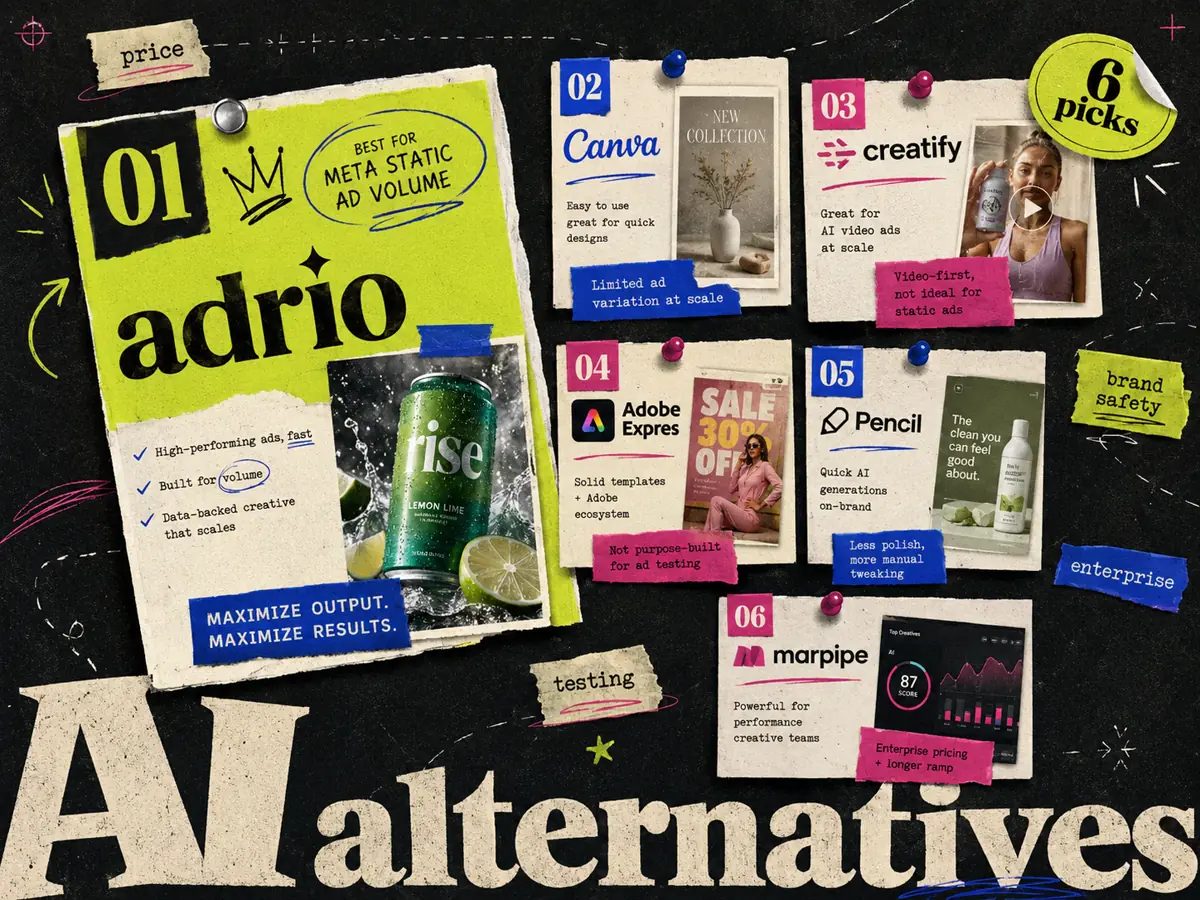
Adrio is the best AdCreative.ai alternative for high-volume Meta static testing because it turns competitor-informed structures into editable, on-brand variants. Canva is best for non-designers, Creatify for AI video and UGC, Adobe Express for brand-safe AI, Pencil for enterprise creative operations, and Marpipe if what you liked about AdCreative was testing many variations.
| Tool | Best for | Trade-off |
|---|---|---|
| Adrio | High-volume Meta static testing | Static and video creation; direct Meta publishing for both |
| Canva | Non-designers and quick edits | General tool, not built for ad testing |
| Creatify | AI video and UGC-style ads | Video focus, not static batches |
| Adobe Express | Brand-safe AI and Adobe workflows | Heavier than a simple ad tool |
| Pencil | Enterprise creative operations | Broad marketing platform; self-serve plans have generation caps |
| Marpipe | Multivariate creative testing | Needs budget and volume to pay off |
Why look past AdCreative.ai
AdCreative.ai does one thing well: it produces a lot of scored options quickly. The friction shows up in three places. The scores are predictions, not results, so they can point you at the wrong variant. The output can look templated once you have seen enough of it. And the pricing scales in a way that surprises smaller teams. None of that makes it a bad tool. It just means a more focused option often fits better once you know your bottleneck.
1. Adrio - best for high-volume Meta static testing
Adrio is built for producing Meta static ads at testing speed. It studies competitor ads, breaks them into angle, hook, format, offer, and layout, then generates editable variants that fit your product and brand. The output is sized for feed, Stories, and Reels, with editable image, copy, logo, colors, and CTA.
Where it differs from AdCreative.ai is the starting point. Instead of scoring generic variations, it adapts structures that already work in the market to your own assets. That tends to produce ads that look like you rather than like a template. For a direct feature comparison, see Adrio vs AdCreative.ai.
Adrio also creates video ads through Spark, including scripts, clips, captions, and scene revisions. Both image and video ads can be published directly to Meta with approval by default. This section focuses on the static-production workflow.
Best for: media buyers and DTC teams running steady static tests.
2. Canva - best for non-designers
Canva is the easiest place to start. Templates, drag-and-drop, and a large asset library let anyone make a clean static ad, and its AI tools speed up backgrounds and copy. For simple ads and quick resizing, it does the job without a learning curve.
Where it gets thin is structured testing. A template library does not force the distinct hooks and angles a real test needs, so you can end up with variations that look different but say the same thing. See our best Canva alternatives for Meta ads for more on that gap.
The catch: Canva is a general design platform, not a paid-social testing workflow.
Best for: non-designers and small teams making ads occasionally.
3. Creatify - best for AI video and UGC
If the reason you want an AdCreative.ai alternative is video, Creatify is the closer fit. It generates AI video and UGC-style ads from a product URL, with AI avatars and scripts, which is a different job from static batches.
It is a good pick when your testing leans on short video and creator-style hooks. It is less relevant if your pipeline is mostly static feed ads. See Adrio vs Creatify for where each one lands.
The catch: the video focus means it is not built for producing static variations at volume.
Best for: teams testing AI video and UGC-style creative.
4. Adobe Express - best for brand-safe AI
Adobe Express pairs quick social templates with AI trained for commercial use, plus a clean path into the wider Adobe ecosystem. For brands that care about licensed, brand-safe AI assets, that matters more than raw speed.
It sits between Canva's ease and a design tool's control, with stronger brand governance than most lightweight ad makers.
The catch: it can feel heavier than a simple ad generator if all you need is fast static variants.
Best for: brand teams that value commercially safe AI and Adobe workflows.
5. Pencil - best for enterprise creative operations
Pencil targets larger teams and agencies that need governance, approvals, and AI creative production across many brands or accounts. If you were pushing AdCreative.ai to run creative ops at scale and hitting its limits, Pencil is built for that.
Pencil also has self-serve plans (Core starts at $14/month for 50 generations as of October 2026), so small teams can try it. The product now spans text, image, video, and team-wide orchestration, which can be more than a team shipping only Meta statics needs.
The catch: the breadth is aimed at multi-team creative operations. See our Pencil AI alternatives if you are weighing it against narrower tools.
Best for: large agencies and brands with formal creative operations.
6. Marpipe - best for multivariate testing
If the thing you liked about AdCreative.ai was generating many variations to test, Marpipe does that job more rigorously. It is built around multivariate testing, measuring combinations of images, headlines, and CTAs so you learn which element drove the result, not just which ad won.
That power needs budget and traffic behind it. It is overkill when your account barely has spend to test five variants.
The catch: multivariate testing only pays off with enough volume.
Best for: structured testing programs with real spend behind them.
Which AdCreative.ai alternative should you pick?
| If your problem is... | Pick |
|---|---|
| Generic static output for Meta | Adrio |
| Too complex, need something simple | Canva |
| You actually need video | Creatify |
| Brand safety and licensed AI | Adobe Express |
| Scaling creative ops across brands | Pencil |
| You want rigorous variation testing | Marpipe |
Most teams do well with one easy tool for quick edits and one focused tool for the creative they test most. If that creative is Meta static, a purpose-built generator will beat a broad suite on both speed and how on-brand the output looks. For the wider field, see the best AI ad creative tools roundup.
FAQ
What is the best AdCreative.ai alternative? For high-volume Meta static testing, Adrio is the best fit because it turns competitor-informed structures into editable, on-brand variants sized for feed, Stories, and Reels. Canva is better for non-designers, and Creatify is better if you need AI video.
Why do people look for AdCreative.ai alternatives? The common reasons are pricing that scales faster than expected, output that can feel templated, and wanting a tool built around one job rather than a broad suite. The right alternative depends on which of those is the issue.
Is there a free alternative to AdCreative.ai? Canva has a capable free tier for simple ads, and the Meta Ad Library is free for research. Most tools built specifically for ad-creative generation at volume are paid, since the generation and brand controls are the product.
What is the best AdCreative.ai alternative for video? Creatify is the closest fit for AI video and UGC-style ads. AdCreative.ai and most alternatives focus on static, so a video-first tool is a better match if that is your format.
Is Adrio better than AdCreative.ai for Meta ads? For Meta static testing, Adrio is built more tightly around the job. It adapts proven ad structures to your brand rather than scoring generic variations. AdCreative.ai is a fair pick when you mainly want many scored options fast across formats.