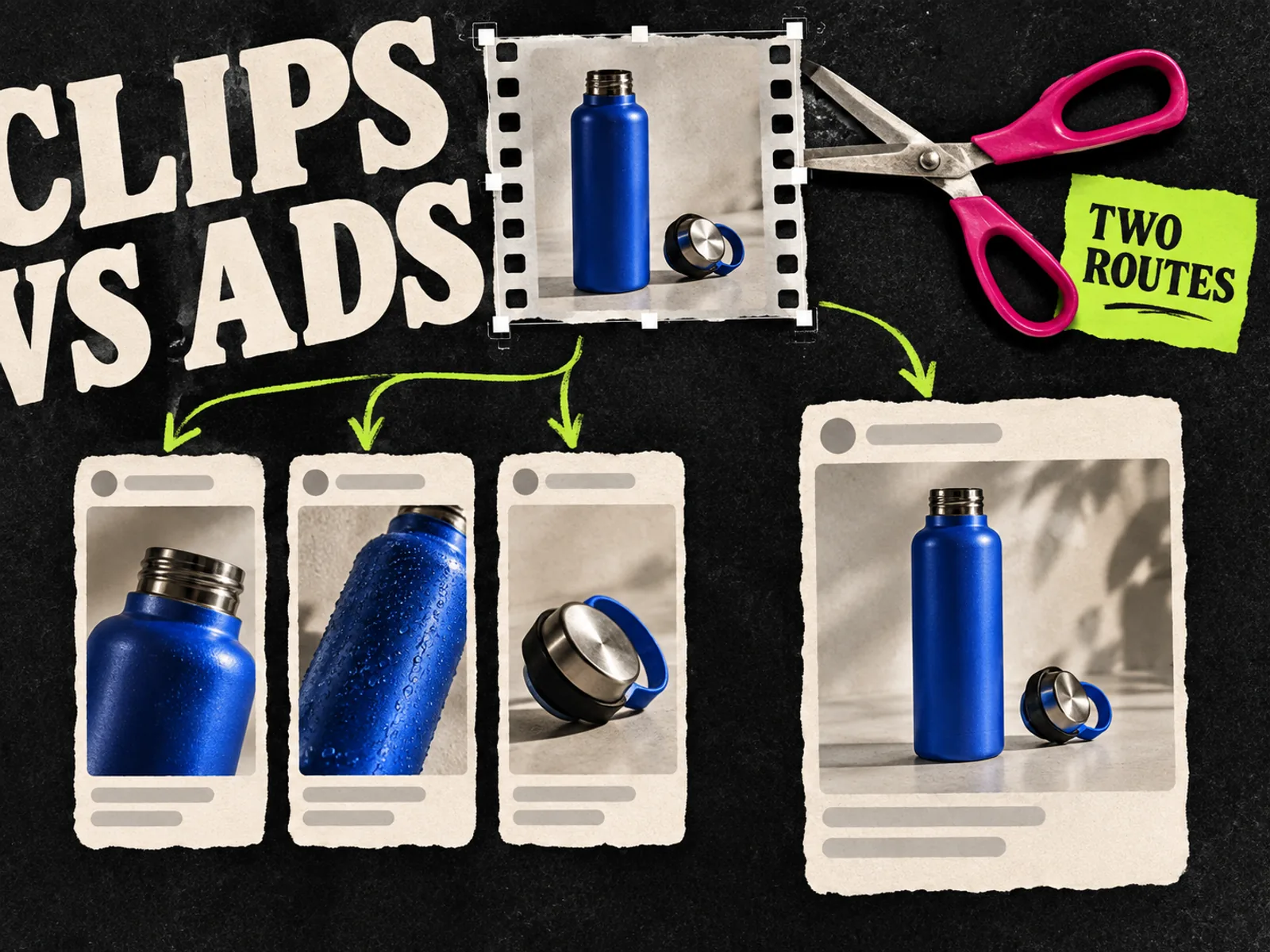
Clipping campaigns pay people to turn existing footage into short posts and distribute them through creator accounts. Meta ads buy distribution through Meta's advertising system. The same product video could work in either. The choice depends on who you want to reach and what you need to learn.
If you need to test whether an offer sells, Meta ads are usually the more direct starting point. Consider clipping when you have footage people could enjoy or share, and someone available to manage the people posting it.
What clipping means in this comparison
Here, clipping means paying for posts on participating accounts. Hiring an editor to cut videos for your own profile is a simpler production job; it doesn't bring the distribution discussed here.
For example, Whop's Content Rewards guide describes clipping campaigns that repurpose existing material, with a campaign budget, a reward rate per thousand views, and a choice of allowed platforms. It treats original creator-made UGC as a separate campaign type. Check the actual campaign terms before assuming every clipping service uses the same payment or approval model.
Meta's auction-based advertising works differently: advertisers choose a business objective and audience settings, then their ads compete for delivery. Meta describes that process in its explanation of personalized ad delivery.
You can decide whether to use static ads or video ads once you've chosen the campaign. Clipping versus Meta ads determines how the content reaches people.
Clipping vs Meta ads at a glance
| Decision | Clipping campaign | Meta ads |
|---|---|---|
| Where the content appears | Participating creators' posts | Paid ad placements |
| What you fund | Editing and posting, often with view-based rewards | Media delivery, plus creative production and management |
| How you influence the audience | Creator selection, platform choices, language, and the brief | Campaign audience settings and delivery optimization |
| What you can change | Source material, submission rules, and future edits; published changes need coordination | Creative, budget, and delivery settings in the ad account |
| What to inspect first | Who sees the posts and whether the product stays understandable | Whether delivery and measured results match the campaign goal |
| What needs separate agreement | Posting duration, revisions, reporting, and reuse of the clips | Any creator or third-party content used in the ads |
Clipping can involve Instagram or Facebook posts too. The platform name alone won't tell you which distribution model you're buying.
Start with the result your team needs
If your immediate question is whether a specific offer can generate purchases, start with a campaign built around that outcome. Meta's delivery system uses the advertiser's chosen objective when predicting likely actions. It still needs useful creative and a working destination; selecting an objective cannot rescue a confusing offer.
Clipping asks a different initial question: can other people make and distribute short versions of your material that attract the right viewers? That's a useful experiment when you have product demonstrations, founder explanations, or recorded conversations with moments that stand on their own.
A long recording is only useful if it contains those moments. An hour of internal product discussion might produce nothing a customer would watch.
Before choosing clipping, find a passage you could show someone without explaining what came before it. Can they identify the product? Is the interesting part relevant to someone who might buy it? If the only attraction is an unrelated joke, the views may tell you very little about demand.
Compare the full cost, not just a quoted CPM
A reward per thousand video views and an ad cost per thousand impressions use different denominators. A view is not a unique person, and neither metric tells you how many people bought. Even view counts can use different definitions across platforms.
Ask a clipping provider what qualifies for payment, when counting stops, and which views can be rejected. Find out whether the quoted price includes editing, account management, review work, and reporting. Ask how audience geography is checked when your business serves only certain markets.
For Meta, include production and management costs alongside ad spend. Count the same kinds of expense on both sides. A clipping invoice that includes editing isn't comparable to media spend alone.
Keep these calculations separate:
- Clipping reward cost per thousand accepted views: reward payouts divided by accepted views, multiplied by 1,000.
- All-in cost per observed purchase: the costs you've agreed to include divided by purchases recorded under a stated attribution method.
The second calculation is only useful when you can explain the purchase count. If a campaign cannot be linked reliably to purchases, report that gap. A cheap view rate doesn't fill it.
Write a brief that survives being cut into pieces
Use the same approved product facts for both channels. Clipping needs extra direction about what an editor may remove, rearrange, or publish.
Take a reusable-bottle campaign as an example. Imagine the brand has footage showing how the lid comes apart for cleaning. Keep that demonstration intact in the clip, and give viewers of the Meta ad a clear route to the product page.
| Brief field | Example instruction |
|---|---|
| Buyer question | How do I clean the lid? |
| Approved source | The current product's lid-removal demonstration |
| Essential sequence | Show the lid being removed, the separate parts, and reassembly |
| Claims | Use only the cleaning instructions supplied with this model |
| Editing limit | Do not cut a qualification out of the spoken explanation |
| Destination | The page for the exact bottle shown |
| Review | Send the first cut for product review before posting |
| Handoff | Supply the posted URL, final export, and agreed reporting |
These are proposed brief requirements, not features every clipping platform provides. If a service cannot support a review before posting, decide whether that fits the content you're distributing.
The ad creative brief template covers the message and deliverables. Add the source timestamps and publication terms for each clipping campaign.
Agree on disclosures and reuse before launch
Paid creator distribution needs clear disclosure. For endorsements that affect U.S. consumers, the FTC's influencer disclosure guide says material brand relationships should be obvious, and video disclosures should appear in the video rather than only in its description. Put the applicable disclosure instructions in the brief before anyone edits.
Also agree on who can reuse each export, where it can run, and for how long. Ask separately about footage, music, and the creator's identity. Permission to publish a clip on one account should not be treated as permission for every later use.
If you want to run creator content through Meta, partnership ads provide a way to advertise with a partner's handle. Arrange the relevant permissions and check eligibility before planning that handoff. A clipping reward and paid-media usage are separate things to settle with the creator.
Run a comparison you can interpret
Write down the decision before spending: "Should we fund another clipping batch, increase this Meta campaign, or revise the source content?" Then choose evidence that can answer it.
- 1.Keep the product, offer, and destination consistent where possible. Record anything that differs.
- 2.Set a spending limit and review date for each channel. Include the staff time needed to manage submissions.
- 3.Use distinct campaign links or codes where supported. Record post URLs and publication dates so you can trace the traffic you do see.
- 4.Review audience relevance and product-related responses alongside views. For sales campaigns, inspect recorded purchases and the attribution method used.
- 5.Separate useful content from successful distribution. An edit may deserve a paid test even if its original post received little reach.
Links and codes won't capture every person who watches, searches for the brand later, and buys. Codes can also spread beyond their original post. Treat them as partial evidence, and avoid adding together platform-attributed sales as though every system counted different customers.
Running both channels at once can help you compare the work and observed results. It won't isolate how many extra sales each caused. That requires a suitable holdout or lift study. With only a few recorded purchases, you may need more evidence before choosing where to spend next.
Give promising clips a separate paid test
Suppose comments on the bottle demonstration repeatedly ask whether the lid is easy to clean. That gives you a concrete question for a new ad: show the parts clearly and explain the cleaning steps. It does not establish that the ad will sell.
Write the idea into a fresh brief, then test it in the channel where you intend to spend. A clip's audience and viewing context can differ from the audience that receives a paid ad.
Adrio can help you build editable static ad variations from approved product images and prepare the placement exports. Keep the source footage and agreed usage terms with the brief so the next person making an ad knows what they can use.
FAQ
Is clipping cheaper than Meta ads?
A clipping campaign may quote a lower cost per thousand views, but that does not establish a lower cost per customer. Compare full costs, audience relevance, and results measured on a basis you can explain.
Are clipping campaigns organic marketing?
The posts may receive organic distribution, while the brand pays for their creation or views. Calling the distribution organic doesn't remove the commercial relationship or the need for appropriate disclosure.
Can I turn a successful clip into a Meta ad?
Yes, if you have the reuse rights and any required creator permissions, and the content meets the ad requirements. Check the final placement previews, then measure its paid performance separately.