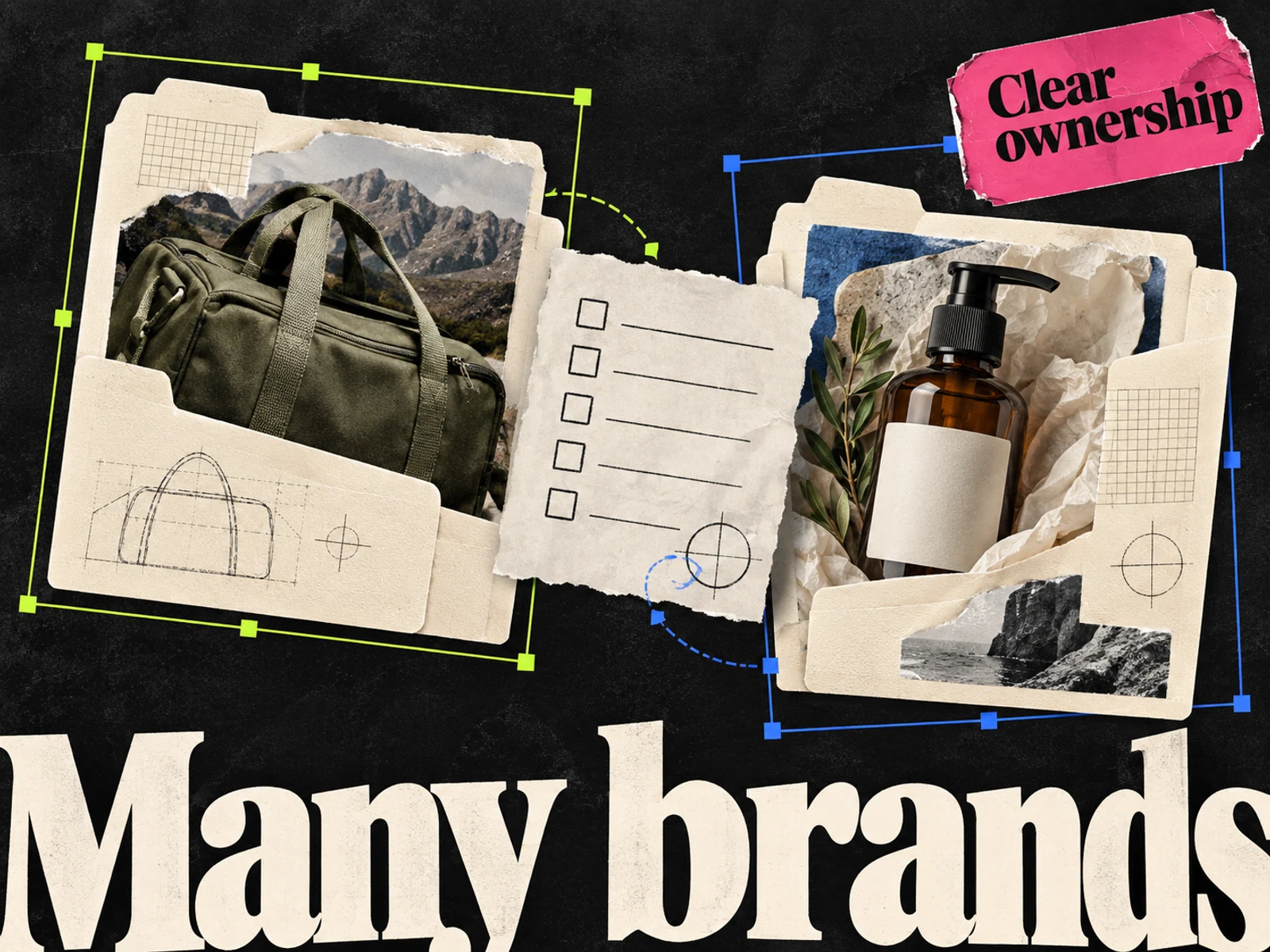
For multiple brands, organize the AI ad workflow around separate product context, approved offers, assets, testing history, and launch responsibility. In Adrio, choose the relevant brand context before working with Spark and verify the intended account before publishing. Reuse the process across clients; review each client's facts and creative independently.
Adrio's current Max plan includes client workspaces, and plans include unlimited member seats. Confirm current entitlements in the pricing details. Workspace access does not replace an agreement about who approves claims, creative, and campaign spend.
Reuse the workflow without blending brand facts
A shared process can help an agency work efficiently. A shared prompt containing several clients' product claims can create confusion. Keep the procedure reusable and supply each brand's context deliberately.
For example, an agency may serve a travel-bag company and a household refill brand. Both need competitor research, concepts, assets, and performance review. Their offers, product evidence, approved language, and audience situations are different.
Before starting a Spark run, confirm the brand, product, and destination. If switching contexts, begin with a short statement of the task rather than assuming the earlier conversation still applies.
Build a working context packet for each client
Keep a concise record the creator and reviewer can use. This is a suggested team document, not a claim that every field is automatically synchronized from client systems.
| Context | What the team needs |
|---|---|
| Product and variants | Correct SKU, packaging, approved photographs, and destination |
| Offer | Current price, promotion, included items, and market |
| Brand | Voice, logo, colors, examples, and required qualifications |
| Evidence | Approved facts, demonstrations, and usable testimonials |
| Research | Competitor references and the pattern worth investigating |
| Account | Intended Meta account and publishing identity |
| Responsibility | Owners of product approval, creative review, launch, and reporting |
Date important offer changes and review them before reuse. A previous campaign brief is useful history, but its promotion may no longer be valid.
Keep the packet short enough to check. If it contains dozens of unrelated claims, the team may not notice which ones apply to the advertised product.
Make research comparable across clients
Use the same research questions while evaluating each brand separately. What customer situation does the reference address? What proof is visible? Which pattern fits this product? What remains unknown about competitor performance?
Adrio's library, saved references, and watchlists can support that research. Bring selected references into Spark with the current brand context. A pattern used in one industry can inspire a question in another, but it does not become evidence that the execution will perform there.
Follow the swipe-file-to-brief process to capture the adaptation. Keep source assets and claims out of a new client's ad unless they belong to the approved inputs for that client.
Plan production around capacity to review
An agency's production limit may be client review time rather than generation speed. A large batch for every client can create a queue of unclear drafts and missed launch dates.
Use a testing backlog per brand. Choose the questions with available evidence, ready assets, and a plausible testing budget. Schedule the production and review handoff together.
For the bag brand, the next batch might investigate organization. For the refill brand, it might demonstrate the refill process. Ask Spark for separate plans and generation costs. Review each before making assets.
Spark supports static and video creation. Consider whether each concept needs movement. The organization benefit may be clear in an annotated still image; a physical refill process may benefit from a sequence.
Set a precise brief for each run
Supply the product, approved offer, buying reason, proof, references, placement, and fixed elements. State whether the task is planning, generation, or a launch proposal.
For this travel-bag brand, plan the organization concept using the approved interior photo and dimensions. Keep the current offer and product URL. Propose one static execution for review. Do not generate or publish yet.
For the second client, write a fresh instruction with that client's product and context. Reusing the planning structure is helpful; reusing the first client's product facts is not.
Once the plan is approved, review the displayed usage cost and generate the asset. Keep the concept identity with the draft so the account review can later explain why it was produced.
Separate client sign-off from account execution
Agree who approves the product facts and offer, who checks creative, and who can authorize a campaign or budget change. A client may approve the message while the agency buyer owns the account proposal.
Spark asks before supported spend-affecting actions by default. Users can approve once, decline, or allow an action going forward; recurring tasks start in Review mode. Treat any ongoing permission as an explicit operational decision.
Before publishing an image or video ad directly to Meta, verify the account, page, destination, asset, campaign settings, and budget. Assign a launch owner so the approved creative reaches the intended account.
The agent approval guide provides the detailed review sequence. Do not assume workspace membership by itself settles the client's authorization rules.
Keep campaign learning specific to the brand
At review, use the relevant date range, conversion definition, offer, and delivery. An apparent pattern across clients may be a useful idea, but account results should remain attached to the conditions in which they occurred.
For example, a product-detail concept may deserve investigation for several clients. That does not mean a strong result on the bag account proves the same concept works for the refill brand. Write the proposed cross-client idea as a hypothesis and test it with the second brand's own evidence.
Use the performance-to-next-test workflow to turn each account's observations into its next brief. Carry forward the learning with enough context that another buyer can review it.
Evaluate a multi-brand tool with two actual clients
Do not evaluate agency fit using only one polished demo brand. Choose two clients with different products and offers, then complete research, a brief, a revision, and the launch handoff for each.
Check that the team can find the right assets and continue another person's work. Ask a second reviewer to identify the intended account and offer from the handoff. Record the missing context and correction work.
Include client workspaces, required collaboration, generation usage, review time, and reporting needs in the purchase decision. Unlimited seats do not mean unlimited production credits or unlimited client capacity on every plan.
Frequently asked questions
Does Adrio support client workspaces?
The current Max plan includes client workspaces. Check the current pricing and plan entitlements before organizing the agency around them.
Can I reuse prompts across clients?
Reuse the task structure, but provide and verify each client's product, offer, assets, approved claims, destination, and account separately.
Can Spark create video for clients?
Yes. It creates scripts, clips, and captions and supports scene revisions. Both image and video ads can be published directly to Meta with approval by default.
What should an agency test before adopting Adrio?
Run two different client briefs through planning, production, revision, approval, and the launch handoff. Measure context errors and review work alongside generation cost.