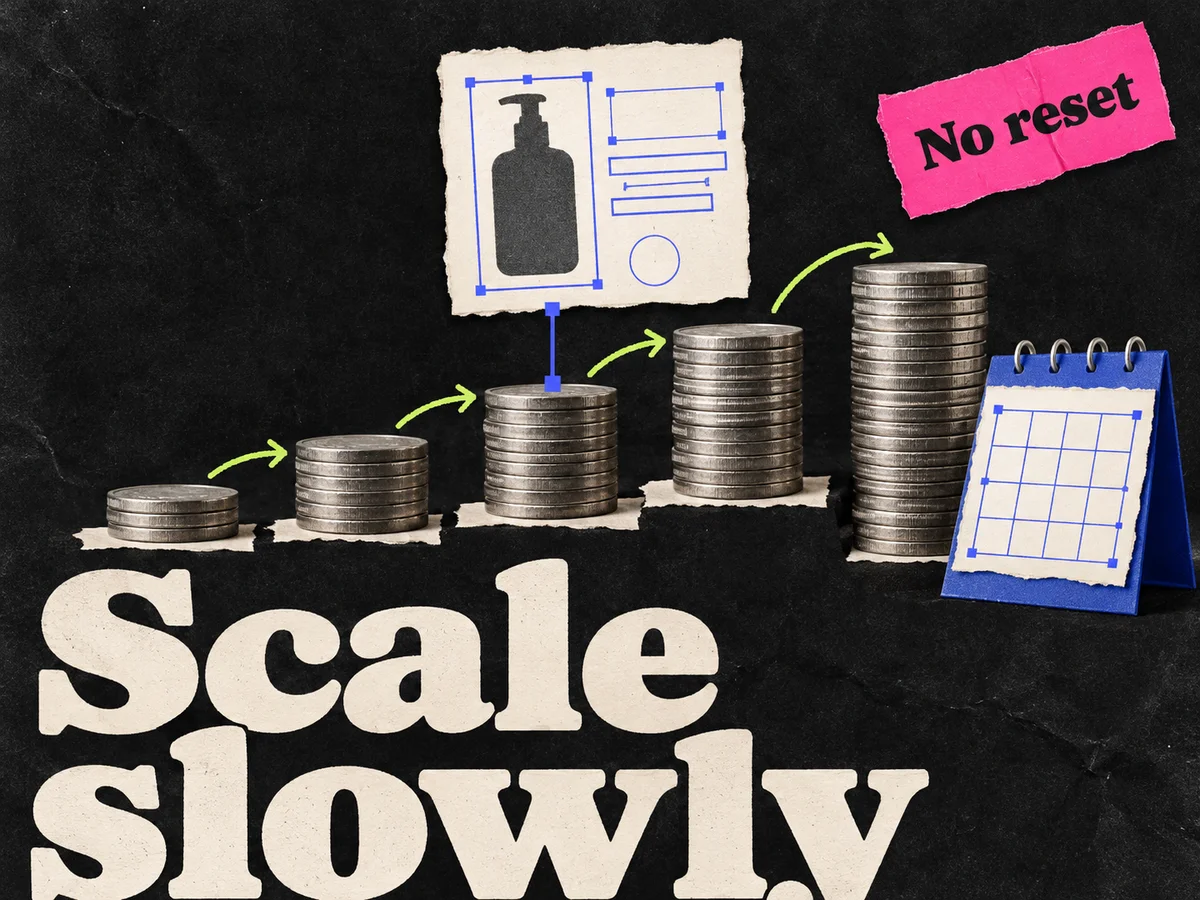
To scale Meta ads without resetting the learning phase, raise the budget on an ad set that has already exited learning in moderate steps, change nothing else at the same time, and add bigger chunks of spend through budget scheduling or new ad sets instead of editing the winner. Meta says a budget change "may or may not be significant, depending on the magnitude of the change," so no percentage is guaranteed safe, and the popular "20% rule" is a practitioner habit, not a Meta rule.
We make Adrio, an AI agent for Meta ads, and it comes up once near the end. Everything about Meta's mechanics below is quoted from Meta Business Help Center pages we checked on October 14, 2026. Numbers marked as heuristics are our working defaults, not Meta guidance.
What Meta says about the learning phase
Meta's About the learning phase page says ad sets exit learning "as soon as they can deliver stably," which "usually occurs after about 50 results in the week after the ad set's last significant edit." While in learning, "ad sets are less stable and usually have a higher CPA."
Two details matter for scaling:
- The clock restarts at the last significant edit, not at launch. Ads Manager has a "Last significant edit" column. Add it next to Results to see how many results an ad set has collected since the clock restarted.
- Meta warns about budget changes directly. It tells advertisers to "set a budget large enough to get enough total results and avoid frequent budget changes (which can cause an ad set to re-enter the learning phase)."
Meta also says "you shouldn't try to avoid the learning phase completely." The goal is to keep your proven ad set stable while you add volume around it.
What actually resets learning
Meta's Significant edits and learning phase page splits edits into ones that always count and ones that depend on size.
| Edit | Resets learning? | Source |
|---|---|---|
| Any change to targeting | Yes | Significant edits |
| Any change to ad creative | Yes | Significant edits |
| Any change to optimization event | Yes | Significant edits |
| Adding a new ad to the ad set | Yes | Significant edits |
| Pausing the ad set for 7 days or longer | Yes, once you unpause | Significant edits |
| Changing bid strategy | Yes. With Advantage+ campaign budget it "might cause multiple ad sets" to reset | Significant edits |
| Budget amount | Depends on size. $100 to $101 "isn't likely"; $100 to $1,000 "may" | Significant edits |
| Bid control, cost per result goal or ROAS goal amount | Depends on size | Significant edits |
| Ad set spending limit amount | Depends on size | Significant edits |
| Campaign budget change with Advantage+ campaign budget | May reset multiple ad sets | Significant edits |
| Advantage+ campaign budget shifting spend between ad sets | No | Significant edits |
| Adding a new ad set to an Advantage+ campaign budget campaign | No, for the existing ad sets | Significant edits |
| Budget increase through a scheduled high demand period | No | Budget scheduling FAQ |
| Duplicating an ad set | Original is untouched; the copy starts its own learning phase | Learning phase |
Does increasing budget reset the learning phase?
Sometimes. Meta's only guidance is the $101 versus $1,000 example. Everything in between is unspecified, but two things help.
First, Ads Manager can show an ad-set-specific number. Jon Loomer's Updates to Meta ads budgeting (published November 2, 2023, last updated March 1, 2025) shows a recommendation on a $100 budget that reads "You can increase your daily budget up to $179 without reentering the learning phase." In an October 15, 2025 episode he adds that ad sets Meta labels "High performing" can take bigger increases than before without reentering learning. When you see a recommendation like this, it is the best number you have for that ad set.
Second, budget scheduling. Meta's FAQ on high demand periods says: "increasing your budget by scheduling a high demand period through budget scheduling won't prompt the delivery system to enter a learning phase." Per About budget scheduling, it works with daily budgets only, allows up to 50 high demand periods per campaign or ad set, each at least 3 hours long, and the scheduled budget can't exceed 8 times the daily budget.
Daily budgets are also not a hard cap. Meta's About daily budgets page says Meta "may spend up to 75% over your daily budget" on some days, while never spending more than 7 times the daily budget in a Sunday to Saturday week. Loomer's article records this as an increase from the earlier 25% flexibility. Don't react to one day of high spend.
Where the 20% rule comes from
Meta's help pages contain no 20% threshold for budget increases. The only 20% in Meta's budget docs is ad set budget sharing, which can move up to 20% of an ad set's daily budget to other ad sets (About campaign budgets and ad set budgets). It is unrelated to learning.
The rule comes from practitioners. Social Media Examiner's 2021 article on two scaling methods recommends raising budget "no more than 20% in a 72-hour period." MAstratos' The Meta 20% budget rule does not exist (August 2026) points out that with only the $101 and $1,000 examples, "everything between +1% and +900% is undefined." Bach.ai's guide to scaling Meta budgets (updated October 1, 2026) says Meta publishes no percentage and treats 20% as a starting habit.
We treat 15 to 20% as a reasonable default when Ads Manager gives no recommendation, not as a promise from Meta.
Vertical vs horizontal scaling
| Vertical scaling | Horizontal scaling | |
|---|---|---|
| What you change | Budget on the existing winner | New ad sets, campaigns, audiences or creative concepts |
| Learning impact | Small steps often keep learning; large jumps may reset it | New ad sets start in learning. In an Advantage+ campaign budget campaign, adding one doesn't reset the others |
| Speed | Slow, one step every few days | Fast, you can add a lot of spend at once |
| Main risk | Efficiency drops as budget outgrows the audience or creative | Conversions split across too many ad sets, which can lead to Learning limited |
| Best for | A stable ad set getting well over 50 results a week | Winners that have hit a ceiling, new angles, new countries |
| Meta guidance to remember | "Avoid frequent budget changes" | "Avoid high ad volumes" and "by combining similar ad sets, you also combine learnings" |
Most accounts need both: vertical steps while the winner has room, horizontal moves once it stops absorbing budget at your target CPA.
A duplicate does not inherit the original's learning. Meta says learning happens when you "create a new ad or ad set." Social Media Examiner's "rapid scale" method duplicates winners at double the budget or more, accepting a new learning phase in exchange for faster spend growth.
A step-by-step scaling routine
The numbers below are our heuristics for an ad set optimizing for purchases, not Meta guidance. Adjust for your margins and volume.
- 1.Confirm the ad set is out of learning. Delivery should read Active. Heuristic: wait for 5 to 7 days of steady CPA after exit before the first increase.
- 2.Look for Meta's own number. If Ads Manager recommends an increase without reentering learning, use that amount as the ceiling.
- 3.Otherwise, raise 15 to 20%. Heuristic. On $100 a day, go to $115 or $120.
- 4.Change nothing else. No creative, targeting, optimization event or bid strategy edits in the same window. If several edits are unavoidable, make them together so you take one reset.
- 5.Wait 3 to 4 days. Heuristic. Judge the multi-day average, not one day.
- 6.Decide. Heuristic thresholds: CPA within 10 to 15% of target, take another step. CPA 15 to 30% worse, hold for another cycle. Worse than that for 3 or more days, go back to the last good budget.
- 7.Use budget scheduling for known peaks. Put sales, launches and weekends into high demand periods.
- 8.Switch to horizontal when the steps stop paying. Add a new ad set with a different angle or audience.
Illustrative schedule at 20% steps:
| Day | Daily budget | Change |
|---|---|---|
| 0 | $100 | Starting point |
| 4 | $120 | +20% |
| 8 | $144 | +20% |
| 12 | $173 | +20% |
| 16 | $207 | +20% |
That roughly doubles the budget in just over two weeks, if each step holds your CPA.
What to do when an ad set is stuck in Learning limited
Meta's About learning limited page says an ad set becomes Learning limited "when it is unlikely to receive about 50 optimization events in the week after your last significant edit," and that it "isn't a penalty." Listed causes include small audience, low budget, low bid or cost control, high auction overlap, an infrequent optimization event, and too many ads.
Meta's fixes, with our notes:
- Combine ad sets and campaigns. Small ad sets chasing the same buyers split the results each one needs.
- Expand your audience. A larger audience gives more chances to hit the optimization event.
- Raise your budget. Do the arithmetic first. At a $40 CPA, 50 purchases a week costs $2,000, about $286 a day. A $100 daily budget at that CPA can't reach 50 purchases in a week, so a 20% bump won't fix it.
- Raise your bid or cost control. Hovering over the status shows a tooltip when this is the cause.
- Change the optimization event. Meta's example is purchases to add to cart. This is a significant edit and a weaker signal.
If a Learning limited ad set hits your CPA target, you don't have to fix it. Loomer argues the algorithm keeps learning regardless of the label.
How creative refresh fits in
Meta lists both "any change to ad creative" and "adding a new ad to your ad set" as significant edits. Loomer has reported adding an ad without triggering learning in one test, but Meta's documentation still lists it, so plan for a reset.
So refresh a winner deliberately:
- Test new creative outside the winning ad set. Run new concepts in a separate testing ad set, and move proven ads into the scaling ad set when you choose to take the reset.
- Bundle the reset. If the winner needs fresh ads and a budget step, do both on the same day.
- Publish new ads instead of editing live ones. Editing a running ad's creative is a significant edit.
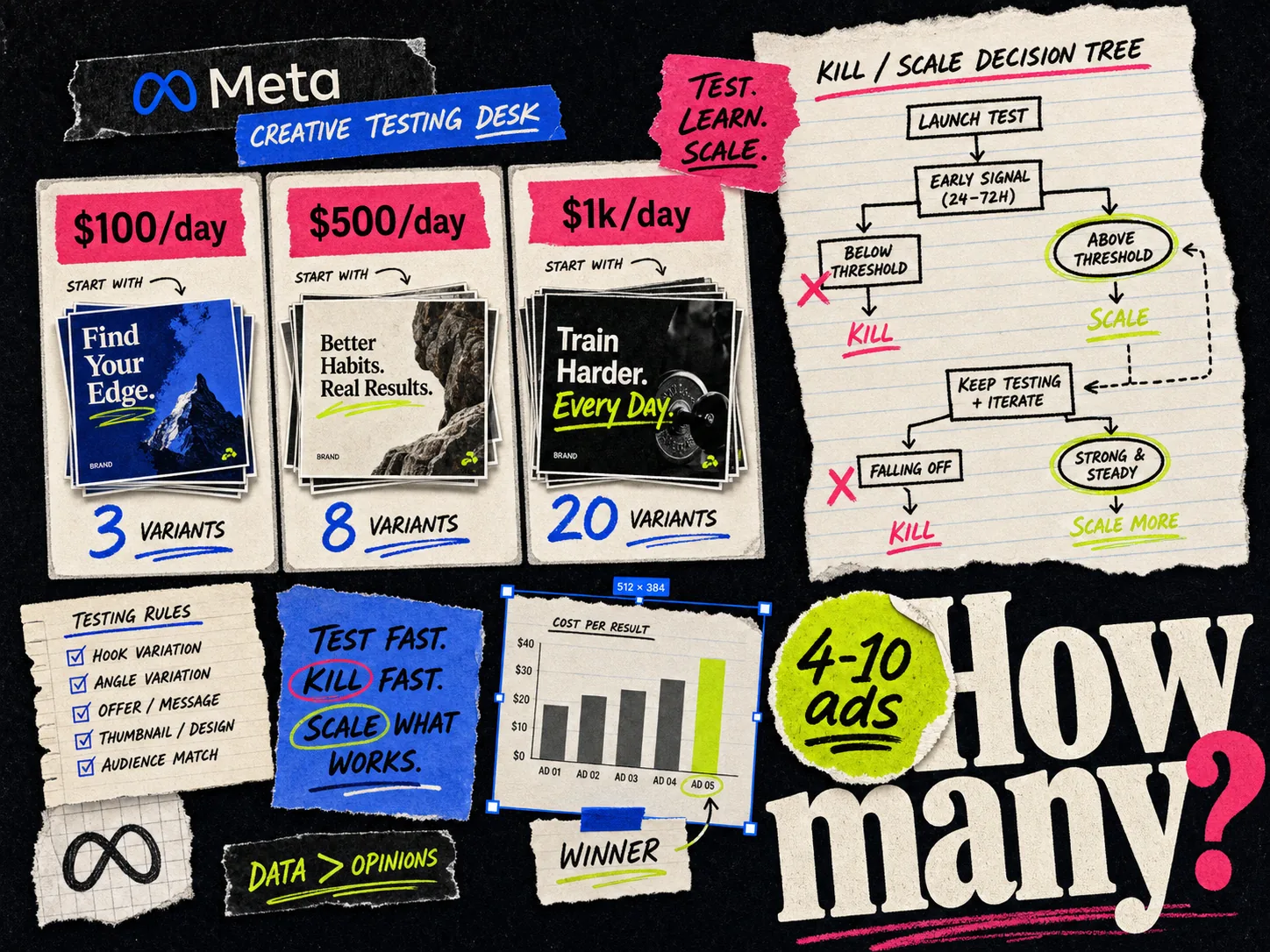
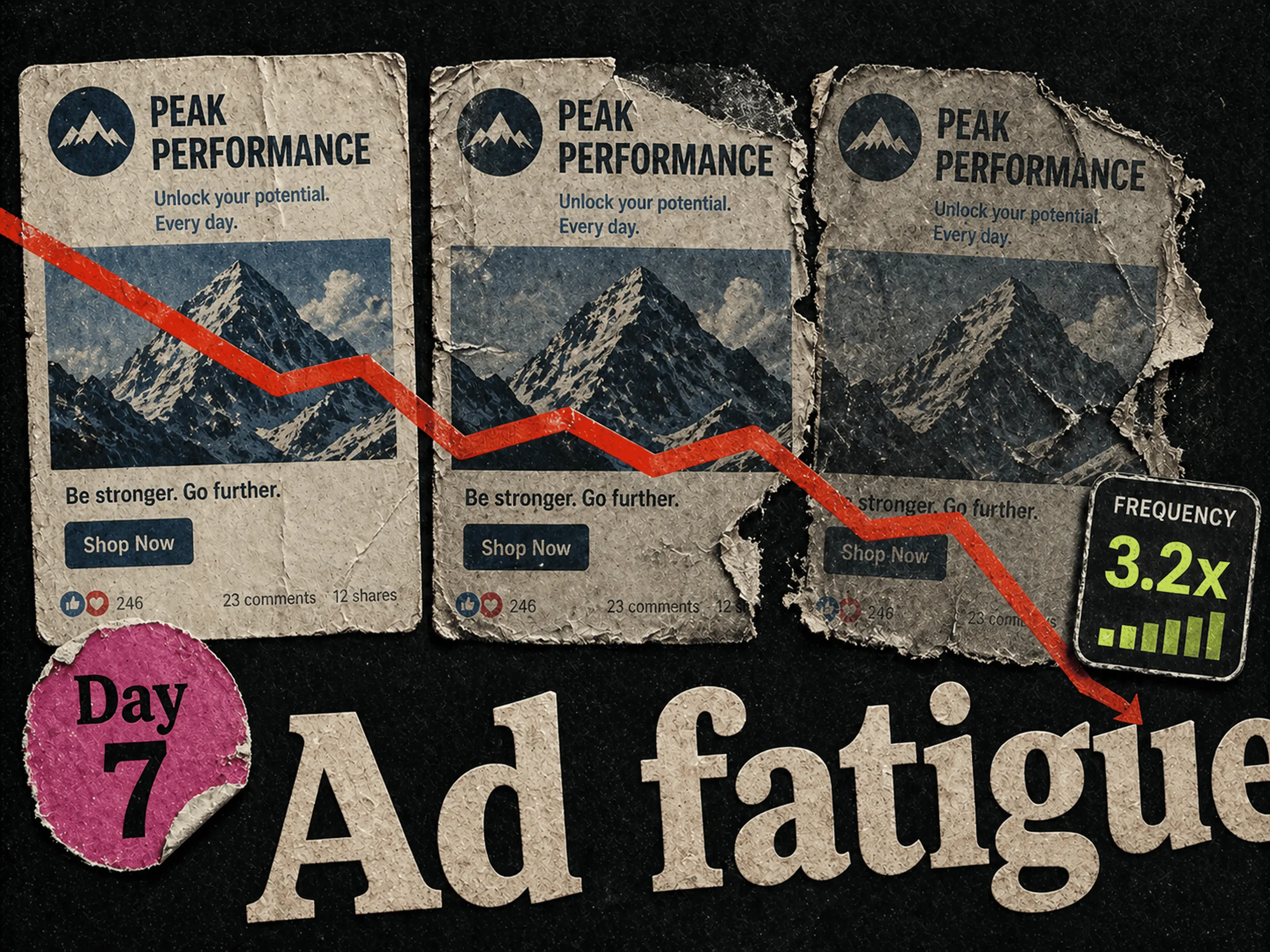
Refresh on fatigue, not on a calendar. Our guide on ad fatigue covers the early signals. For batch sizes, see how many ad creatives to test on Meta. New ad sets for horizontal scaling need concepts that are actually different from the winner, as explained in iteration vs diversification.
Automating it safely
Automated rules and AI agents can reset learning faster than a human ever could. Rules that nudge budgets every few hours keep every ad set permanently stuck in learning, and their owners usually blame the algorithm. Whatever tool you use, set a maximum change per step, a maximum number of changes per 24 hours, daily caps per ad set and per account, and human approval on increases.
This is the exact failure mode Adrio was built around. Its Spark agent reads return, CPA and CTR on every ad, moves spend from losing ad sets to winners, pauses losers and starts the next test, which is the routine in this article run for you. By default it asks before every action. Other modes are Full access, which still asks before spending credits or launching, and Autopilot. Here's the part that matters for learning phase specifically: spend limits apply on top, and Spark cannot exceed them even with approval. The ceilings cover each campaign or ad set per day, the whole account per day, the month, and change pace, both per change and per 24 hours. That last limit is not feature number forty-one on a pricing page; it exists because of this article's whole subject. Automations only add spend once both daily limits are set, and new scheduled automations start in Review mode. See Meta ad agent approval controls for what each approval covers and best AI agents for Meta ads for how it compares.
Adrio isn't the right pick if you also need to manage Google or TikTok budgets, since it works with Meta only.
FAQ
Does increasing budget reset the learning phase on Meta?
It can. Meta says a budget change "may or may not be significant, depending on the magnitude of the change." A $100 to $101 change isn't likely to reset learning, while $100 to $1,000 may. Budget increases through scheduled high demand periods won't trigger learning, according to Meta.
Is the 20% budget rule an official Meta rule?
No. Meta's help pages give no percentage for safe budget increases. The 20% rule is a practitioner heuristic. If Ads Manager shows a recommendation saying you can increase up to a certain amount without reentering learning, use that number instead.
What counts as a significant edit on Meta?
Meta lists any change to targeting, ad creative or optimization event, adding a new ad, pausing for 7 days or longer, and changing bid strategy. Changes to budget, bid or cost goals and ad set spending limits may count depending on size.
Does duplicating an ad set keep its learning?
No. A duplicate is a new ad set and goes through its own learning phase. The original is not affected.
Should I scale vertically or horizontally?
Scale vertically while the winning ad set still holds CPA after each step. Switch to horizontal scaling with new ad sets, angles or audiences once it stops absorbing budget, and combine ad sets if they end up Learning limited.