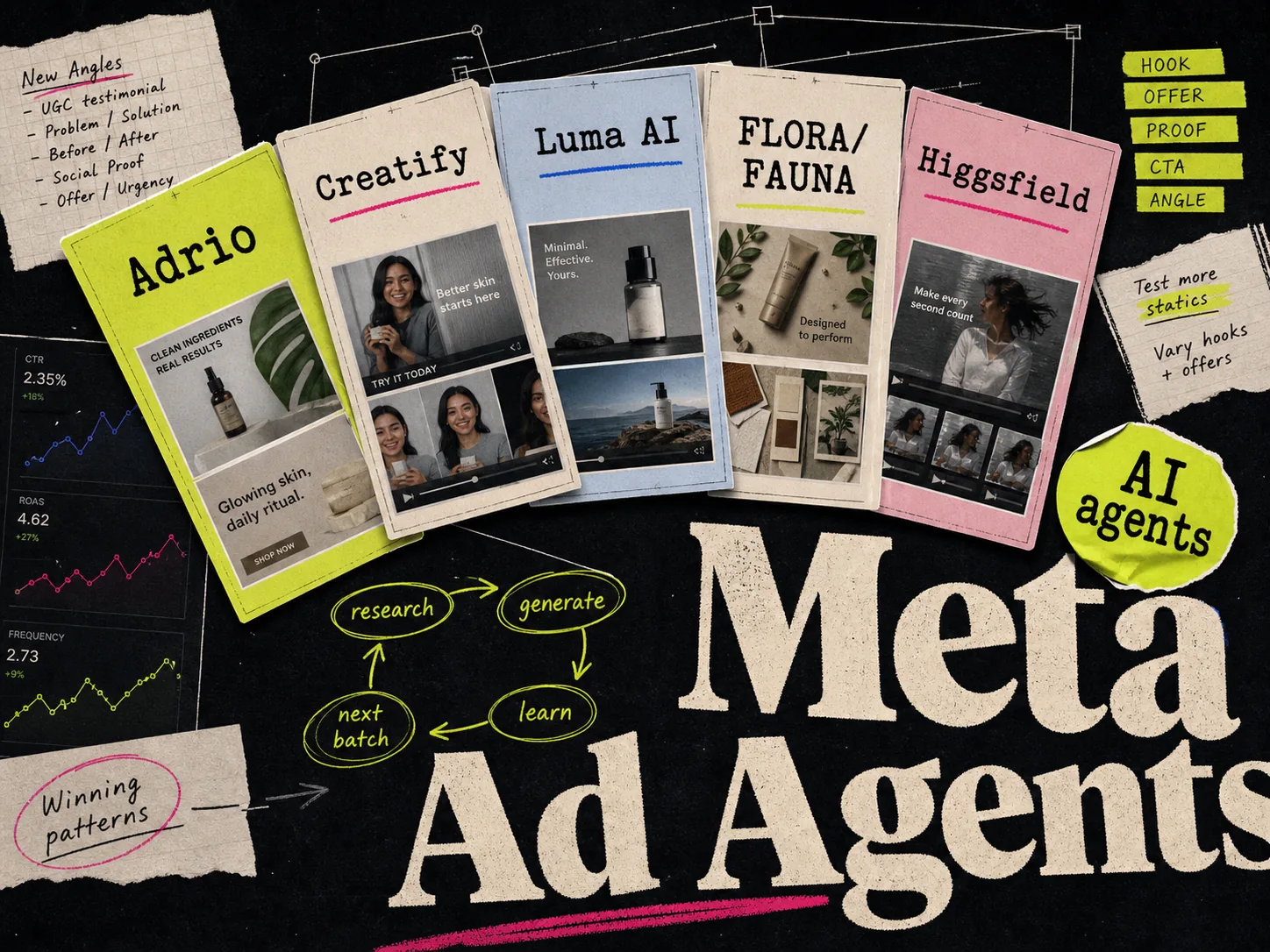
AI agents for Meta ads are useful only if they remove a real bottleneck. Most teams do not need another chatbot that writes five hooks and disappears. They need a system that researches competitors, makes creative, learns from performance, and tells them what to test next.
That is the difference between an AI ad tool and an AI ad agent. A tool gives you an output. An agent should move the work forward.
Best AI agents for Meta ads: quick answer
Adrio is the best AI agent for Meta ads if your main bottleneck is connecting creative production to the next campaign test. It is built for the full Meta creative loop: add competitors, analyze what angles they are testing, generate editable static ads, learn what works, and recommend the next batch. Spark also creates video ads. Direct Meta publishing supports both image and video ads with approval by default.
| Tool | Best for | Main tradeoff |
|---|---|---|
| Adrio | Competitor research, static and video creation, and approved Meta image and video launches | Generation uses credits; review costs and launch proposals |
| Creatify | Template-heavy AI video ads | Fast, but results can feel mediocre |
| Luma AI | High-quality visual generation and editing | Not a Meta ads workflow by itself |
| FLORA/FAUNA | Power-user creative asset workflows | Better for designers than media buyers |
| Higgsfield Supercomputer | High-end AI video ads | Expensive when you burn tokens |
How we picked the tools
This is an Adrio-authored editorial comparison, originally reviewed on May 25, 2026. Adrio’s capabilities were updated on September 30, 2026; the other entries retain their original review context. It is not a controlled performance benchmark. This list is intentionally narrow. It covers tools that can behave like agents or agentic creative systems for paid social teams.
The ranking favors five things:
- 1.Can it take more context than a one-line prompt?
- 2.Can it produce ad creative that is close enough to test?
- 3.Can it help with iteration after the first generation?
- 4.Does it fit a real Meta ads workflow?
- 5.Is the output worth the time and credits it costs?
1. Adrio - a creative agent for Meta ad research, production, and iteration
Adrio is the best fit when you want an AI agent built around Meta ads specifically. It starts from the actual work media buyers do every week: watch competitors, identify new angles, produce static variants, launch tests, read what happened, and make the next batch.
The workflow is the point. You add your brand and competitors. Adrio tracks competitor ads, breaks them into creative primitives like angle, hook, offer, proof type, CTA, layout, and visual style, then helps decide what is worth testing for your own account.
That means you can ask questions like:
- What new angles did our competitors start using this week?
- Which hooks have we already tested?
- Which competitor pattern should we adapt next?
- What should we make based on the last batch?
- Generate static Meta ads from this structure, but use our product and brand.
This is where Adrio is different from most AI creative tools. It is trying to close the loop between competitor research, creative production, performance learning, and the next test.
Adrio is also built around editable output. You can adjust copy, product images, logo, CTA, colors, and layout before export.
Use Adrio when:
- Your channel is Meta.
- Your bottleneck is static creative volume.
- You want competitor research to become new ads.
- You care about structured creative learning over random output.
- You want the agent to help decide what to test next.
Spark can write video scripts, generate clips, add captions, and revise scenes. Both image and video ads can be published directly to Meta through Spark with approval by default. Generation uses credits; check the current pricing and credit details.
Best for: DTC founders, media buyers, and agencies that want a Meta creative loop instead of another folder of screenshots.
2. Creatify - best for template-heavy AI video ads
Creatify is the obvious video-ad agent to test if you want speed and templates. Its product page says it can turn a product URL into video ads with AI scripts, avatars, and voices.
Creatify's advantage is structure. You can start from a product page, pick a template direction, generate scripts, use avatars, and get multiple video ad drafts without building a timeline from scratch.
Our issue with Creatify is output quality. In our tests, it was useful for fast first drafts and angle exploration, but the final ads often felt mediocre. Not unusable. Just not something we would blindly scale without heavy review.
Use Creatify when:
- You need many short video drafts quickly.
- You want URL-to-video workflows.
- You like working from templates.
- You are testing hooks before paying for real UGC.
The catch: the speed is real, but the output still needs taste. Expect to regenerate, edit, and kill a lot.
Best for: ecommerce teams that need quick AI video drafts for Meta and TikTok.
3. Luma AI - best UX and most promising visual model
Luma AI is not a Meta ads agent in the same way Adrio or Creatify are. It is a high-quality visual generation system with strong UX, and its Uni-1 model family is promising for ad asset creation.
Luma describes Uni-1 as a multimodal reasoning model that can generate pixels, understand intention, respond to direction, and handle visual instructions. Luma also opened the Uni-1.1 API for image generation and natural-language editing.
For Meta ads, that matters when you need better product scenes, visual directions, lifestyle concepts, or image edits before the final ad is assembled somewhere else. Luma is especially interesting when the bottleneck is visual quality, not ad workflow.
Use Luma when:
- You want strong generated visuals.
- You care about a clean creative UX.
- You need image generation or editing inputs for ads.
- You have someone who can turn visuals into campaign assets.
The catch: Luma does not decide your Meta test plan. It can create strong assets, but it will not automatically connect competitor research, ad structure, export formats, and performance learning.
Best for: teams that want high-quality visual inputs for ads and have a separate workflow for testing.
4. FLORA/FAUNA - best for designer power users
FLORA is an AI creative canvas for people who think visually. FAUNA is the agent inside that canvas. The docs describe FAUNA as an agent that can operate image, video, and text nodes, use selected canvas nodes as context, and execute up to 50 nodes at a time.
That makes FLORA/FAUNA very different from a one-click ad generator. It is closer to a power-user creative workspace. If you are a designer, art director, or visual operator, that is a good thing. You can build assets, explore directions, remix references, and keep the process visible on a canvas.
For Meta ads, FLORA/FAUNA is useful before production or around asset development. You might use it to create product scenes, visual territories, moodboards, image variants, or campaign assets that later become ads.
Use FLORA/FAUNA when:
- You are comfortable working on a canvas.
- You want control over image, video, and text nodes.
- You are building assets before final ads.
- You are a designer who wants a more flexible AI workflow.
The catch: it is not the simplest path for a media buyer who just needs five Meta ads by tomorrow. It rewards taste and control.
Best for: designers, creative directors, and teams building reusable ad assets.
5. Higgsfield Supercomputer - best for high-end video ads
Higgsfield Supercomputer is the most ambitious video system on this list. Its product page frames Supercomputer as an agent that can take a brief, plan the work, choose models and presets, and deliver assets such as reels, ads, product shots, or a week of content.
For video ads, Higgsfield is the strongest option here. It is especially good when you want more cinematic output, richer scenes, product videos, or campaign-level video production rather than quick templated UGC.
The tradeoff is cost. Higgsfield can burn a lot of tokens, especially when you iterate heavily. Use it when the creative upside justifies the spend.
Use Higgsfield when:
- Video quality matters more than low cost.
- You need product shots, cinematic scenes, or richer video ads.
- You are willing to iterate with credits.
- You want an agentic video workflow rather than a simple template editor.
The catch: expensive tools make expensive mistakes. Go in with a tight brief, strong references, and a clear approval standard.
Best for: teams making higher-end AI video ads or campaign assets.
Which AI agent should you choose for Meta ads?
Pick based on the bottleneck:
| If you need... | Pick |
|---|---|
| A closed-loop Meta static creative system | Adrio |
| Quick AI video ads from templates | Creatify |
| High-quality image generation and editing | Luma AI |
| Designer-controlled asset workflows | FLORA/FAUNA |
| High-end AI video ad production | Higgsfield Supercomputer |
For most performance teams, the clean setup is not one tool for everything. Use Adrio for the Meta static creative loop, a video tool like Creatify or Higgsfield when the test needs motion, and Luma or FLORA/FAUNA when you need stronger visual assets.
FAQ
What is the best AI agent for Meta ads?
Adrio is the best AI agent for Meta ads when the goal is static creative testing. It is built around the full loop: competitor tracking, creative analysis, static ad generation, performance learning, and deciding what to test next.
Is Creatify good for Meta ads?
Creatify is useful for fast AI video ad drafts, especially if you want templates, avatars, and URL-to-video workflows. In our tests, the output often needed cleanup and selection before it felt campaign-ready.
Is Luma AI good for ads?
Luma AI is good for generating and editing visual assets that can become ads. It is not a complete Meta ads workflow by itself, so teams still need a way to structure tests, export placements, and read performance.
Is FLORA/FAUNA for media buyers or designers?
FLORA/FAUNA is better for designers and creative power users. Media buyers can use the output, but the product shines when someone wants control over nodes, assets, references, and visual exploration.
Is Higgsfield Supercomputer worth it for ads?
Higgsfield Supercomputer is worth testing when video quality matters and the budget can handle token-heavy iteration. It is less attractive for cheap high-volume testing where the brief is loose.