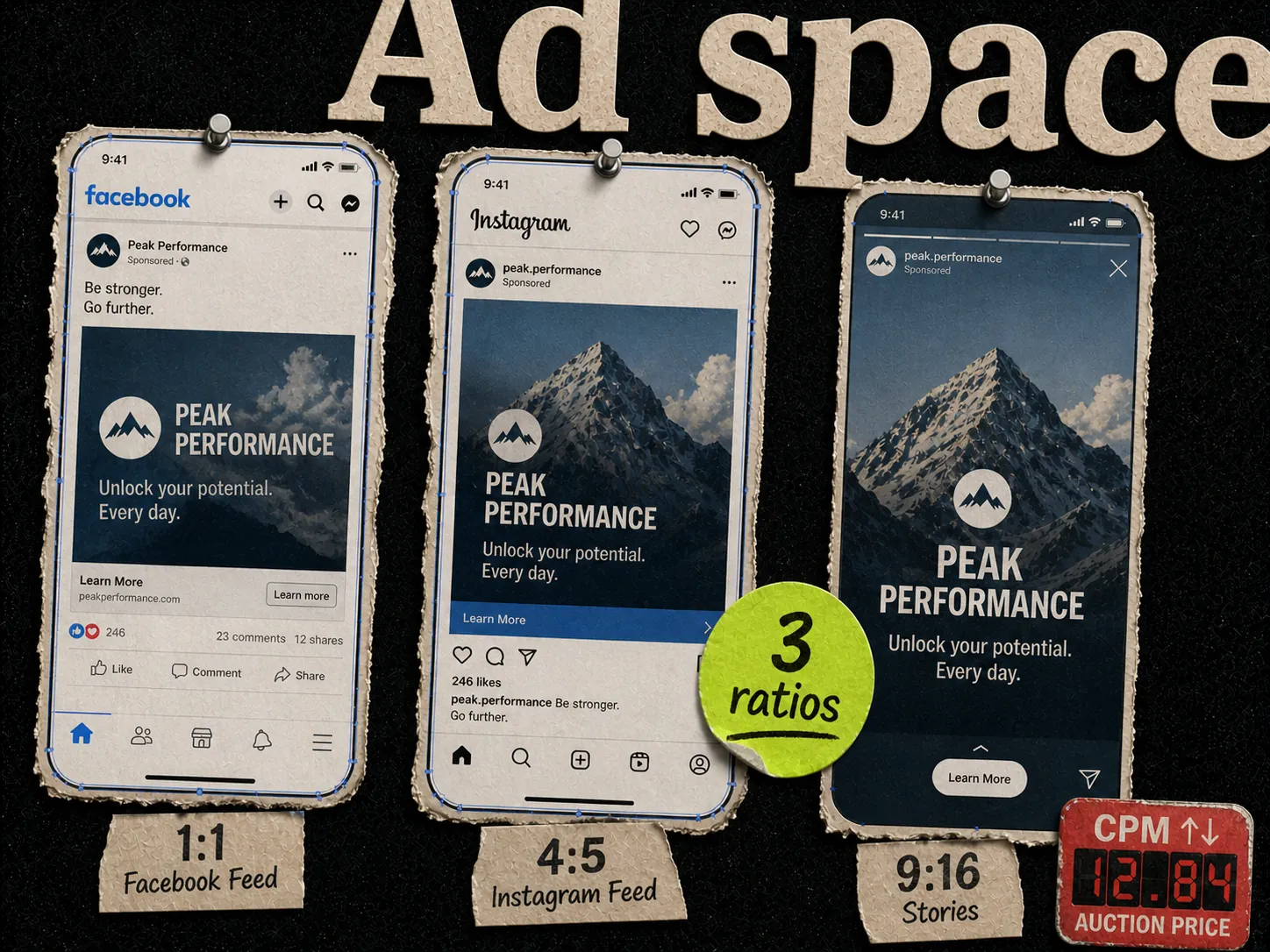
Ad space is the slot on a webpage, app or feed where an ad is shown. On Meta, that slot could be the Facebook Feed, an Instagram Story, a Reels overlay, or a Marketplace listing card. Each slot has its own size, behaviour, and price.
This guide covers what ad space is, how Meta's placements work in 2026, the formats you need to ship to cover them, and what actually moves the cost of that space up or down.
TL;DR
Ad space is the area where a single ad appears, while ad inventory is every ad space a publisher has to sell over time. On Meta, ad space splits across Feed, Stories, Reels, Marketplace, Search, the right column, and the Audience Network, each with its own dimensions. Advantage+ Placements covers all of them at once if you ship 1:1, 4:5, and 9:16 versions of the same ad. Creative quality moves your CPM more than your bid does, so most of the work is upstream of the auction.
Ad space meaning, in one paragraph
Ad space is the specific area on a website, app, or social platform where an advertisement is displayed. Inside Meta's ecosystem that means a placement like the Facebook Feed or an Instagram Story. The dimensions of the space decide what creative fits, and the demand for the space decides what it costs.
For the short version, see our glossary entry on ad space. For the full picture of how it gets bought and sold, read on.
Ad space vs ad inventory
People use these two terms interchangeably, but they are not the same.
- Ad space is one slot, like the 4:5 image card in the Facebook Feed or a single Instagram Story.
- Ad inventory is everything a publisher has available to sell over a window of time, covering every Story slot and every Feed card across every user for, say, the next 24 hours.
So when a media buyer says CPMs are climbing because Meta is short on inventory, they mean the total pool of ad spaces in their target audience is shrinking relative to demand, not that one specific slot has changed.
How Meta ad placements work in 2026
Meta sells ad space through an auction. When a user opens Facebook or Instagram, Meta picks an ad to fill the next slot based on bid, predicted action rate, and ad quality. Higher predicted action rate means lower CPM for the same outcome.
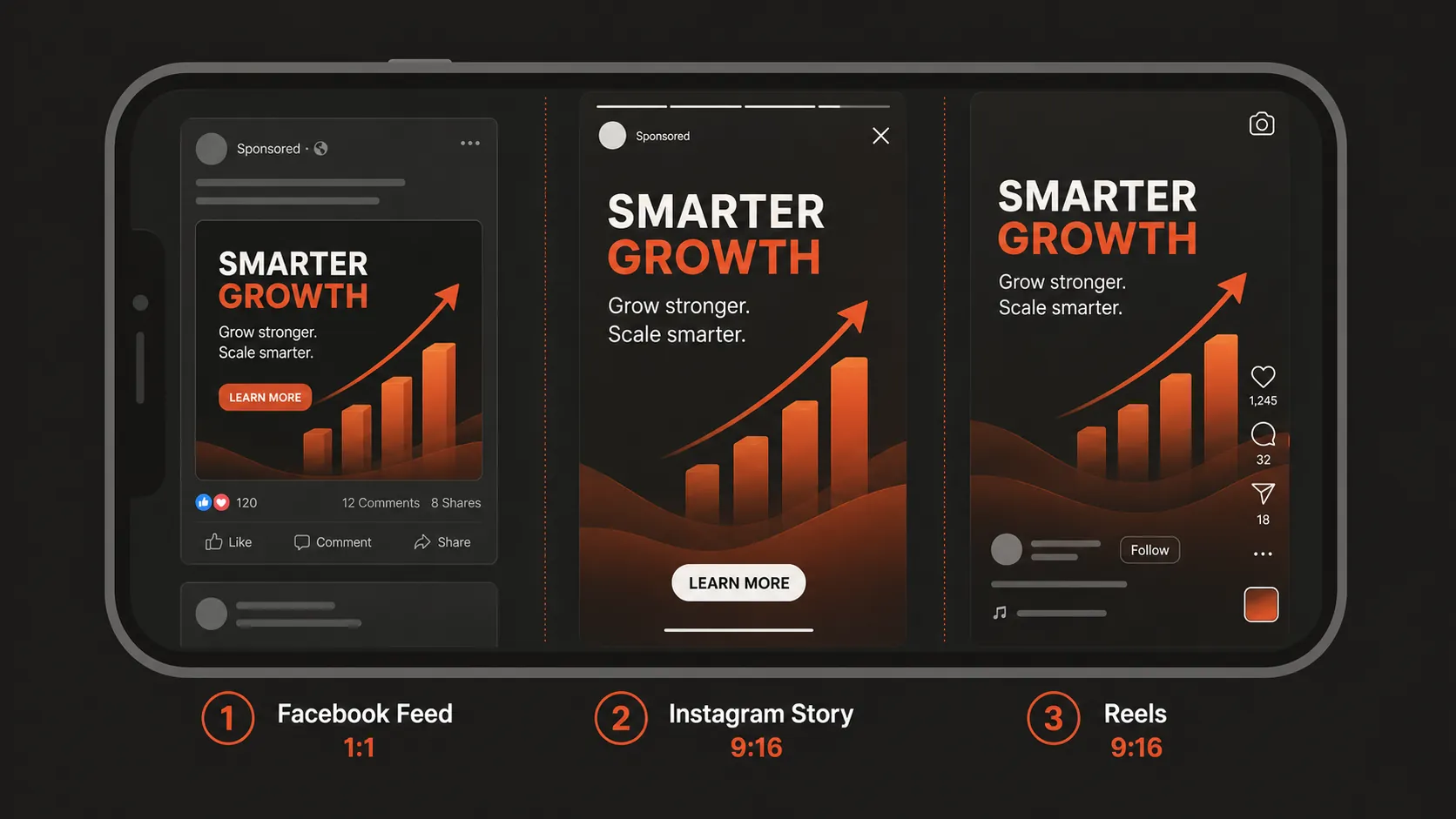
The placements available in 2026:
| Placement | Surface | Default ratio |
|---|---|---|
| Facebook Feed | 1:1 or 4:5 | |
| Instagram Feed | 1:1 or 4:5 | |
| Stories | Facebook, Instagram | 9:16 |
| Reels | Facebook, Instagram | 9:16 |
| Reels overlay | Facebook, Instagram | 9:16 |
| Marketplace | 1:1 | |
| Search results | Facebook, Instagram | 1:1 |
| Right column | Facebook desktop | 1:1 |
| Audience Network | Third-party apps | varies |
| Messenger inbox | Messenger | 1:1 |
You have two ways to buy these placements:
- Advantage+ Placements. Meta picks where each impression goes. You ship multiple aspect ratios and the algorithm decides what to serve where.
- Manual placements. You pick which surfaces to run on. Useful when one placement fatigues fast, or when a specific surface drags performance down on your account.
Advantage+ is the default for most accounts in 2026. It works as long as you actually give it the formats it needs to fill every slot.
The three aspect ratios you have to ship
Every ad campaign on Meta runs on three creative ratios. Skip one and you lose access to that ad space.
- 1:1 (square). Feed, Marketplace, Search, right column, Messenger.
- 4:5 (portrait). Feed only, but the highest-volume placement Meta has.
- 9:16 (vertical). Stories, Reels, Reels overlay.
A square ad will run in Stories, but it gets letterboxed and the CTR drops noticeably. A 9:16 ad will run in the Feed, but Meta crops it down to a square and the headline often disappears in the process. If you only ship one or two ratios, Advantage+ either skips the placements that need the missing ratio or serves a cropped version that performs worse than the placements you did cover.
For a deeper take on which formats win in which placement, see our creative testing framework.
Static display advertisement vs dynamic ad space
Two terms get mixed up here.
A static display advertisement is an ad with a fixed image, copy, and layout. It does not change once it loads. Most of the highest-performing ads on Meta in 2026 are static.
A dynamic ad uses Meta's Dynamic Creative or Catalog feed to swap pieces of the ad based on the viewer. The image, headline, or product shown can change per user. Useful for ecom catalogs with hundreds of SKUs. Less useful for a single offer with one hero product.
Static ads are usually faster to produce and read in a test, because the variant that wins is the variant the user actually saw. Dynamic ads are harder to read because Meta is recombining your headlines, descriptions and images in the background, so the reporting attributes performance to a fuzzier composite rather than one specific creative.
For most accounts spending under $50k a month, static gives more usable signal per dollar. Above that level, especially with deep product catalogs, dynamic starts to earn its place alongside static rather than replacing it.
What changes the cost of ad space
CPM is the price of 1,000 impressions of ad space. Five things move it:
- 1.Audience overlap. If three of your ad sets target the same lookalike, you bid against yourself and CPM climbs.
- 2.Seasonality. Black Friday week, Q4 in general, and the days before Mother's Day all push CPM up by 30 to 80% across most verticals.
- 3.Ad quality and relevance. Low-quality scoring inside Meta means you pay more to reach the same person. Quality is mostly a creative problem.
- 4.Placement mix. Stories and Reels usually have lower CPMs than Feed, but Feed clicks tend to be higher intent, so the cheaper space does not always come out ahead on cost per purchase.
- 5.Bidding strategy. Highest volume, cost cap, and bid cap all change how Meta competes for ad space on your behalf.
The lever most teams underuse is ad quality. A 0.5 point lift in relevance score usually drops CPM more than a manual bid change does.
How to get more out of your Meta ad space
The teams that get the most out of Meta's ad space in 2026 do four things differently.
They ship in batches. Not one ad per week, but four to six variants of the same concept. That gives Advantage+ enough creative to fill every placement without serving the same image into the ground.
They study competitor ads first. Meta Ad Library shows everything currently running in your category from brands bigger than yours, which makes it one of the cheapest research inputs you can get. The useful things to look at are which hooks the leaders open with, which aspect ratios they actually ship, and how often they refresh creative before fatigue sets in.
They test one variable at a time. Same offer, same audience, same CTA. The only thing that changes is the hook or the image. For a deeper take see our hook guide.
They retire ads early. A static ad on Meta typically starts losing CTR around day 14 to 21 on cold audience, and most teams that get the most out of their ad space have the next batch in the queue before that drop arrives.
Where AI fits into ad space in 2026
The bottleneck for most media buyers running Meta in 2026 is creative supply rather than strategy. Advantage+ wants 4 to 6 ads per concept across three aspect ratios, which works out to roughly 12 to 18 export-ready files per concept every week if you want to keep a single campaign properly fed.
That production volume is the part where AI tooling has actually become useful. The job is narrow: take one approved concept and turn it into the dozen-or-so files that Meta needs to cover Feed, Stories, Reels and the rest, with the brand styling kept consistent across every export.
We built Adrio for exactly that step in the workflow, so the time between approving a concept and having a full multi-format batch ready for upload is closer to an afternoon than a sprint. The output keeps your typography, colours and layout system, so it goes straight into the ad account rather than into a redesign pass first. For how it compares against other tools in this space, see our Adrio vs AdCreative AI comparison and Adrio vs Canva writeups.
FAQ
What is the ad space meaning in digital marketing? Ad space is the slot on a website, app, or social platform where a single ad appears. On Meta, that means a placement like the Facebook Feed or Instagram Stories. The slot's dimensions decide what creative fits and demand for the slot decides what it costs.
What is a static display advertisement? A static display advertisement is a digital ad with a fixed image, copy, and layout. It does not change after it loads. Most direct-response ads on Meta in 2026 are static, because they are faster to ship and easier to read in a test.
What is the difference between ad space and ad inventory? Ad space is one slot where a single ad appears, while ad inventory is the total set of slots a publisher has available to sell over a given window of time. So when CPMs spike because Meta is short on inventory, it means the overall pool of slots in your target audience has tightened relative to the demand bidding for them.
How do Meta Advantage+ placements use ad space? Advantage+ Placements lets Meta serve your ad across every available surface and shift spend toward the placements where it performs best for your objective. To get useful coverage out of it, the ad needs to be uploaded in 1:1, 4:5 and 9:16, since any missing ratio means Meta either skips the placements that depend on it or serves a worse-performing crop.
Why does ad format matter for Meta placements? Each placement has different dimensions. A 1:1 ad runs in Feed, Search, and Marketplace. A 9:16 ad runs in Stories and Reels. If you only have one ratio, you cut yourself off from large parts of Meta's ad inventory and pay higher CPMs on the placements you can still reach.
What is a static ad on social media? A static ad on social media is an image or text ad with no video, animation or interactive elements, so it loads once and stays the same for every viewer. They remain a large share of the top-performing creatives in most Meta ecom accounts in 2026, partly because they are cheaper to produce and partly because the test results are easier to read than dynamic equivalents.
Should I use Advantage+ Placements or manual placements? Start with Advantage+ if you have all three aspect ratios ready. Switch to manual only when one specific placement is dragging your account performance and Advantage+ keeps reallocating spend back to it.