Facebook ad spy tools help you see what other brands are running, but the best tool depends on what you do after the research. Some tools are databases. Some are swipe files. Some turn competitor patterns into briefs. A few help you turn the reference into a new ad.
This guide ranks the best Facebook ad spy tools for 2026 based on practical workflow: finding ads, organizing references, spotting repeated angles, briefing creative, and turning research into testable Meta ads.
TL;DR
Use the Meta Ad Library first because it is the official source for active Meta ads. Use Foreplay if you need a swipe file. MagicBrief closed on July 31, 2026; evaluate its successor Canva Grow for the work it now covers. Use Minea or BigSpy if you need ecommerce and cross-platform research. Use Adrio when the goal is not just spying, but turning a winning structure into new on-brand static Meta ads.
| Tool | Best for | Why it stands out |
|---|---|---|
| Meta Ad Library | Free official research | Shows active ads across Meta products |
| Foreplay | Swipe files and creative organization | Save, tag, sort, and share ad inspiration |
| Canva Grow | Advertising inside Canva | Successor workflow to evaluate after MagicBrief closed |
| Adrio | Turning references into new static ads | Competitor-informed generation and editable Meta formats |
| Minea | Ecommerce product and ad research | Large searchable ad database across Facebook, TikTok, and Pinterest |
| AdSpy | Deep Facebook and Instagram archive | Large focused database with advanced filters |
| BigSpy | Broad multi-platform ad database | Large cross-platform database and budget-friendly research |
| Motion | Performance-informed competitive reviews | Combines creative analytics and competitor intelligence |
1. Meta Ad Library - best free official source
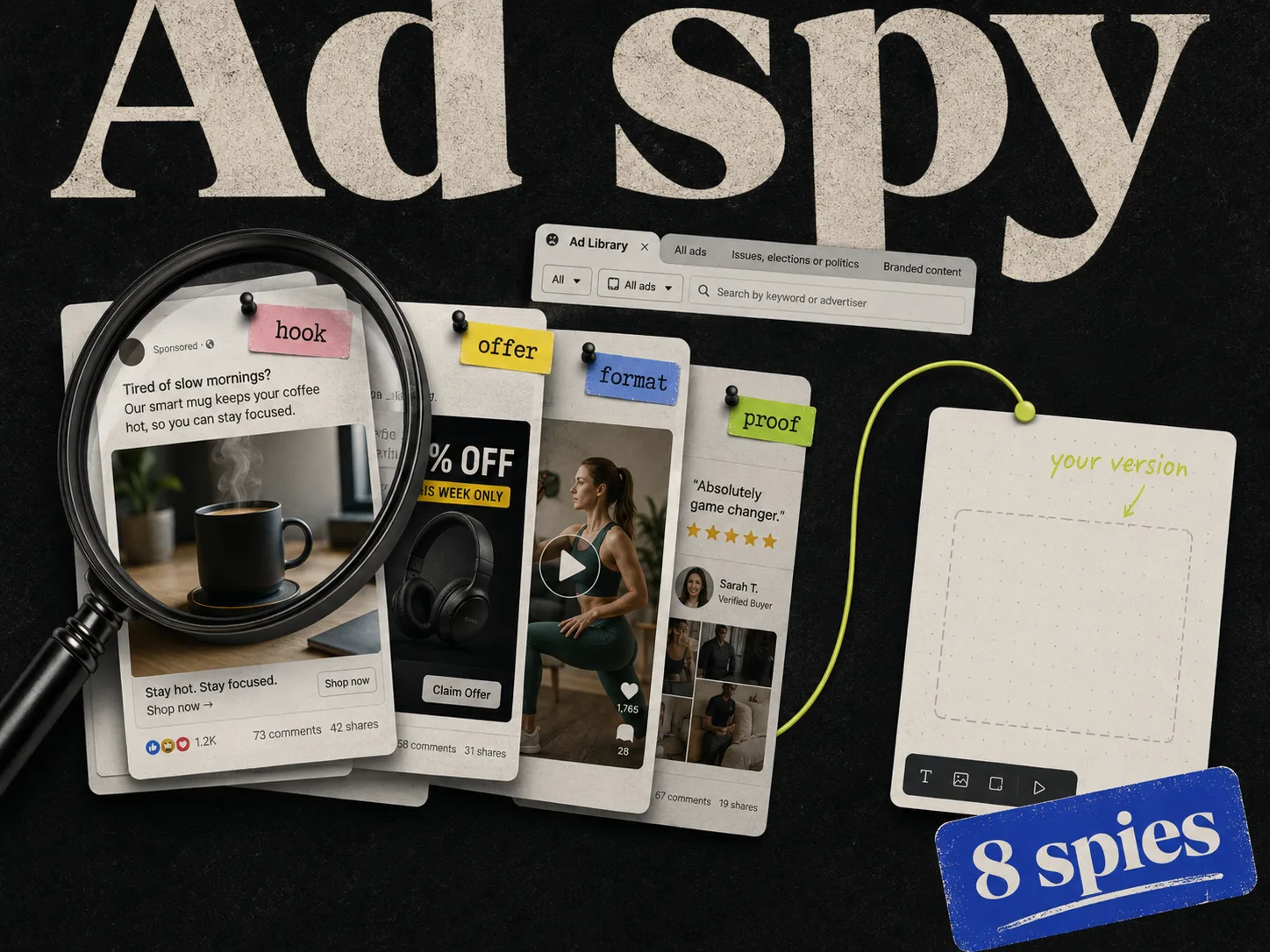
The Meta Ad Library should be the starting point for every competitor research workflow. Meta describes it as a place to search ads running across Meta products. It is free, official, and useful for checking what a brand is currently running on Facebook and Instagram.
Use it to answer:
- What ads is this brand running right now?
- Which products or offers are they promoting?
- Which creative formats appear repeatedly?
- What hooks and CTAs are they using?
- Are they testing many variations or only a few?
Its weakness is organization. The native interface is not built for tagging, saving, comparing, or seeing a history of creative changes over time. That is why paid tools exist.
Best for: free first-pass research and source-of-truth checks.
2. Foreplay - best swipe file for ad inspiration
Foreplay is built around saving and organizing ads. Its pricing page lists features such as saving ads from ad libraries, folders and boards, landing page screenshots, live ad active status, team comments, advanced filtering, transcription, discovery, and competitor tracking through Spyder.
Foreplay is strongest when your problem is creative organization. If your team constantly drops screenshots into Slack, loses links, or cannot remember which ad inspired which brief, Foreplay is a clear upgrade.
Best for:
- Agencies building client swipe files
- Creative teams saving references from Meta and TikTok
- Teams that need boards, tags, notes, and collaboration
- Strategists who review ads weekly
Watch-out: a swipe file does not automatically create new ads. You still need a production workflow.
If you are comparing Foreplay with a lighter swipe-file tool, our Foreplay vs SwipeKit vs Adrio breakdown shows what each product is built to hand back to the team.
3. MagicBrief has closed: evaluate its replacement workflow
MagicBrief closed on July 31, 2026. Its team built Canva Grow, which connects creative generation, publishing, and performance insights inside Canva. Treat it as a new product to evaluate, not a promise that your old research collections migrate automatically.
If your main need is saving competitor references, compare a research-focused tool separately. Our MagicBrief alternatives guide explains how to rebuild research, reporting, and production workflows after the shutdown.
4. Adrio - best for turning competitor research into new Meta static ads
Adrio is not a pure ad spy database. It belongs on this list because many teams do competitor research for one reason: they need to make better ads faster.
The Adrio workflow starts with a reference structure, then adapts it to your product, brand assets, copy, and offer. That matters because copying a competitor asset is both lazy and risky. The useful thing is the structure: layout, hierarchy, hook type, proof type, product treatment, and CTA placement.
Use Adrio when:
- You already know which competitor ads are worth learning from
- You need static Meta variants, not just a saved reference
- You want to keep product images, colors, fonts, and CTA overlays editable
- You are testing hooks, layouts, or offers every week
Best for: media buyers who want research to become launch-ready static ads.
5. Minea - best ecommerce ad and product research tool
Minea positions itself as an ecommerce ad spy tool across Facebook, TikTok, and Pinterest. Its official page says it gives access to a searchable database of 100M+ ads, plus spend signals, estimated budgets, engagement metrics, creative variations, product sourcing, and competitor tracking.
Minea is especially useful for dropshipping, ecommerce product research, and trend spotting. It is less focused on creative review quality than a swipe-file or brief platform, but it has strong breadth for ecommerce.
Best for:
- Ecommerce product research
- Dropshipping research
- Cross-platform ad discovery
- Finding ad angles tied to trending products
6. AdSpy - best deep Facebook and Instagram database
AdSpy is a focused Facebook and Instagram ad database. Its official site describes it as a large searchable database of Facebook and Instagram ads, with global coverage and search filters.
AdSpy is a practical option when you care more about depth on Facebook and Instagram than a broad cross-platform creative workflow. Affiliate marketers and performance buyers often prefer tools like this because search depth matters more than collaboration polish.
Best for:
- Facebook and Instagram research
- Advanced filtering
- Affiliate and direct-response research
- Teams that want database depth over workflow features
7. BigSpy - best broad, budget-friendly ad database
BigSpy covers multiple platforms and positions itself around a large ad database, competitor tracking, niche research, and multi-platform monitoring. Its current site describes coverage across major platforms including Facebook, Instagram, TikTok, YouTube, Twitter, Yahoo, Pinterest, Unity, Google, Shopify, and Amazon.
BigSpy is useful when you want breadth and affordability. It is not as workflow-oriented as Foreplay, but it can be a good research layer for teams scanning many markets.
Best for:
- Cross-platform research
- Budget-conscious media buyers
- Broad market scans
- Finding examples outside Meta
8. Motion - best when competitor research needs performance context
Motion is mainly a creative analytics and reporting tool. It pulls creative and performance data from Facebook, TikTok, and other platforms into visual reports. Motion also has competitor and brand intelligence features in its broader creative strategy workflow.
Motion is strongest after launch. It helps answer which creative patterns are working in your own account. That context makes competitor research sharper because you stop saving ads that look impressive but do not match the patterns your audience rewards.
Best for:
- Creative performance reviews
- Weekly reporting
- Pattern analysis
- Teams connecting research to results
What to look for in a Facebook ad spy tool
The database size is only one factor. The better question is: can the tool support your weekly creative process?
Look for:
- Freshness: Are ads updated often enough to spot current tests?
- Search quality: Can you find ads by brand, keyword, format, hook, or landing page?
- Organization: Can you save ads into boards and tag why they matter?
- History: Can you see what changed over time?
- Export: Can research become a brief, deck, or creative request?
- Production: Can you turn the reference into new on-brand creative?
Most teams need fewer tools than they think. One official source, one organization layer, and one production workflow is enough.
A simple competitor ad research workflow
Use this once per week:
- 1.Pick 10 competitors or adjacent brands.
- 2.Open each brand in the Meta Ad Library.
- 3.Save ads that have been active long enough to suggest budget confidence.
- 4.Tag each saved ad by angle, format, hook type, proof type, and CTA.
- 5.Look for repeated patterns across at least 3 brands.
- 6.Turn 1 to 2 patterns into new Adrio concepts.
- 7.Generate 4 to 10 static variants and test them against your current control.
The goal is not to copy. The goal is to reduce blank-page risk.
Where Adrio fits
Most Facebook ad spy tools stop at research. Adrio is for the next step: turning a reference structure into new creative that uses your own brand, product, assets, and offer.
That is the difference between "we found a winning ad" and "we launched a testable variation before the angle went stale."
FAQ
What is the best free Facebook ad spy tool? The Meta Ad Library is the best free option because it is the official source for active ads across Meta products.
What is the best paid Facebook ad spy tool? Compare Foreplay for saved references, Adrio for research connected to creative production, and Minea for ecommerce product research. MagicBrief closed on July 31, 2026; evaluate Canva Grow for its successor workflow.
Can Facebook ad spy tools show exact spend and targeting? Usually no. Most tools estimate performance signals or infer patterns. Exact competitor targeting and spend are not fully public for ordinary commercial ads.
Is it legal to use Facebook ad spy tools? Researching public ads is normal competitive intelligence. Copying another brand's creative, assets, claims, or landing page is a bad idea. Use the structure, not the asset.
How should I use competitor ads without copying? Extract the pattern: hook type, layout, proof, offer framing, CTA, and visual hierarchy. Then rebuild it with your own product, brand, copy, and evidence.